
Engineering Plastics (PA, PC, POM, PET, PMMA) Material Page
Engineering plastics are a group of robust thermoplastic materials that possess superior mechanical and thermal properties compared to commodity plastics like PE or PP. They are designed to withstand mechanical stress, high temperatures, and chemical exposure, making them the preferred choice for structural industrial components and metal replacement applications. At JUCHENG, we have extensive experience in molding these high-performance materials. Our facility is equipped with specialized dehumidifying dryers and oil-temperature controllers to process moisture-sensitive resins like Nylon (PA) and PET, ensuring every part meets strict dimensional tolerances and performance criteria.
Engineering Plastics Injection Molding Materials
JUCHENG's Capabilities for Engineering Plastics
Processing engineering resins requires tighter process control than standard plastics. JUCHENG delivers:
- Precision Tooling: We build hardened steel molds capable of holding tight tolerances (+/- 0.02mm) required for engineering assemblies like gears and connectors.
- Moisture Management: Materials like Nylon and PET are hygroscopic. We utilize industrial desiccant dryers to ensure moisture content is below 0.02% before molding, preventing hydrolysis and surface defects.
- High-Heat Molding: Our machines are equipped to handle the higher melt temperatures and mold temperatures (up to 140°C) required for crystalline engineering plastics.
- Fiber Reinforcement: We specialize in molding glass-filled (GF) variants of Nylon and PET, optimizing gate locations to minimize warpage and maximize fiber orientation strength.
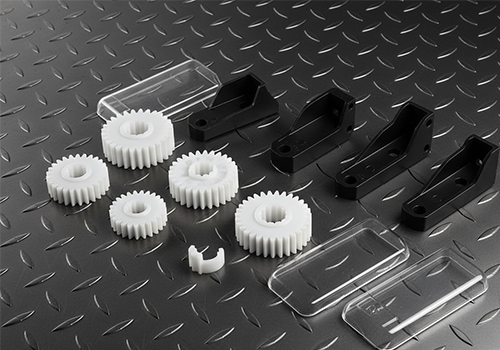
Detailed Material Profiles
We stock and mold the complete spectrum of engineering thermoplastics:
1、Polyamide (PA / Nylon)
- Description: A semi-crystalline plastic known for its toughness and wear resistance. We offer PA6 (good surface finish, tough) and PA66 (higher heat resistance, stiffer).
- Key Advantages: Exceptional fatigue resistance, low friction coefficient, high chemical resistance (oils/fuels). Glass-filled grades offer metal-like stiffness.
- Ideal Applications: Automotive under-hood parts, gears, bearings, power tool housings, cable ties.
- Description: An amorphous engineering thermoplastic characterized by its high impact strength and optical transparency.
- Key Advantages: Virtually unbreakable impact resistance, high heat deflection (approx. 135°C), transparent options available. Good dimensional stability.
- Ideal Applications: Safety helmets, automotive headlamp lenses, bulletproof glass laminates, electronic display windows.
- Description: A highly crystalline polymer often called "the metal of plastics." It bridges the gap between metal and plastic properties.
- Key Advantages: Excellent lubricity (low friction), high stiffness, low moisture absorption, and excellent dimensional stability in wet environments.
- Ideal Applications: Precision gears, snap-fit assemblies, sliding bearings, door handles, plumbing components.
- Description: A transparent thermoplastic used as a lightweight, shatter-resistant alternative to glass.
- Key Advantages: Highest optical clarity (92% light transmission), excellent UV resistance (does not yellow), high surface hardness (scratch resistant).
- Ideal Applications: Automotive tail lights, light guides, cosmetic jars, display panels, lenses.
- Description: We refer here to Engineering Grade PET (often glass-filled), not the bottle grade. It is a semi-crystalline polyester.
- Key Advantages: Extremely high stiffness and strength when reinforced, excellent electrical insulation, low moisture absorption (compared to Nylon), high dimensional stability.
- Ideal Applications: Automotive electrical connectors, coil bobbins, structural housings, wiper arms.
Design Guidelines for Engineering Plastics
- Ribbing: Essential for structural parts (PA, PBT, PET) to prevent warpage, but must be <60% of wall thickness to avoid sink marks.
- Draft Angles:
PC/PMMA: Minimum 1° - 2° (amorphous materials tend to stick).
- Radii: Avoid sharp corners! Engineering plastics (especially PC and POM) are notch-sensitive. Use generous radii to distribute stress.
- Gate Location: Critical for glass-filled materials to hide weld lines and ensure strength in the load-bearing direction.
Comprehensive Comparison Table
Physical properties comparison of Engineering Plastics:
| Property | Polyamide 66 (PA66) | Polycarbonate (PC) | POM (Acetal) | PMMA (Acrylic) | PET (30% GF) | Unit |
| Structure | Semi-Crystalline | Amorphous | Semi-Crystalline | Amorphous | Semi-Crystalline | - |
| Density | 1.14 | 1.20 | 1.41 | 1.18 | 1.56 | g/cm³ |
| Shrinkage | 1.0 - 2.0 | 0.5 - 0.7 | 1.8 - 2.2 | 0.2 - 0.6 | 0.2 - 0.9 | % |
| Tensile Strength | 80 | 65 | 70 | 70 | 140 | MPa |
| Flexural Modulus | 2,900 | 2,300 | 2,600 | 3,000 | 9,000 | MPa |
| Impact Strength | High | Very High | Medium | Low | Medium | - |
| Heat Deflection (0.45 MPa) | 200 | 135 | 160 | 95 | 225 | °C |
| Optical Clarity | Opaque | Transparent | Opaque | Excellent | Opaque | - |
FAQ: Engineering Plastics
Q: Why does Nylon (PA) need conditioning?
A: Freshly molded nylon is dry and brittle. It absorbs moisture from the air (conditioning) to reach its final equilibrium toughness.
Q: Can PC be used for chemical environments?
A: PC is sensitive to solvents and stress cracking. For chemical resistance, we recommend semi-crystalline materials like POM or PA.
Q: Difference between PMMA and PC?
A: PMMA is clearer and more UV stable but brittle. PC is much stronger (impact resistant) but scratches easier and is less UV stable.
A: Freshly molded nylon is dry and brittle. It absorbs moisture from the air (conditioning) to reach its final equilibrium toughness.
Q: Can PC be used for chemical environments?
A: PC is sensitive to solvents and stress cracking. For chemical resistance, we recommend semi-crystalline materials like POM or PA.
Q: Difference between PMMA and PC?
A: PMMA is clearer and more UV stable but brittle. PC is much stronger (impact resistant) but scratches easier and is less UV stable.

Request Your DFM & Quote – Upload Your Drawings
ㆍFill in your requirements and upload your 2D&3D file, we will feedback your project quotation and DFM within 24 hours.ㆍFile types: STEP, STP, IGES, IGS, SLDPRT, 3DM, SAT, X_T, DWG, DXF, STL, PDF, ZIP and more. File size: < 128 MB Part size: < 1500*1500*1500 mm
ㆍPrivacy: We respect your privacy. Here you can find an example of a non-disclosure agreement. By submitting this form, you agree to our terms & conditions and privacy policy.
ㆍPrivacy: We respect your privacy. Here you can find an example of a non-disclosure agreement. By submitting this form, you agree to our terms & conditions and privacy policy.
