


The moving path inside an arthroscopic suture passer matters as much as the outline of its closed jaws. In a needle-passing construction, a needle or shuttle must follow a defined route and meet its receiving feature through the intended motion. A component can pass an outside-size check while that relationship is still wrong.
Development should therefore begin by identifying the actual mechanism and tracing its movement. This article explains how an engineering team can turn that path into a component drawing, manufacturing sequence, and prototype evaluation. It addresses instrument development, not surgical technique or selection for a patient.
Not every passer moves a needle the same way
The Arthrex suture-passing device overview includes several different instrument constructions. Some involve needle delivery and capture; others use penetrating or retrieving features. The variety is a reason to name the mechanism explicitly, not to assume one illustrated product defines the whole category.
Identify the fixed and moving elements in the approved design. Depending on the architecture, these may include an outer shaft, a sliding or rotating actuator, jaws, a needle guide, a receiver, and a handle connection. State which pieces are included in the supplier’s order and which are reference components supplied by the development team.
For an arthroscopic suture passer, drawings of individual pieces need a common assembly reference. Otherwise, a guide slot and a receiver can each be locally correct while their installed positions do not agree. Include the relevant assembled conditions and revisions rather than asking the supplier to infer the mechanism from an external rendering.
Draw the path through the operating positions
Represent the mechanism at the positions needed to understand its movement: the defined starting state, relevant intermediate positions, and the required final state. The drawing owner should decide which positions govern clearance, delivery, capture, or release. Do not use a single fully closed view as the complete explanation of a moving assembly.
Trace the reference chain from the actuator connection to the working end. Ask where axial travel becomes local movement and which pivots or guides determine direction. Identify permitted motion separately from unwanted play. This helps the team distinguish a long tolerance chain from an isolated feature that needs a more direct control.
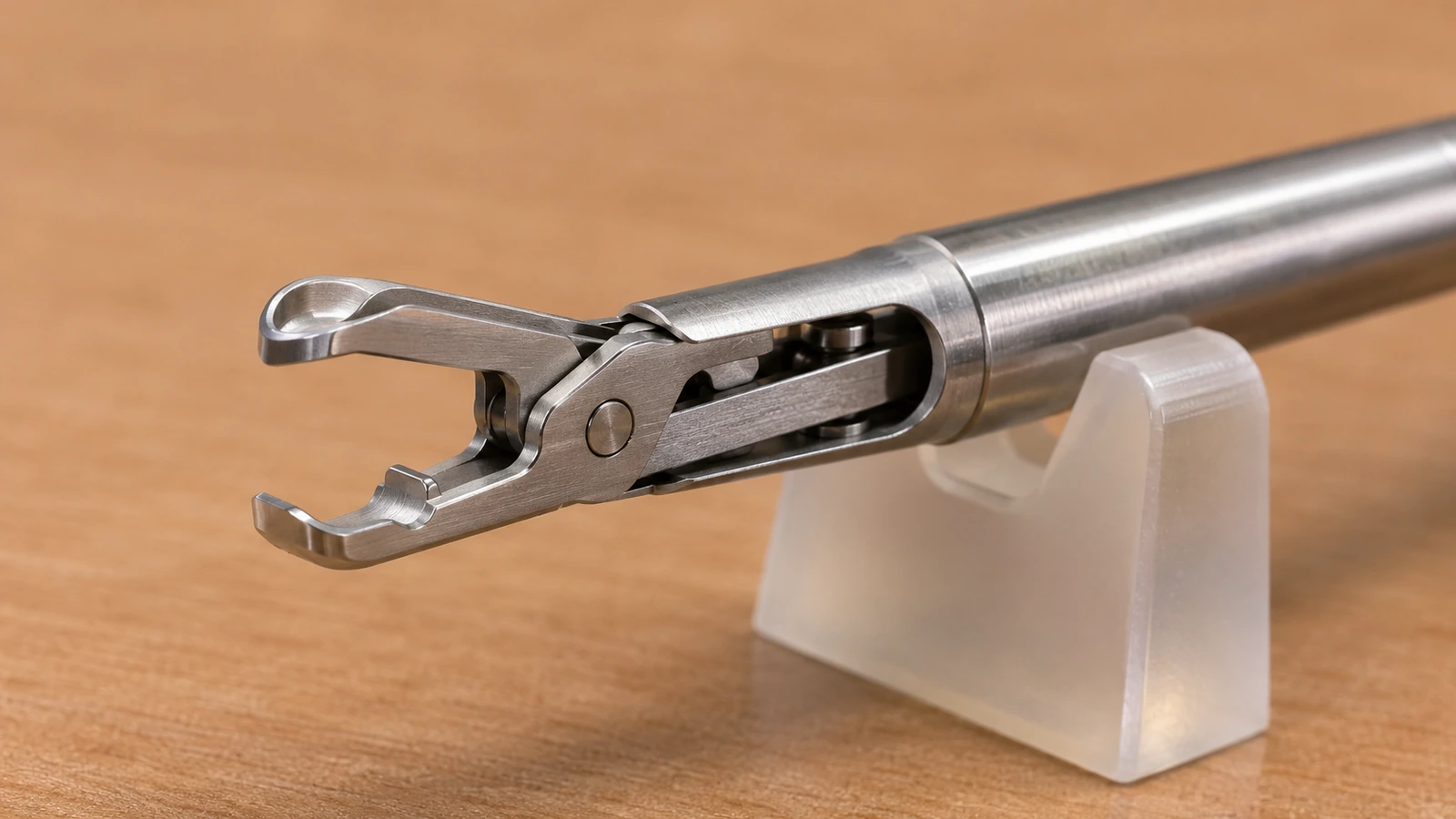
The suture pathway is a separate review item. Openings, transitions, or retaining features that interact with the specified suture can require defined surface and edge conditions. A general instruction to smooth the instrument does not establish those requirements and may alter a deliberate working feature.
Choose inspection points where an error can still be found
Certain features become difficult to inspect after the distal assembly is complete. A recessed guide, pivot hole, or receiver feature may need measurement before assembly, followed by a separate motion check. Decide that sequence before the manufacturing route hides the feature.
Specify what each check establishes. Dimensional inspection can report a guide profile or pivot relationship. An assembled evaluation can address whether an identified reference needle follows the specified path under the approved conditions. Neither result automatically establishes tissue performance or clinical suitability.
Inspection fixtures should represent the correct references without forcing the components into an artificially favorable position. If an assembly must be pushed sideways to reach its receiver, the resulting apparent engagement may conceal the issue. The approved method should distinguish ordinary assembly loads from manipulations that change the geometry being evaluated.
Manufacturing access can change the best sequence
For a custom arthroscopic suture passer, Jucheng Precision can review the drawing-defined metal component scope, access to small features, and the intended prototype question. Useful early discussions concern which surfaces can be reached and how references will be transferred between operations.
Slender shafts, small jaw features, and internal guides may require different processes. Turning can suit cylindrical stock, while local slots or pockets may need milling or another confirmed operation. Do not select a method solely from the component’s size or assume all features can be completed in one setup.
Plan finishing while the relevant edges remain accessible. A hidden intersection or narrow channel can require a more specific approach than an exposed outer face. The process should remove unwanted burrs without erasing functional geometry. Where the design includes sharp working areas, their definition must remain separate from general handling edges.
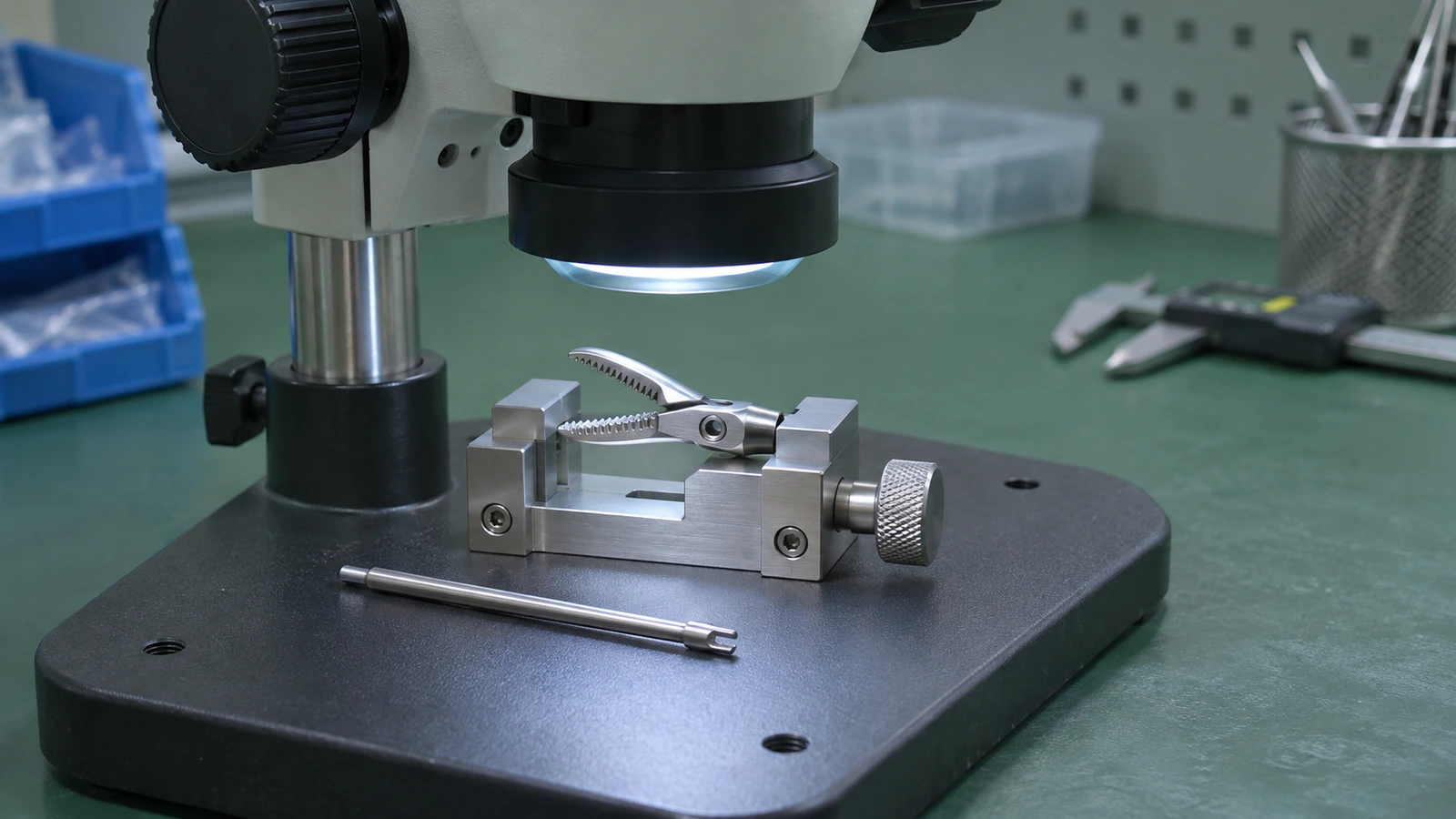
The site’s CNC machining capability supports a component-level manufacturability discussion. Any specialized process, assembly operation, or test must be confirmed for the particular project; a service overview is not evidence that an entire instrument family is ready for clinical supply.
Material choices affect more than a polished appearance
An approved material specification should include grade, condition, required records, and any subsequent treatment. Different components may have different stiffness, wear, corrosion, or processing requirements. Do not choose one stainless grade for the whole mechanism merely because every part should look similar.
Jucheng’s stainless steel machining information can be used to discuss the manufacturing implications of the specified grade. Heat treatment or surface processing can alter local geometry, so the route should identify when critical features are finished and inspected.
For reusable designs, cleaning and reprocessing requirements belong in the device program’s definition. A supplier can discuss access and component features, but a smooth surface or raw-material certificate does not establish validated cleaning, sterilization compatibility, or regulatory release. Keep those conclusions tied to their proper evidence.
Investigate a missed receiver without reshaping it first
Consider a hypothetical bench sample in which the needle approaches the receiver but does not consistently meet it. This is an engineering scenario, not a reported Jucheng case. Enlarging the receiver immediately could conceal an actuator-travel error, guide displacement, pivot variation, or assembly offset.
Compare the approved starting position, actuator travel, component identification, and assembly references. Check the mechanism at the relevant intermediate positions, using the specified reference parts and method. Record where the observed path first differs from the intended one. That location is more useful than a general statement that the jaws do not align.
Then connect the observation to measured features and a proposed correction. If the cause is not established, label it as an open hypothesis. Preserve the original sample condition where possible so that a later change can be compared with evidence rather than memory.
Frequently asked questions
Is a suture passer just a small needle holder?
No. A particular passer may deliver, guide, capture, retrieve, or retain a suture-related element through its own mechanism. Define that construction instead of importing the acceptance plan for an unrelated gripping instrument.
Does correct closed-jaw geometry prove the motion is correct?
No. Intermediate positions, travel, clearance, and the guide-to-receiver relationship can remain unverified. Select inspection and assembly checks that answer the actual development question.
Should a prototype use production material?
That depends on its purpose. A geometric model may answer an access question, while a specified mechanical evaluation may require the approved material and condition. State the intended use before choosing a substitute.
What should accompany a supplier review?
Provide the component drawings, assembly positions, mating references, material and finishing requirements, sample quantity, and requested checks. A clear motion definition allows the supplier to discuss machining and inspection without guessing how the finished device is intended to behave.

