
Polyethylene (HDPE / LDPE) CNC Machining Material
Polyethylene (PE) is the most common plastic in the world, valued for its chemical resistance, low moisture absorption, and food-grade compliance. In CNC machining, the two most relevant forms are HDPE (High-Density Polyethylene) and LDPE (Low-Density Polyethylene). While they share the same chemical makeup, their density and molecular structure create distinct physical properties. At JUCHENG, we machine both grades to produce durable wear parts, chemical tanks, and food processing components. Our expertise in machining soft, waxy plastics ensures precise tolerances without deformation.
JUCHENG's Polyethylene Machining Capabilities
Machining Polyethylene requires sharp tooling and careful heat management. JUCHENG offers:
- Material Stock: We stock a wide range of HDPE (Rigid) and LDPE (Flexible) sheets and rods, including FDA-compliant grades.
- Precision Milling: Our specialized plastic machining protocols prevent "gumming" and ensure smooth surface finishes on these waxy materials.
- Large Part Capacity: We can machine large-scale chemical tanks, cutting boards, and wear strips up to 2 meters in length.
- Burr-Free Finish: We utilize manual and cryogenic deburring to remove the persistent feathers/burrs often left on machined PE.
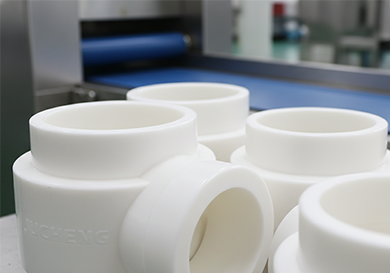
Advantages of CNC Machining HDPE / LDPE
| Advantage | Detailed Description | Key Benefit |
| Excellent Chemical Resistance | Resistant to most acids, bases, alcohols, and vegetable oils. | Ideal for chemical storage components and laboratory equipment. |
| Low Moisture Absorption | Absorbs almost zero water (<0.01%), making it waterproof and rot-resistant. | Perfect for marine environments, outdoor applications, and cutting boards. |
| High Impact Strength | HDPE is tough and absorbs impact well without cracking (though less rigid than engineering plastics). | Suitable for heavy-duty wear strips and protective guards. |
| Food Safe (FDA) | Most natural grades meet FDA/USDA guidelines for food contact. | The standard material for food processing machinery and cutting surfaces. |
| Cost-Effective | One of the most affordable thermoplastic materials available. | Economical solution for large, simple parts and prototyping. |
Technical Parameters & Material Properties
Comparison of High Density vs Low Density grades:
| Grade Category | Detailed Characteristics | Ideal Applications |
| HDPE (High Density) | Rigid, tough, and opaque (milky white). Offers higher tensile strength and temperature resistance than LDPE. It has a low coefficient of friction and good wear resistance. | Chemical tanks, cutting boards, wear strips, chain guides, orthotics, marine starboard. |
| LDPE (Low Density) | Softer, more flexible, and more transparent/translucent than HDPE. It has lower tensile strength but higher ductility. Very easy to machine but difficult to hold tight tolerances due to flexibility. | Squeeze bottles prototypes, flexible tubing, orthotic liners, corrosion-resistant work surfaces. |
| UHMW-PE | Ultra-High Molecular Weight PE. Highest abrasion resistance and impact strength of any plastic. Self-lubricating surface. | Chute linings, star wheels, heavy-duty conveyor guides, dock bumpers. |
CNC Machining Guidelines for Polyethylene
- Clamping: PE is slippery and can deform under pressure. We use vacuum tables or soft jaws with light clamping force to prevent warping.
- Heat Control: PE has a high thermal expansion rate. We keep the workpiece cool with air blast or water-soluble coolant to maintain dimensional accuracy.
- Tooling: High-rake, sharp carbide tools are essential. Dull tools will cause the material to melt and smear rather than cut.
- Surface Finish: Machined PE naturally has a matte, waxy finish. It is difficult to polish to a high gloss and is typically left "as-machined."
Application Scenarios
- Food Industry: Cutting boards, butchery blocks, conveyor components, star wheels.
- Chemical Industry: Tank linings, acid-resistant fittings, pump parts, fume hoods.
- Marine: Bumpers, cabinetry, water tanks, rod holders (Starboard).
- Medical: Orthotic and prosthetic devices (due to moldability and skin safety).
Physical Properties Table
Comparison of Virgin vs. Glass-Filled PTFE:
| Property | HDPE | LDPE | UHMW-PE | Unit |
| Density | 0.95 | 0.92 | 0.94 | g/cm³ |
| Tensile Strength | 20 - 30 | 10 - 15 | 40 - 50 | MPa |
| Hardness (Shore D) | D60 - D70 | D40 - D50 | D60 - D65 | - |
| Melting Point | 130 | 110 | 135 | °C |
| Water Absorption | < 0.01 | < 0.01 | < 0.01 | % |

Request Your DFM & Quote – Upload Your Drawings
ㆍFill in your requirements and upload your 2D&3D file, we will feedback your project quotation and DFM within 24 hours.ㆍFile types: STEP, STP, IGES, IGS, SLDPRT, 3DM, SAT, X_T, DWG, DXF, STL, PDF, ZIP and more. File size: < 128 MB Part size: < 1500*1500*1500 mm
ㆍPrivacy: We respect your privacy. Here you can find an example of a non-disclosure agreement. By submitting this form, you agree to our terms & conditions and privacy policy.
ㆍPrivacy: We respect your privacy. Here you can find an example of a non-disclosure agreement. By submitting this form, you agree to our terms & conditions and privacy policy.
