


Light propagation dictates the ultimate judge of material purity in modern hardware development. When an engineer designs an automotive headlight lens, a medical diagnostic window, or a high-end fiber optic light guide, the primary adversary is not structural failure, but the scattering of photons. Standard "general-purpose" molding fails to provide the crystalline clarity required for these applications, often resulting in parts marred by "haze," "black specks," or "silvering." Navigating this technical ceiling requires the strategic deployment of injection molded optics. This specialized branch of the Injection molding application industries involves a radical departure from traditional manufacturing logic. It demands surgical management of melt thermodynamics and tool steel morphology to ensure that what was designed in CAD is physically realized without a single optical blemish. Jucheng Precision operates as a high-fidelity optics sanctuary, utilizing specialized cleanroom environments and diamond-polished tooling to ensure your hardware possesses the aesthetic soul and photometric accuracy your brand requires for market dominance.
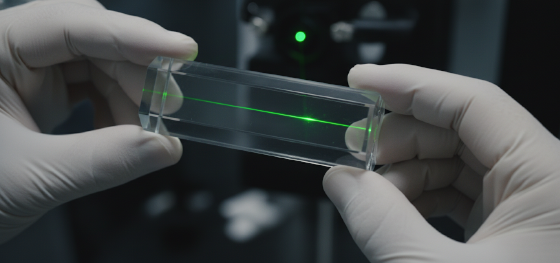
Establishing an optical supply chain demands the rejection of "toy-grade" clear resins. Amateurs often treat transparent parts like any other plastic, unaware that the different refractive indices and moisture sensitivities of polymers like PC and PMMA can ruin a photometric assembly if not managed with desiccant-shield rigor. Jucheng Precision eliminates these "Optical Disasters" by enforcing a strict "Molecular Purity" protocol. We don't just "melt plastic"; we engineer a controlled environment where vacuum degassing and all-electric precision prevent the internal voids and inclusions that kill high-performance hardware. This guide deconstructs the standoff between PC and PMMA, the necessity of S136 stainless steel tooling, and why JUCHENG’s metrological audit is the mandatory foundation for anyone launching injection molded optics in the 2026 market. We provide the manufacturing insurance needed to ensure your design intent is perfectly visible.
Material Standoff: The Battle for Refractive Supremacy
Tooling Purity: Engineering SPI A-1 Mirror Surfaces
Internal Energy: Eradicating Birefringence and Stress
Atmospheric Defense: Cleanroom Protocols for Zero Inclusions
JUCHENG Protocol: Spectrophotometer and 3D Optical Audits
Material Standoff: The Battle for Refractive Supremacy
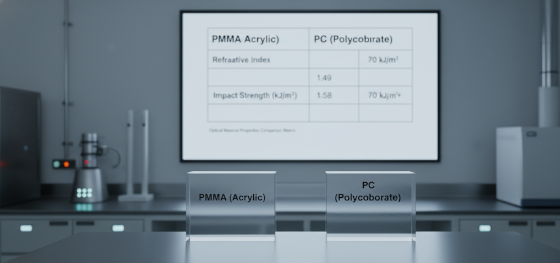
Selecting the correct transparent medium requires a cold-blooded analysis of "Toughness-to-Clarity" ratios. While standard Injection molding materials focus on flexural modulus, optical polymers focus on the Refractive Index (RI). Polycarbonate (PC) is the undisputed champion of impact resistance ("Bulletproof Glass"), but it possesses a higher RI (1.58), making it more prone to chromatic aberration. Acrylic (PMMA), conversely, offers the highest light transmission (92%) and a lower RI (1.49), mirroring the clarity of high-end crown glass. Jucheng Precision engineers partner with you during the DFM phase to map these properties to your specific use case. Below is the technical performance matrix utilized by our facility to guide optical material routing:
| Property | Optical Grade PC | Acrylic (PMMA) |
|---|---|---|
| Light Transmission | 88% - 90% | 92% (Clarity Winner) |
| Impact Strength | Extreme (Unbreakable) | Low (Brittle) |
| Haze (%) | < 1.0% | < 0.5% |
| UV Resistance | Moderate (Needs Additives) | Superior (Natural) |
Tooling Purity: Engineering SPI A-1 Mirror Surfaces
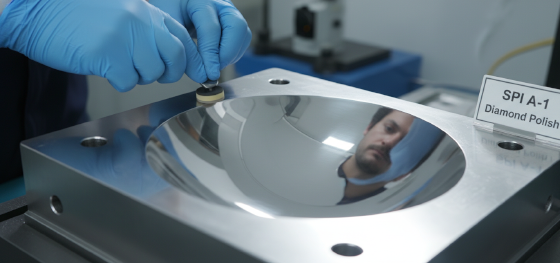
Specular brilliance is an achievement of steel metallurgy and manual craftsmanship. In the domain of injection molded optics, the part is merely a liquid negative of the mold cavity. If the steel has microscopic "pits" or tool marks, the light will scatter, ruining the lens’s focal accuracy. Jucheng Precision eliminates these "Ghost Marks" by utilizing S136 through-hardened stainless steel for all optical projects. Unlike standard P20 steel, S136 possesses the extreme molecular density needed to take a high diamond buff without surface inclusions. Our master model makers spend dozens of hours hand-polishing these cavities to an SPI A-1 finish, achieving a surface roughness (Ra) of less than 0.02 microns. This tooling rigor ensures that your headlight lenses and diagnostic windows arrive with a mirror-like finish that minimizes light diffraction, securing the high-fidelity reflection required for premium hardware.
Internal Energy: Eradicating Birefringence and Stress
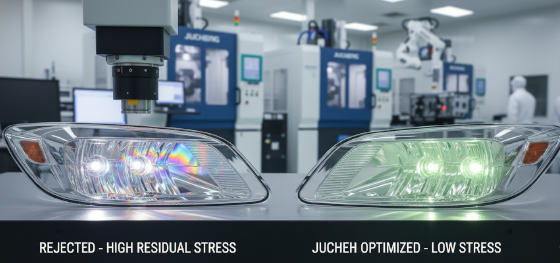
Residual stress is the invisible predator of optical longevity. When molten plastic is injected at high pressure (exceeding 15,000 psi), the polymer chains are often "frozen" in a state of extreme tension. This manifests as birefringence—rainbow-like stress patterns visible through polarized light. In thick-walled injection molded optics, these stresses can lead to "Crazing" (micro-cracking) or warping over time. Jucheng Precision manages this through "Slow-Fill" protocols and advanced thermal stabilization. We utilize high-wattage oil heaters to maintain elevated mold temperatures, allowing the molecular chains to relax as they solidify. We don't just "shoot and ship"; we audit the internal energy of every part using polarized light inspection to ensure your lenses are structurally stable and optically inert. This thermodynamic sovereignty is what prevents the premature failure of high-stakes medical and automotive assemblies.
Atmospheric Defense: Cleanroom Protocols for Zero Inclusions
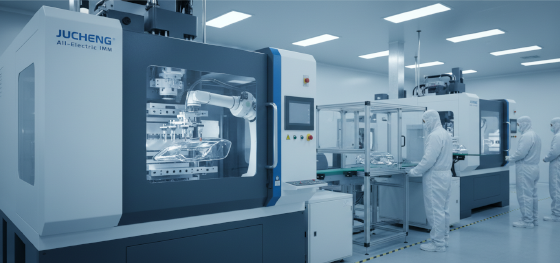
Manufacturing "Inclusions" are the primary reason for batch rejection in clear plastic production. A single dust particle as small as 50 microns—invisible on a black part—acts as a macroscopic crater in an optical light guide. Jucheng Precision operates its optical lines within Class 10,000 (ISO 7) cleanroom environments. We utilize all-electric injection presses to eliminate the risk of hydraulic oil mist contamination. Our "Closed-Loop" material handling systems ensure that the resin never touches the open air from the desiccant dryer to the injection nozzle. For medical device injection molding optics, this level of atmospheric sovereignty is mandatory to prevent cross-contamination. We turn the injection bay into a surgical environment, ensuring every part number is a pure manifestations of the digital CAD intent, free of the "Black Specks" and "Haze" that plague uncertified vendors.
JUCHENG Protocol: Spectrophotometer and 3D Optical Audits
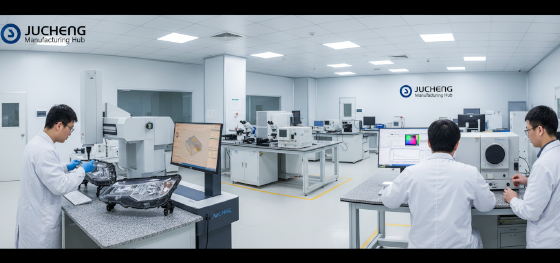
Engineering excellence at Jucheng Precision is built on the foundation of metrological validation. We don't just "hope" your optics are clear; we prove it with spectral data. Our quality control lab utilizes spectrophotometers to measure "Yellowing Index" and total light transmission, providing you with a documented pedigree of performance. We also utilize 3D non-contact scanners to verify the curvature accuracy of your lenses against the original STEP file. This data-driven rigor is the cornerstone of our success in the Low Volume Injection Molding sector, allowing us to deliver certified optical hardware in batches as small as 100 units. Stop gambling your photometric success on inaccurate mockups or dirty factory floors. Leverage our decade of optical mastery to validate rapidly and launch confidently. Contact our technical team today for a free DFM review and see how we can turn your digital light patterns into a crystalline, physical reality that is documented for survival.

