


The chemistry is within specification. The tensile results look reasonable. The report carries a mill name and a heat number. Yet the delivered parts have a different lot reference, and nobody can explain how the two identifiers connect.
That is not a small paperwork gap. A mill test report is useful evidence only when its material scope and identity can be connected to the material actually used. For an aerospace machining order, reading the numbers is only half the review; the other half is following the stock into the finished components.
Decide What the Report Is Supposed to Prove
A mill test report, often abbreviated MTR, records material identification and specified test information for the covered material. Names such as material test report or mill test certificate may be used in purchasing practice. The required content depends on the product, governing specification, and contract; the document title alone does not establish its adequacy.
An MTR may include chemical composition, mechanical test results, product dimensions, heat or lot identification, and the condition in which the material was supplied. It does not automatically prove that a finished component meets its drawing, that a later heat treatment was controlled, or that the final surface finish is acceptable.
Within aerospace quality control and inspection, material evidence is one part of the release package. Dimensional reports, special-process records, and delivery declarations answer different questions.
Before reviewing a report, identify the purchasing requirement it is intended to satisfy. If the order requires an original mill report and a traceable distributor record, a generic statement of compliance is not an equivalent replacement. If a particular inspection-document type is specified, assess that requirement explicitly rather than inferring it from the heading.
Match Identity Before Comparing Results
Start with the material designation, product form, temper or heat-treatment condition, and specification. A report for bar is not automatically suitable evidence for plate, even when the nominal alloy is the same. Likewise, the right alloy in the wrong condition does not become acceptable because its chemistry passes.
Next, connect the identifiers. The mill’s heat number, a distributor’s stock number, the shop’s receiving lot, and the finished-part production lot may all differ. Different numbers are not necessarily a problem, but there must be a controlled relationship between them.
| Record or item | Identity to compare | Question |
|---|---|---|
| Purchase order and drawing | Alloy, condition, form, specification, revision rule | Is this the material that was actually ordered? |
| Mill report | Heat or lot, product description, results | What material does this report cover? |
| Received stock | Physical marking and receiving record | Can this stock be linked to that report? |
| Cutting and production records | Blank allocation and production lot | Which delivered parts came from this stock? |
A supplier’s own requirements illustrate the distinction. Penn Stainless’ external-provider quality terms include material traceability and identification provisions. These are an example of contractual controls, not proof that every buyer uses identical requirements.
Read Each Result Against the Right Requirement
Chemistry: confirm the units and the covered material
Compare reported elements with the applicable limits for the specified grade. Check whether a value is expressed as a percentage or another unit, whether a result is an actual measurement or a limit statement, and whether all contractually required elements are addressed. An empty cell is not automatically a passing result.
Mechanical properties: do not mix test conditions
Tensile strength, yield strength, elongation, and hardness describe different properties. Elongation can depend on specimen geometry and gauge length; directional test results depend on specimen orientation. Product thickness and material condition can also affect which requirements apply.
Typical catalog values are not the acceptance limits for a specific lot. A report can be lower than a catalog’s typical value and still meet the applicable requirement, or exceed one attractive number while failing another required condition. Review the whole specification requirement rather than selecting the strongest-looking result.
Processing and supplementary tests: check applicability
Where heat treatment, ultrasonic inspection, or other supplementary evidence is required, determine whether the report includes it or references a separate record. Do not assume every MTR contains every test a finished aerospace component might need.
Material selection questions belong to the wider aerospace materials topic. This review is about whether the supplied evidence supports the selected material and purchasing conditions.
A Sample Receiving Review with One Missing Link
Consider a fictional order for machined aluminum brackets. The controlled drawing specifies a particular alloy, temper, and plate product. The shipment includes a mill report with matching material details and acceptable stated results. The shop’s delivery certificate references production lot P-104, while the mill report references heat H-208.
The different identifiers are not themselves a rejection reason. The reviewer asks for the receiving and allocation record connecting heat H-208 to the stock used for P-104. If that relationship is documented and the remaining requirements are satisfied, the identity question can be resolved.
If the only response is “we normally buy this alloy from that mill,” the missing link remains. A normal purchasing habit is not evidence for this shipment. Hold the affected material or parts under the applicable quality procedure while the supplier investigates.
Even a successful identity check does not complete finished-part acceptance. The brackets still require the specified dimensional and processing evidence. A valid mill report supports raw-material conformity; it does not measure the final hole pattern.
Trace the Material After Cutting Begins
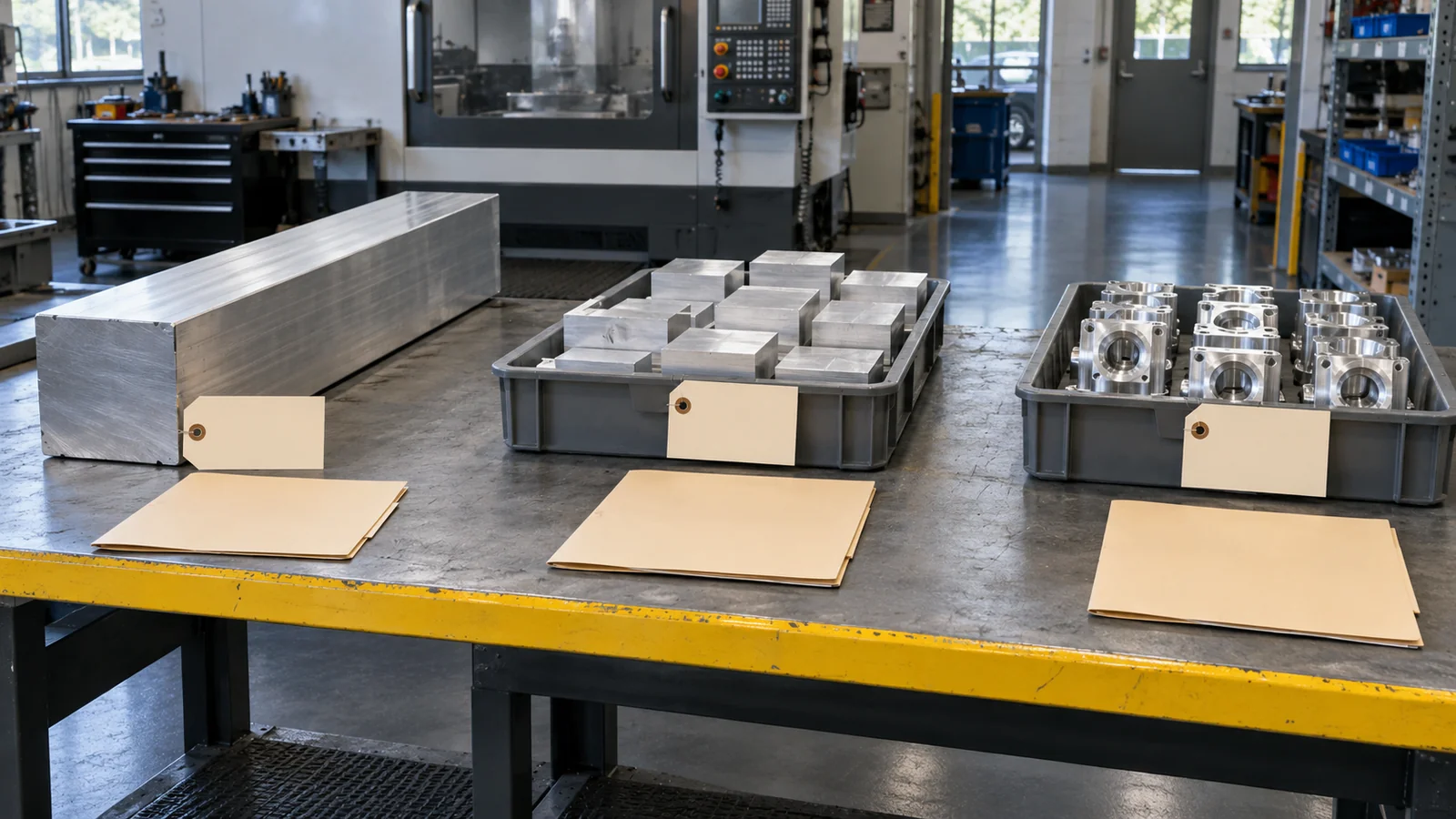
Cutting often removes the original marking. Plan identity transfer before it disappears. The method may use approved labels, travelers, containers, or digital allocation records, depending on the product and quality requirements. The important point is that the physical stock and the evidence remain connected.
Mixed lots require deliberate control. If several heats enter one production order, identify which parts belong to which input material, at the level required by the contract. Do not combine documents into a single folder and assume that proximity establishes traceability.
Reusable offcuts need the same discipline. An unmarked remnant may be perfectly usable for an unrestricted shop purpose yet unsuitable for an order requiring documented material identity. Relabeling it from memory is not a controlled recovery method.
Later operations can create additional evidence requirements. A raw-material report does not describe an independently performed heat treatment or coating unless the relevant records actually cover that process. Keep the evidence chain explicit.
Know When to Hold the Shipment
Escalate unexplained identifier mismatches, missing required results, incorrect material condition, illegible pages, or unexplained document alterations. Distinguish a clarification request from an approved deviation: asking a question does not authorize acceptance.

Some discrepancies are administrative and recoverable through a controlled reissued document. Others indicate an actual material or traceability problem. Require the responsible supplier to investigate and issue the appropriate evidence; do not edit a certificate locally to make it agree with the order.
Additional testing may answer a specific technical question, but it does not automatically recreate the original traceability chain. For example, confirming an alloy family does not establish every required processing condition or prove which mill lot supplied the part. Any alternative acceptance route needs the appropriate authority.
Request the Right Evidence Before the Order
Specify the material designation, required report type, traceability level, document language, and delivery format in the RFQ or purchase order. State whether records must be reviewed before production or merely delivered with the shipment. Include any customer-specific flow-down requirements explicitly.
When requesting machined parts from Jucheng Precision, send the drawing and evidence requirements together. This makes it possible to discuss stock sourcing and document availability before committing to a route. Do not assume an unspecified certificate can always be reconstructed after material has been consumed.
For a first delivery, the material package should also align with the agreed aerospace first article inspection scope. Keep material verification and dimensional verification distinct while ensuring they refer to the same part revision and production context.
A useful MTR review ends with a defensible statement: this report covers this material, this material was used for these parts, and the reported evidence satisfies the requirements assigned to it.