


Achieving a flawless, injection-molded visual aesthetic before opening expensive production tools is a major milestone for design teams. Specifying sla rapid prototyping provides your product designers with exceptionally smooth surfaces, sharp edges, and tight dimensional tolerances that are completely ready for presentation. This high-resolution vat photopolymerization process acts as an essential Quick-turn rapid prototyping service, utilizing precise UV lasers to cure liquid resin into complex cosmetic parts with extreme microscopic detail.

Suffer from coarse, grainy printed parts with visible layer lines that require hours of slow, manual filling and sanding? Standard filament-extrusion or powder-bed printers are limited by raw bead sizes, leaving distinct steps along curved faces that ruin aesthetic reviews. Shifting to an optical light-curing strategy completely removes these finish flaws, delivering liquid-smooth patterns straight from the vat.
Let's explore the electrochemical mechanics of liquid resin vat curing, analyze its outstanding capability in fabricating clear lenses and miniature housings, and review the post-processing sanding steps required to achieve presentation-ready parts.
How Stereolithography (SLA) Works
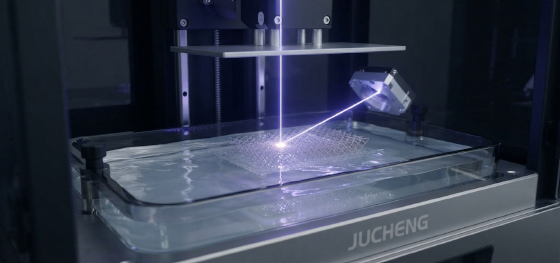
To design high-resolution components, understanding the physical polymer crosslinking process is vital. This advanced additive method utilizes liquid photopolymer resin contained within an industrial build vat. An ultraviolet (UV) laser beam, directed by high-speed galvanometer scanners, traces the 2D cross-sectional slices of your CAD file onto the surface of the resin.
As the liquid resin absorbs the UV energy, its monomer chains instantly bond and solidify. Once a single layer (typically 0.05mm to 0.1mm thin) is cured, the printer's elevator platform moves, a recoating blade sweeps to apply a fresh liquid layer, and the laser traces the next slice. This highly uniform process makes sla rapid prototyping exceptionally precise, delivering isotropic structures with incredibly fine detail and crisp corners.
Ideal Applications: Clear Parts and High-Detail Miniatures

The outstanding resolution of light-polymerization makes it the premier choice for highly detailed B2B hardware verification. Unlike other additives that leave porous voids, solidifying liquid resin allows us to manufacture components with optical clarity. This is the standard rapid prototyping process to verify custom automotive headlight lenses, clear light pipes, and microfluidic manifold blocks.
Furthermore, the process excels at creating complex, high-detail miniatures for medical diagnostic mock-ups and trade show exhibition pieces. The micro-focused laser spot size allows us to build delicate internal ribs, micro-threads, and thin-walled enclosures with extreme geometric fidelity, providing design teams with immediate physical models that match the visual intent of standard injection molded plastics.
Post-Processing SLA Parts: Painting and Polishing

A solid resin component straight out of the vat is rarely ready for aesthetic reviews. After the building phase finishes, parts must be washed in solvent baths to remove uncured resin and placed in UV post-curing chambers to reach full mechanical strength. Because the process requires physical support columns to anchor overhangs, the parts also display minor scar marks once the supports are removed.
To restore a retail-ready appearance, our skilled technicians execute premium post-processing. We perform progressive manual wet-sanding, moving from 400-grit to 2000-grit to erase support scars. For optical clear parts, we execute multi-stage polishing with fine compounds, followed by applying clear UV-stable acrylic lacquers, completely sealing the pores to achieve glass-like transparency.
Get Presentation-Ready SLA Prototypes at Jucheng Precision

Sourcing flawless visual prototypes requires an integrated, meticulous finish-control system on the shop floor. Jucheng Precision operates multiple large-format industrial stereolithography systems in climate-controlled clean rooms. This advanced setup allows us to avoid airborne dust contamination during building, ensuring that your high-transparency panels and cosmetic bezels are completed with extreme clarity.
Our finishing department is fully staffed with expert model makers who specialize in manual wet-sanding, color-matched wet painting, and mirror polishing. As your premier rapid prototyping service, we offer a 24-hour free DFM analysis to check your CAD files for unbendable angles or support clearance limits. Supported by our flexible no MOQ policy and rapid delivery guarantee, we manage your project from initial file ingestion to final, high-end visual verification inside our 8000-square-meter facility.
FAQ: Critical Questions About SLA Rapid Prototyping
Our engineering team has compiled professional, concise solutions to the most common quality challenges faced during stereolithography runs:
Are SLA rapid prototypes strong enough for functional stress testing?
Generally no, standard SLA photopolymers are highly brittle and tend to chip under strain. For functional 卡卡 or hinge testing, we recommend utilizing SLS nylon or custom CNC plastic prototyping.How do you prevent clear SLA parts from turning yellow over time?
Clear photopolymers naturally yellow when exposed to environmental UV rays. We prevent this discoloration by applying a specialized UV-resistant polyurethane clear coat over the polished parts.Why must we design drainage holes in hollow SLA part models?
Hollowing a part traps liquid resin inside the cavity during printing. Designing small drainage holes (minimum 1.5mm) allows the uncured resin to drain out easily before post-UV curing, preventing cracking.What is the standard dimensional tolerance of SLA rapid prototyping orders?
Our industrial SLA systems hold tight linear tolerances within ±0.1mm for the first 100mm, allowing you to verify tight-tolerance snap-fits and assembly clearances with extreme precision.

