


Designing short-run plastic hardware requires a meticulous evaluation of mold release directions to prevent geometric features from trapping parts inside core cavities. Features like side holes, internal snap tabs, or external hooks represent undercuts that prevent the part from ejecting straight out along the primary pull vector. Sourcing early technical reviews allows engineering groups to identify problematic geometries before cutting metal, keeping initial mold fabrication costs to a minimum. Smart CAD modifications eliminate complex moving mold components, ensuring low-volume parts exit soft cavities cleanly without scuffing or tearing.
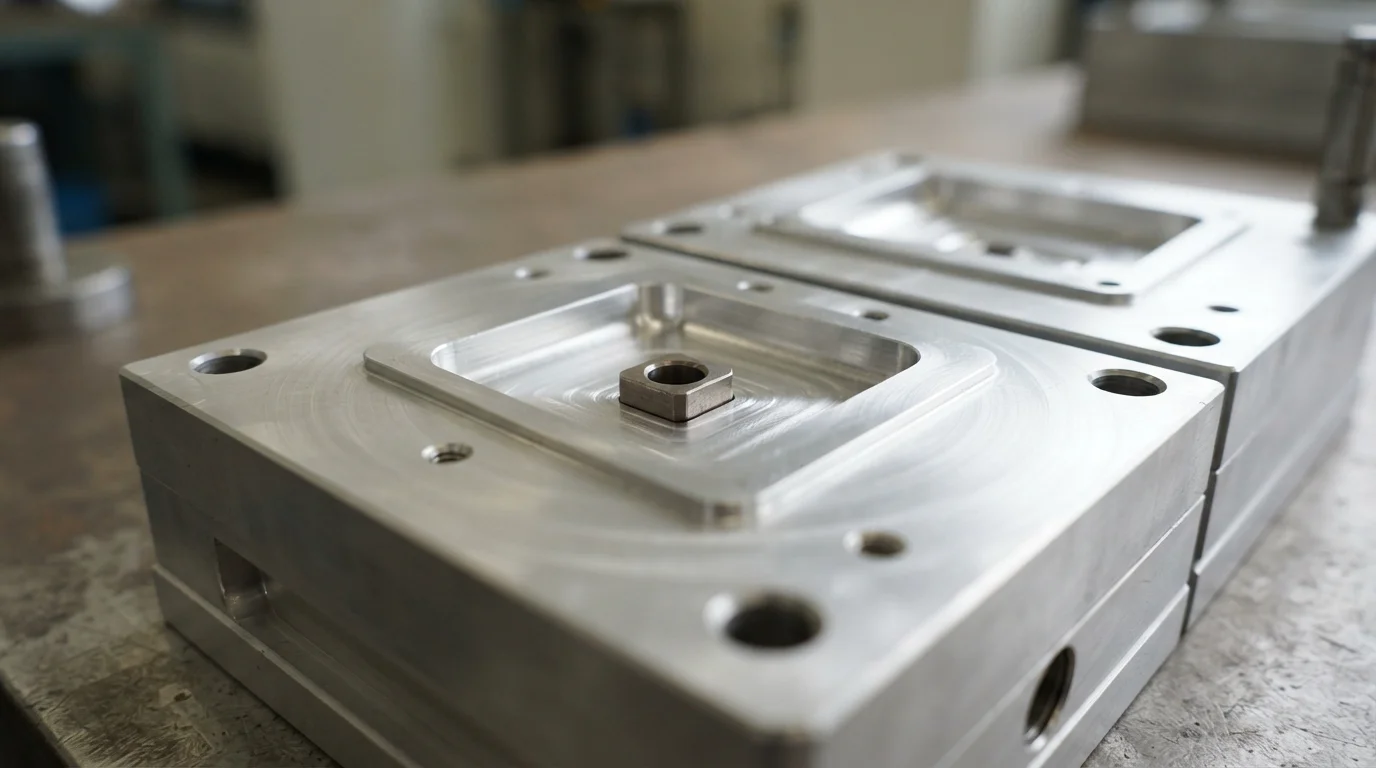
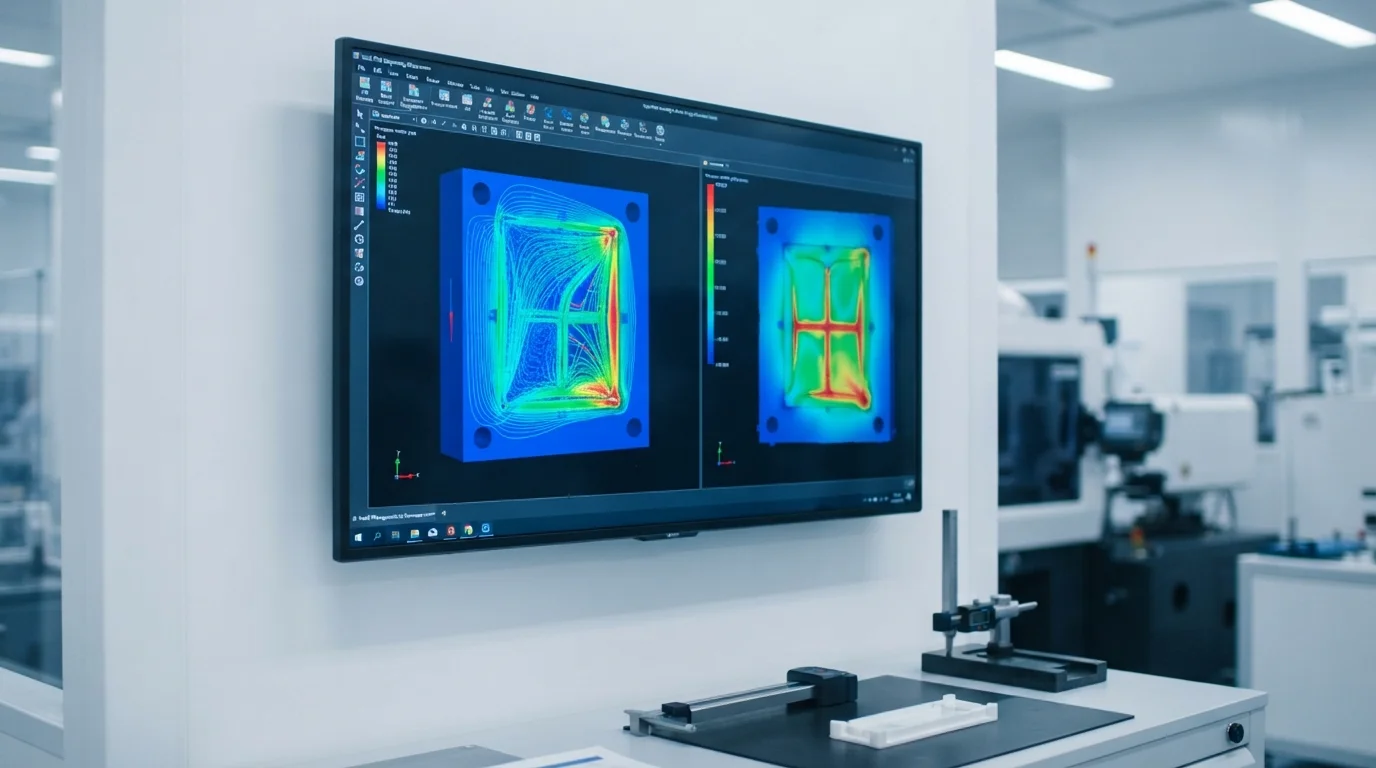
Slicing complex three-dimensional CAD geometries precisely allows experienced toolmakers to analyze parting lines, draft angles, and wall thicknesses using advanced mold flow simulation software. Managing undercuts in rapid tooling configurations helps product teams balance mold complexity against initial capital expenditures. Sourcing your copies from an experienced partner ensures design changes are propagated across all stages safely. Let me guide you through proven design tricks that bypass expensive mechanical sliders during low-volume prototyping runs.
Table of Contents
1. Undercut Geometry and Why It Increases Mold Expenditures
2. Eliminating Undercuts via Pass-Through Cores and Parting Line Shifts
Undercut Geometry and Why It Increases Mold Expenditures
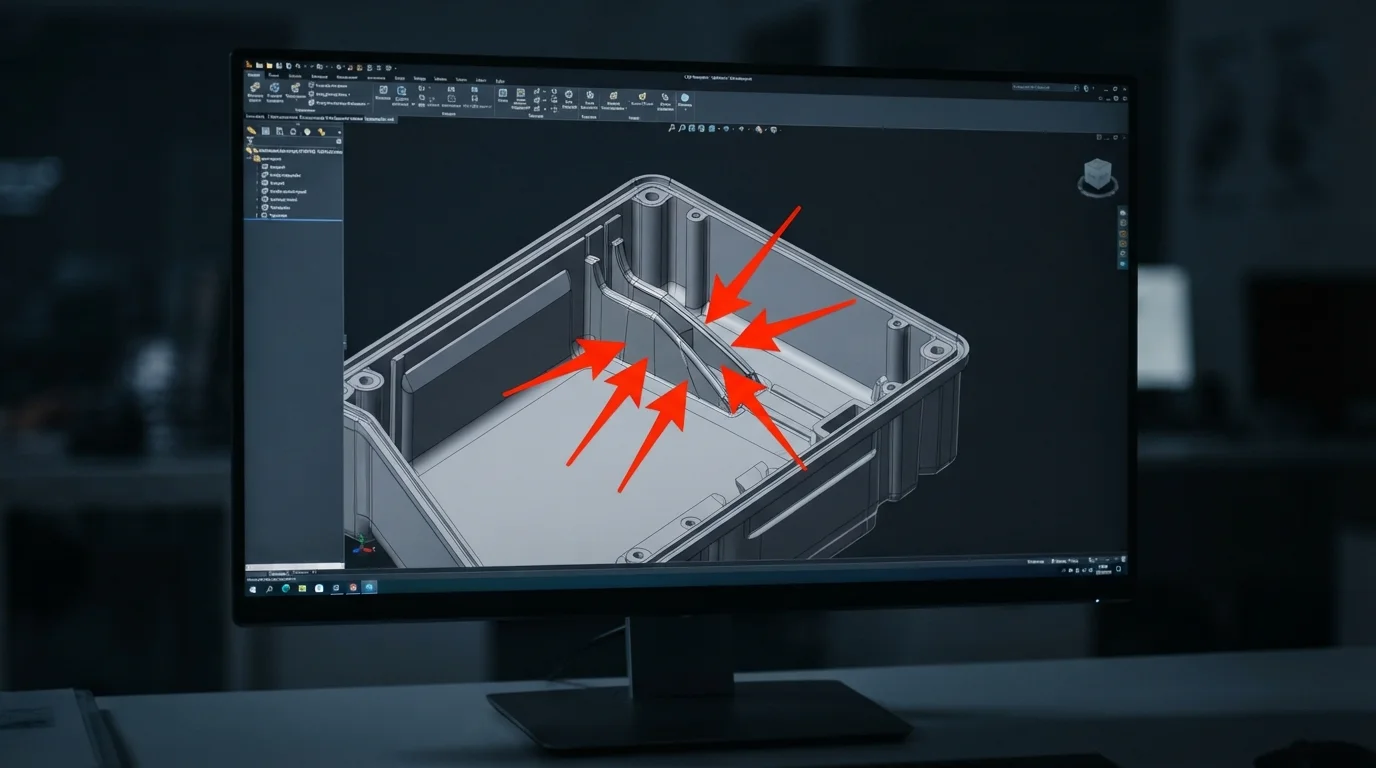
Question: What is an undercut in plastic injection molding? An undercut is any protrusion, hole, or recessed area that prevents a molded part from ejecting straight out along the mold’s primary opening axis.
Standard straight-pull injection molds open and close along a single coordinate axis, making any perpendicular protrusion or hole an immediate ejection obstacle. Forcing a part with unmitigated undercuts out of the core tears the polymer skin or crushes soft aluminum cavity walls completely. Toolmakers must incorporate moving side-actions like hydraulic slides or angled lifters to pull the undercut feature clear before the part ejects. Adding these moving steel components increases mold fabrication hours dramatically, driving up initial tooling budgets.
Adhering to comprehensive design guidelines for rapid tooling enables product developers to minimize mold complexity before committing to raw metal core blocks. Sourcing a dedicated Rapid Tooling Service program using AL7075-T6 Aluminum or soft P20 tool steel delivers genuine injection-molded components from production-grade resins within weeks. Soft metal cavities dissipate heat rapidly, shortening cooling cycles and boosting production speeds. Eliminating unnecessary mechanical sliders protects soft aluminum shut-offs from early wear.
Eliminating Undercuts via Pass-Through Cores and Parting Line Shifts
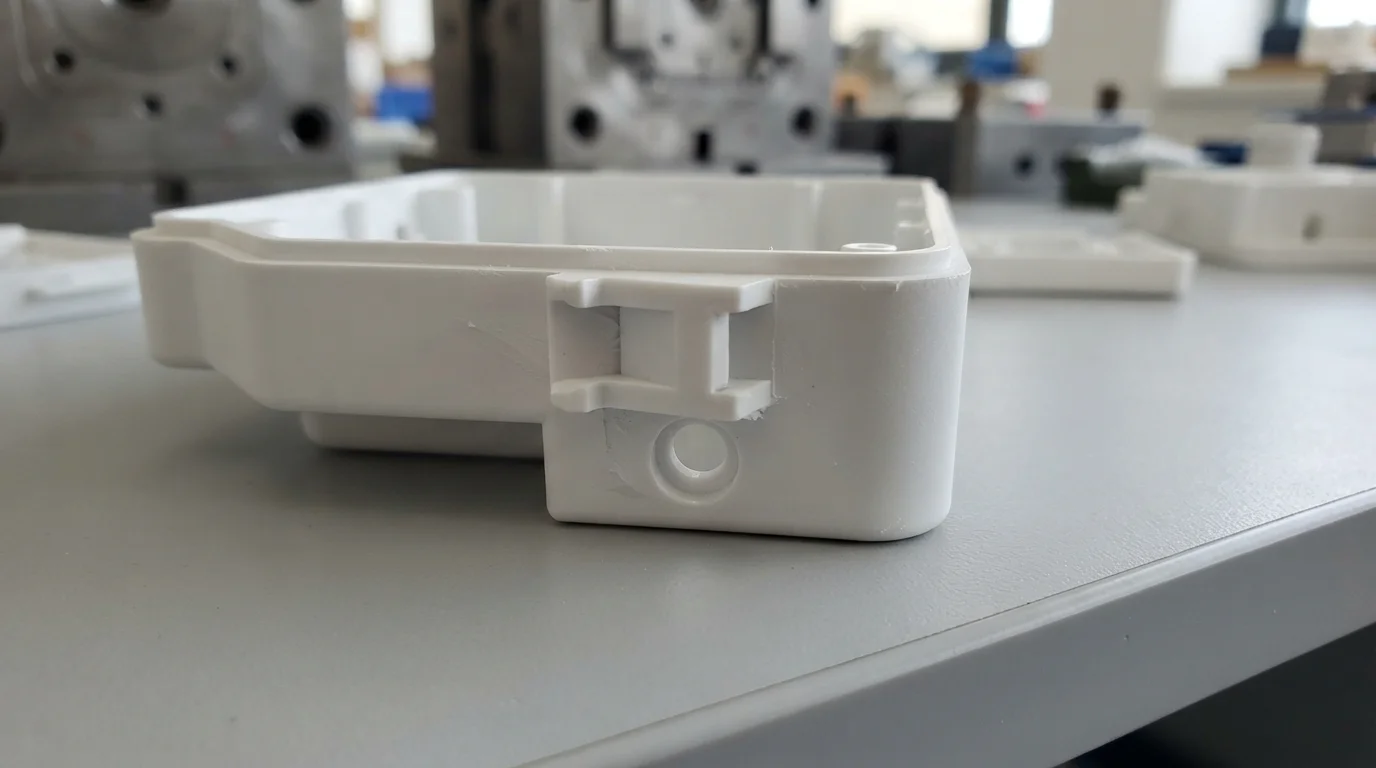
Question: How do pass-through shut-offs eliminate mold undercuts? Placing a hole or cutout directly underneath an internal snap tab allows the core and cavity halves to meet through the hole, forming the catch without moving slides.
Redesigning part geometries to bypass undercuts represents the most effective DFM strategy for keeping rapid mold costs low. Implementing pass-through cores—placing a small rectangular cutout directly beneath a snap-fit tab—allows the opposing mold half to reach through and form the undercut locking face. Core and cavity steel shut off against each other cleanly through the cutout, forming the locking hook without requiring any moving slides. Sourcing early DFM reviews ensures this simple cutout modification is integrated before cutting raw mold blocks.
Shifting the mold parting line represents another proven technique to resolve external side undercuts on curved enclosures. Positioning the parting line so that it intersects the middle of a side hole or boss turns the undercut into a straight-pull feature that releases naturally as the mold halves split. Sourcing functional parts molded from solid engineering plastics like ABS, Nylon (PA), or Polycarbonate (PC) provides authentic material behavior under dynamic loading. Addressing undercuts in rapid tooling CAD models early prevents expensive tooling modifications during pre-production trials.
Hand-Loaded Inserts versus Automatic Hydraulic Sliders
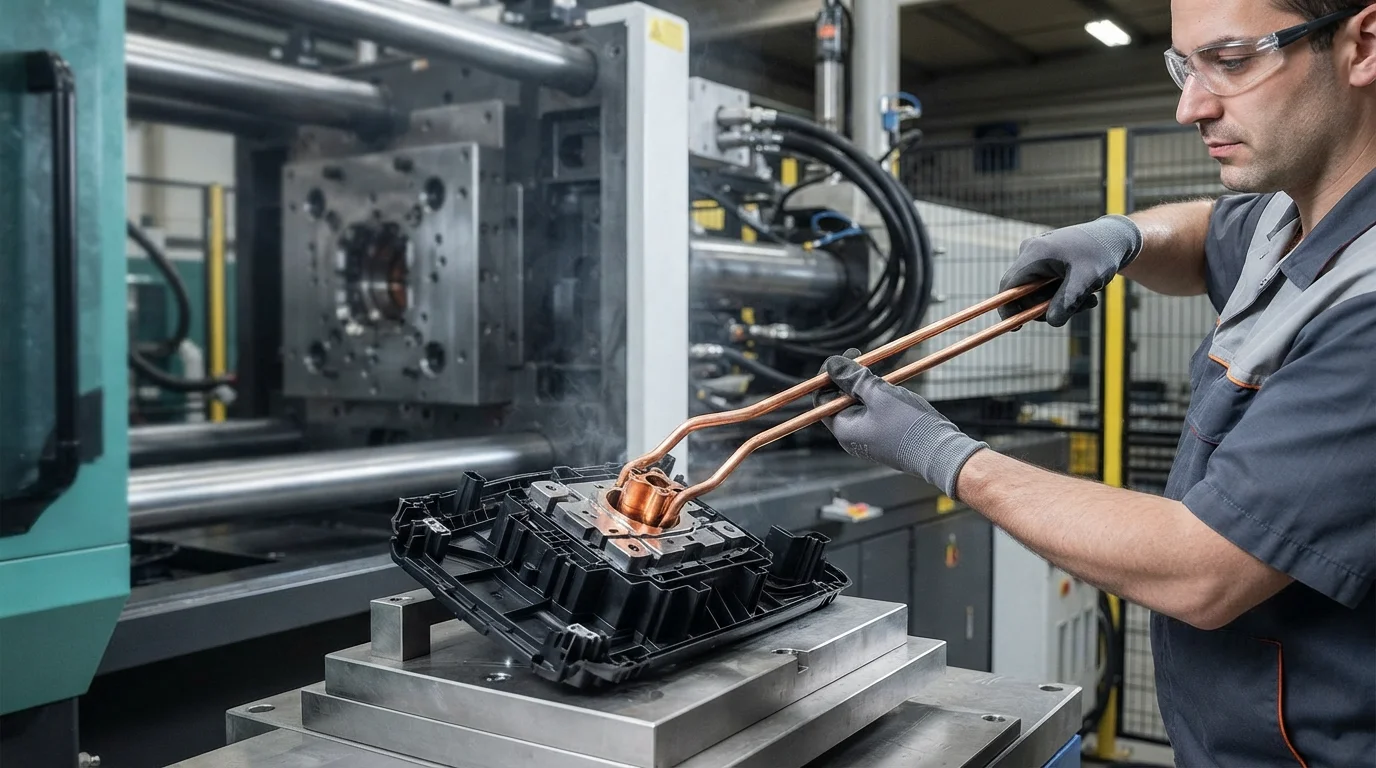
Question: How do hand-loaded inserts lower rapid tooling costs? Machine operators place loose steel inserts manually into the mold cavity before each cycle, bypassing thousands of dollars in automatic slide mechanisms for short runs.
When an undercut feature cannot be redesigned or shifted onto a parting line, hand-loaded inserts offer an exceptionally cost-effective intermediate solution. Operators manually place small aluminum or steel loose core pieces into the open mold cavity before each injection cycle. Molten resin flows around the insert, forming the undercut feature cleanly. After injection, the part ejects with the loose insert attached, allowing the operator to knock the insert free on a bench and reuse it in the next cycle. Bypassing automatic hydraulic slides saves up to 50 percent on initial mold fabrication costs for short-run programs.
Jucheng Precision operates a fully-integrated factory setup containing both multi-axis CNC Machining Service centers and precision injection molding presses. Factory engineers deliver comprehensive 24-hour free DFM reviews to optimize gate locations, parting lines, and undercut configurations before cutting metal. Sourcing functional parts from a professional Prototype Service or bridge mold facility ensures your team receives honest, cost-saving advice for your specific production volume. Managing undercuts in rapid tooling efficiently guarantees your product scales smoothly from early prototypes to mass production.
Partnering with a certified Injection Molding Service specialist ensures your finished hardware matches the premium software experience. Sourcing your quotes manually ensures experienced engineers analyze your 3D STEP files to find additional ways of eliminating undercuts and lowering tooling costs. Custom components undergo rigorous coordinate metrology checks to confirm exact dimensional compliance. Sourcing high-quality prototypes ensures your designs are built to withstand severe dynamic forces safely.
Frequently Asked Questions (FAQ)
What is the easiest way to eliminate an internal undercut without adding mold cost?
Pass-through shut-offs and parting line shifts represent the easiest design modifications to eliminate undercuts without adding mold cost. Placing a small cutout directly beneath a snap tab allows the opposing mold half to form the locking hook without moving sliders.
When should hand-loaded inserts be chosen over automatic side sliders?
Hand-loaded inserts are placed manually inside the mold cavity before each cycle, making them ideal for short runs of 100 to 5,000 parts. Automatic hydraulic sliders move automatically with the mold opening action, adding thousands to initial mold costs but enabling fast cycle times for high-volume runs.
Can flexible elastomers bump off small undercut features without slides?
Flexible elastomers like TPU or Polyethylene can pop off small, rounded undercuts during ejection without damaging the mold or part. Rigid engineering plastics like PC or Nylon, however, will shear or stress-whiten if pulled past an undercut without proper draft or moving inserts.

