

How Can Low-Volume Molding Slashes Laboratory Analyzer Casing Costs?
Views: 1 Author: Allen Xiao Publish Time: 2026-06-06


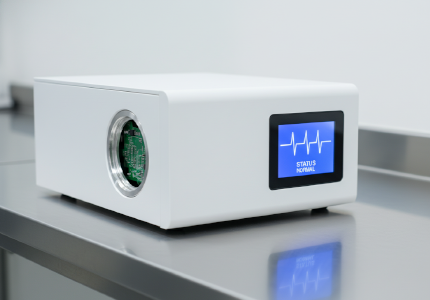
Milling massive solid aluminum blocks to house a giant blood analyzer guarantees financial ruin. Procurement teams scaling low-volume diagnostic equipment constantly hit a brutal manufacturing wall. Paying hundreds of thousands of dollars for heavy steel injection molds makes zero mathematical sense when your total market demand caps at fifty units annually. Specifying a custom Laboratory instrument casing built via advanced polymer chemistry perfectly bridges this massive financial gap.

Spilling highly corrosive reagents onto a cheap plastic chassis guarantees an immediate chemical meltdown. Hardware startups building clinical testing equipment frequently underestimate the brutal daily wiping protocols enforced by modern hospitals. Validating your geometric blueprint through a rugged Medical device enclosure prototype eliminates these massive safety liabilities. Testing physical polymers directly against harsh biological cleaning agents prevents your commercial launch from turning into a massive product recall.
Bypassing expensive steel tooling requires mastering alternative liquid polymer physics. Let's explore why reaction mixing dominates oversized medical housings, how flexible silicone molds mimic commercial aesthetics, and why scaling into rapid aluminum tooling saves your medical brand.
content:
Chemical Resistance: Surviving Corrosive Lab Spills
Vacuum Casting: Perfecting Benchtop Prototypes
Rapid Tooling: Slashing Low-Volume Production Debts
Medical-Grade Finishes: Paint and Silk-Screening
Turnkey Hub: Streamlining Clinical Hardware Assembly
FAQ: Honest Answers About Reagents and Tooling
Chemical Resistance: Surviving Corrosive Lab Spills
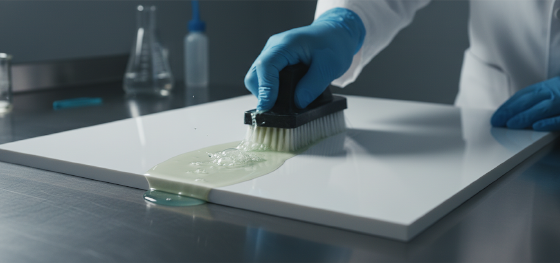
Why do standard commercial plastics fail violently inside professional laboratories?
Basic polymers physically degrade and discolor when constantly bombarded by caustic diagnostic chemicals and sterilization bleach, causing the outer walls to turn yellow, brittle, and eventually shatter during routine clinical handling.
Formulating specialized polyurethane blends guarantees absolute chemical immunity. Producing your Laboratory instrument casing with these engineered liquids creates a remarkably dense, non-porous outer skin that actively repels aggressive biological fluids without staining or melting under pressure.
Maintaining a sterile, flawless white aesthetic remains non-negotiable for medical brands. Smooth, organically curved polymer shells allow technicians to wipe away dangerous contaminants instantly without snagging their cleaning cloths on rough manufacturing layer lines.
Vacuum Casting: Perfecting Benchtop Prototypes
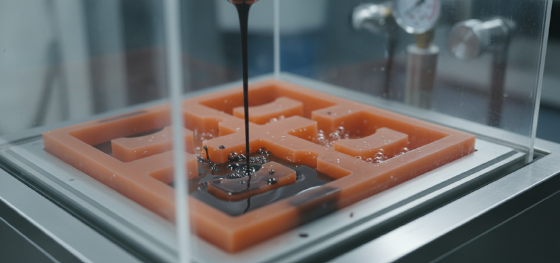
What fabrication method works best for small batches of compact diagnostic tools?
Pouring liquid polyurethane into flexible silicone master molds under deep atmospheric vacuum pressure flawlessly replicates the exact texture and rigidity of mass-produced commercial plastic.
Pitching medical hardware to venture capitalists demands breathtaking physical prototypes. Flimsy, visibly layered plastic prints scream amateur engineering, instantly killing any chance of securing heavy funding for your diagnostic startup.
Silicone replication completely solves this commercial hurdle. You receive twenty to fifty visually perfect casings that look, feel, and assemble exactly like a million-dollar commercial product, allowing for rigorous clinical trials and investor demonstrations.
Rapid Tooling: Slashing Low-Volume Production Debts

What happens when your clinical demand exceeds fifty units but remains under ten thousand?
Transitioning into rapid tooling utilizes heavy-duty aluminum cavities instead of premium H13 tool steel, allowing machines to inject real thermoplastic pellets at a fraction of the traditional NRE cost.
Paying for massive steel tooling makes absolutely zero mathematical sense for niche biomedical equipment. Aluminum molds cut significantly faster on CNC spindles, slashing your initial factory debt and accelerating your commercial launch date.
Operating this exact hybrid strategy allows companies to build a massive Diagnostic instrument housing affordably. Heavy hospital carts require huge plastic panels; utilizing low-cost aluminum molds pushes those giant parts efficiently without extreme hydraulic force.
Medical-Grade Finishes: Paint and Silk-Screening
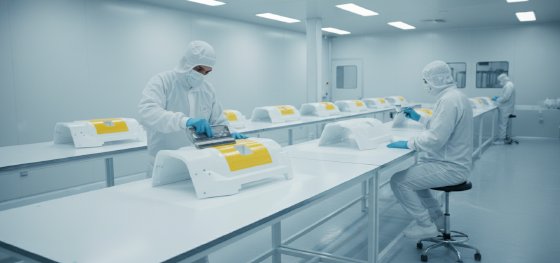
Why must hardware teams paint their polyurethane prototypes before clinical testing?
Raw casting resins lack UV stability and will naturally yellow under harsh fluorescent hospital lighting; applying premium automotive-grade white paint permanently locks in that sterile, pristine aesthetic.
Shipping raw plastic across town to a separate paint shop invites massive transit scratching. Maintaining absolute cosmetic perfection requires keeping the painting booths directly adjacent to the molding presses to avoid dust contamination.
Printing permanent warning labels and critical operational instructions is legally mandatory. Factory technicians utilize specialized two-part epoxy inks during the silk-screening phase to ensure your warning labels never wipe off under heavy bleach scrubbing.
Turnkey Hub: Streamlining Clinical Hardware Assembly

Why trust JC Rapid to execute your complex medical hardware assemblies?
Because we pour the raw polyurethane, CNC mill the internal mounting brackets, and execute the final medical-grade painting entirely under one integrated, dust-free factory roof.
Fragmenting your supply chain guarantees severe tolerance mismatches. If your internal structural metal clashes with your exterior Laboratory analyzer casing, disconnected vendors will simply blame each other while your assembly line starves.
Stop bleeding capital on mismatched clinical hardware and overpriced steel molds. Send your complex CAD files to our engineering department today for a rigorous DFM audit, securing flawless medical assemblies instantly.
FAQ: Honest Answers About Reagents and Tooling

Can flexible silicone molds perfectly replicate microscopic internal screw threads?
Casting fine internal threads using soft silicone is notoriously unreliable due to material shrinkage. We proactively cast solid plastic mounting bosses and manually tap the precise threads later using CNC machinery.
Does rapid aluminum tooling wear out quickly when pushing abrasive plastics?
Aluminum cavities naturally degrade faster than hardened steel. However, for low-volume medical runs under ten thousand units, aluminum easily survives the thermal shock without requiring expensive mold rebuilds.
Will the medical grade white paint chip if the device is dropped?
Applying specific chemical adhesion promoters before spraying the topcoat forces the paint to fuse molecularly with the polyurethane substrate, providing extreme impact resistance against accidental drops.
Why do vacuum-cast parts sometimes have tiny air bubbles on the surface?
Inexperienced operators failing to draw a deep enough vacuum allow atmospheric gas to remain trapped inside the silicone mold. Our advanced pressurized chambers violently extract all oxygen, guaranteeing absolutely dense, void-free walls.

ㆍPrivacy: We respect your privacy. Here you can find an example of a non-disclosure agreement. By submitting this form, you agree to our terms & conditions and privacy policy.
