


Skipping strict regulatory auditing during early product development represents a massive financial gamble. Medical device startups often assume they can worry about compliance after their first flight trials, only to find their prototypes rejected by testing labs. Sourcing a verified ISO 13485 compliant prototype eliminates this dangerous bottleneck, ensuring your hardware aligns perfectly with international safety standards [1]. Defeating early-stage design flaws saves millions of dollars in eventual compliance delays.

Securing venture capital funding requires proving your clinical hardware is ready for FDA submission. Investors refuse to write heavy checks for non-compliant designs that face major redesign delays. Developing a robust Medical device enclosure prototype under a certified quality management system accelerates your path to market, giving your stakeholders total confidence.
Balancing development speed with uncompromising safety requirements defines modern healthcare engineering. Let's dissect why early compliance prevents massive tooling reworks, how material documentation blocks supply chain fraud, and why advanced metrology ensures absolute mechanical consistency.
content:
Regulatory Gateways: Why Early Compliance Matters
Material Traceability: Securing Absolute Certifications
Quality Control: Deploying Advanced Metrology Labs
Unified Assembly: Enforcing Tolerances Across Assemblies
FAQ: Honest Answers About Audits and Tooling
Regulatory Gateways: Why Early Compliance Matters
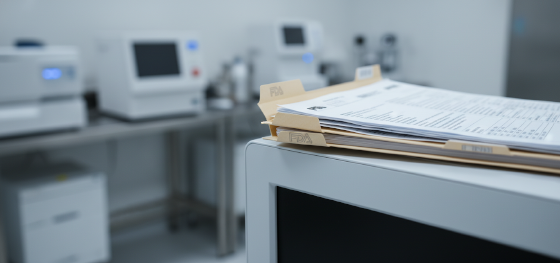
Why must medical developers enforce ISO 13485 standards during the prototyping phase?
Because capturing early manufacturing data under a certified quality management system ensures your design can transition seamlessly to mass production without requiring expensive structural reworks [1].
Transitioning from late-stage R&D to full clinical trials requires absolute validation consistency. If the initial hand-built models differ geometrically from the eventually molded parts, your early testing data becomes legally useless.
Ordering an ISO 13485 compliant prototype guarantees that every single manufacturing step, temperature profile, and tolerance is recorded [1]. This precise data trail allows our engineering team to duplicate the exact same tolerances during high-volume production.
Material Traceability: Securing Absolute Certifications
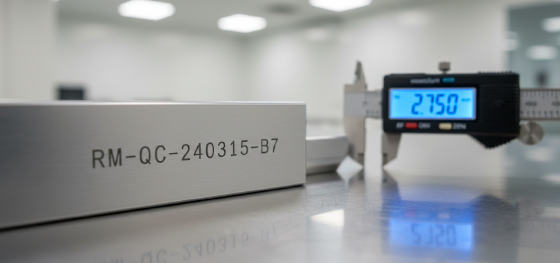
How do medical brands prevent hazardous, uncertified materials from entering their supply chain?
By demanding complete raw material traceability and official material certificates (CoA) for every single batch of metal and polymer ingots used.
Sourcing raw plastics from unverified brokers introduces massive biological liabilities. Cheap polymers can leach toxic chemicals when wiped with aggressive clinical bleach, causing severe patient reactions and immediate product recalls.
Securing our ISO 13485 compliant prototype fabrication guarantees absolute material security [1]. We provide complete chemical trace records for every single medical-grade materials batch, ensuring your hardware clears international custom audits effortlessly.
Quality Control: Deploying Advanced Metrology Labs

How do contract manufacturers verify microscopic tolerances on complex organic geometries?
By deploying coordinate measuring machines (CMM) and optical laser scanners to inspect the 3D dimensions directly against your original CAD files.
Relying on hand calipers is physically impossible when measuring complex interlocking curves. Precise CMM inspections verify the flatness of O-ring sealing grooves, preventing biological fluids from leaking inside.
Maintaining a strict 99.8% product qualification rate requires this level of physical discipline. We monitor our machinery continuously to prevent dimensional drift during high-speed, long-run production cycles.
Unified Assembly: Enforcing Tolerances Across Assemblies
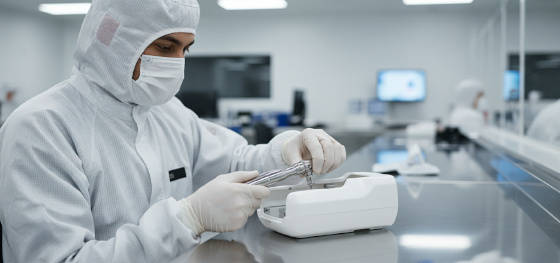
Why must you consolidate the fabrication of your surgical tools and exterior enclosures?
Because splitting your order across multiple machine shops guarantees severe assembly errors, whereas single-source contract manufacturing ensures perfect zero-gap fitment.
Designing a custom Disposable surgical tool handle CNC part demands absolute metallurgical rigidity. If the CNC milled metal shaft fails to align with the cast plastic cover, the joint will wobble.
Operating our integrated medical fabrication bay allows us to deliver a complete, highly precise ISO 13485 compliant prototype assembly [1]. We ensure the metals and polymers interlock flawlessly, eliminating any logistical friction.
FAQ: Honest Answers About Audits and Tooling

| Regulatory Question | Direct Compliance Answer | B2B Impact |
|---|---|---|
| Does ISO 13485 increase prototype cost? | Yes, reflects rigorous material tracking. | Prevents massive pre-market auditing failures. |
| Can we use standard automotive molds? | No, requires validated clinical injection setups. | Guarantees certified material purity. |
Why do medical-grade plastics require specialized cleanroom packaging?
Dust and biological oils from standard shipping warehouses will contaminate the sterile surface. We package all clinical components in protective cleanroom bags immediately after manufacturing.
Do you provide full Material Test Reports with every global shipment?
Providing complete material chemical certifications (CoA), dimensional inspection reports, and RoHS compliance certificates with every single delivery is our standard practice.

