

Scaling Smart: overmolding vs two shot molding for Low Volume
Views: 1 Author: Allen Xiao Publish Time: 2026-03-16


Financial paralysis often sets in when a hardware startup receives its first quote for a dual-material product. When you design a premium handheld diagnostic tool with a soft-touch elastomeric grip over a rigid chassis, you are immediately forced into a high-stakes manufacturing crossroads. Traditional high-volume factories will aggressively push for a "Two-Shot" (2K) solution, promising automated speed while demanding a $50,000 tooling sacrifice before the first unit is even molded. If the market rejects your design or if a minor ergonomic update is required, that $50,000 becomes a permanent sunk cost. Navigating this fiscal minefield requires a dispassionate evaluation of overmolding vs two shot molding. In the high-velocity world of precision manufacturing, the choice of automation is rarely about quality; it is a cold calculation of amortized ROI. While one technology utilizes expensive rotating platens to mold two materials in one cycle, the other relies on a sophisticated "Pick-and-Place" strategy to achieve the same monolithic bond at a fraction of the initial capital expenditure. Jucheng Precision operates as a strategic manufacturing navigator, providing the technical data needed to master the overmolding vs insert molding spectrum without mortgaging your company's future on premature automation.
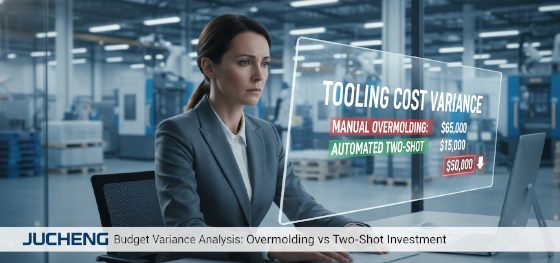
Establishing a lean supply chain begins with the acknowledgment that "Manual" does not equal "Inferior." For quantities between 100 prototypes and 10,000 production units, the traditional overmolding process—where a rigid core is molded in tool A and then manually moved to tool B for the second material—remains the undisputed champion of profitability. Jucheng Precision eliminates the "Complexity Tax" by utilizing optimized single-shot molds to simulate the performance of $100k automated systems. This guide deconstructs the mechanical divide between rotating platens and manual inserts, the mathematical crossover points for tooling debt, and why our flexible facility provides the mandatory foundation for your next hardware breakthrough. We turn "expensive dual-shot dreams" into "profitable multi-material realities."
content:
Pick-and-Place Economics: The Low-CapEx Advantage
Automated Rigor: The Physics of the Rotating Platen
Financial Thresholds: Pinpointing the 50,000-Unit Pivot
Dimensional Combat: Precision vs. Practicality
JUCHENG Strategy: Bridging the Gap to High Volume
Pick-and-Place Economics: The Low-CapEx Advantage
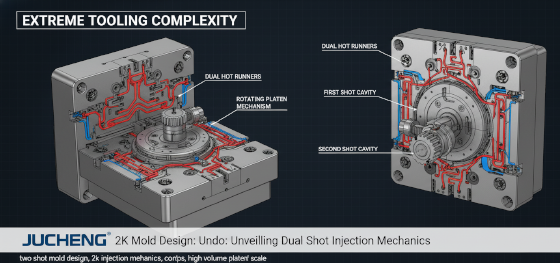
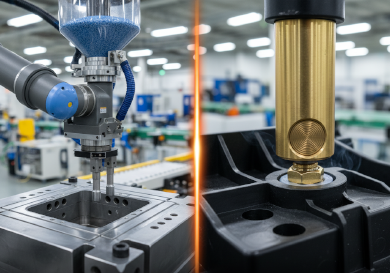
Capital allocation dictates the survival of disruptive technology. The fundamental advantage of the "Pick-and-Place" method in the overmolding vs two shot molding standoff is the radical reduction in NRE (Non-Recurring Engineering) fees. Traditional overmolding utilizes two standard, independent mold bases. You are paying for the precision-ground steel of two simple cavities rather than the insane mechanical choreography of a 2K tool. At Jucheng Precision, we advocate for this "Stair-Step" approach for early-stage medical and consumer electronics projects. Because we are not building complex internal rotation mechanisms or specialized hot-runner manifolds, your tooling cost stays in the $5,000 to $12,000 range. This low entry fee allows you to preserve cash for marketing and iterative design updates. Furthermore, if you discover a flaw in the rigid substrate after the first batch, you only need to modify one small mold rather than reworking a multi-ton 2K asset. We prioritize "Risk Mitigation," ensuring that your initial launch is not anchored by an immovable financial weight.
Automated Rigor: The Physics of the Rotating Platen
Manufacturing velocity is the primary driver of Two-Shot (2K) molding dominance at massive scales. This process utilizes a specialized injection press with two separate barrels and a mold that physically rotates or uses a "core-back" mechanism. The machine injects the first material, the mold rotates 180 degrees, and the second material is injected immediately while the first is still warm. This "One-Cycle" logic eliminates human touch-time and slashes cycle times to seconds. However, this mechanical brilliance requires a "Tooling Sacrifice." A 2K mold is a masterpiece of precision engineering; the alignment between the two halves must be accurate to within five microns across multiple cycles. The hot runner systems must be balanced to ensure identical pressures in both materials. When evaluating overmolding vs two shot molding, engineers must recognize that they are buying a custom-built robot, not just a mold. Jucheng Precision reserves this technology for our clients with clear visibility into 100,000+ unit EAU (Estimated Annual Usage), where the higher piece-price of manual labor finally outweighs the massive upfront cost of the 2K steel.
Financial Thresholds: Pinpointing the 50,000-Unit Pivot
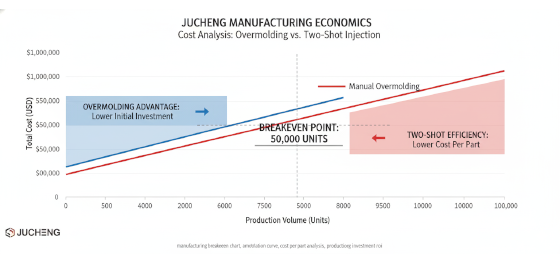
Procurement strategies often fail when engineers ignore the "Amortization Intersection." Let’s construct a cold-blooded mathematical comparison for an ergonomic medical handle. A manual overmolding setup might cost $8,000 in tooling but incur a $3.50 labor-heavy piece price. A Two-Shot (2K) setup requires a $50,000 tool but drops the piece price to $1.20 due to automation. For a 5,000-unit run, the overmolding project total is $25,500, while the 2K total is a staggering $56,000. In this scenario, choosing 2K is financial suicide. The "Breakeven Point"—the moment where the $2.30 savings per part finally pays off the $42,000 tooling delta—occurs at approximately 18,260 units. However, when you factor in the "Cost of Quality" and the risk of design changes, Jucheng Precision generally recommends the 50,000-unit mark as the safe pivot point. If your volume forecast is under 20,000 pieces per year, research into overmolding vs two shot molding will always lead back to the pick-and-place method as the most fiscally responsible path. We run these "Sensitivity Audits" for every RFQ, ensuring your tooling strategy matches your bank balance.
Dimensional Combat: Precision vs. Practicality
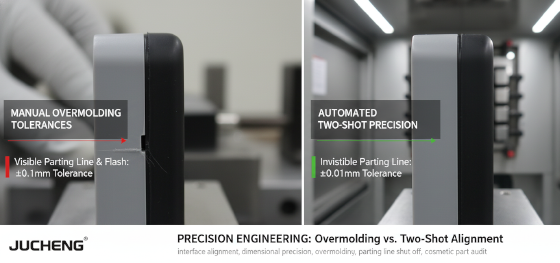
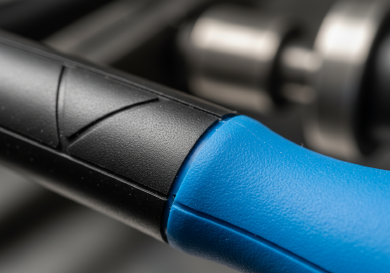
Tactile perfection is often easier to achieve through the controlled isolation of manual overmolding. In a 2K mold, the "Shut-off" (the line where two materials meet) is dictated by a mechanical seal inside a single tool. If the thermal expansion of the steel isn't perfectly managed, you get "Bleed" or flash. In manual overmolding vs two shot molding workflows, Jucheng Precision utilizes the "Precision Fit" of the pre-cast rigid core. Because the core has already cooled and stabilized before it enters the second mold, we can design the second tool to "Pinch" the part with extreme force, creating a razor-sharp color transition. While 2K molding offers the advantage of superior "Molecular Freshness" (bonding two molten plastics), modern TPE/TPU chemistries are engineered to bond perfectly even to cold substrates. We provide the material lot traceability and pull-off strength reports to prove that our manual process delivers the same industrial-grade bond as a 2K machine, ensuring your ruggedized housings survive the most aggressive drop tests without a single delamination.
JUCHENG Strategy: Bridging the Gap to High Volume
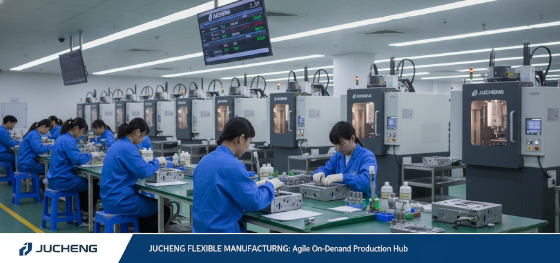
Manufacturing excellence at Jucheng Precision is built on the foundation of "Volume-Matched Technology." We don't just "take orders"; we act as your manufacturing navigator. Our facility, housing over 150 CNC machines and dedicated assembly-ready injection bays, is optimized for the agile middle-ground of hardware development. We initiate your project using manual overmolding to deliver your first 5,000 units within weeks, allowing you to generate revenue and gather user data. As your market traction accelerates toward mass-market levels, we handle the seamless transition to high-speed 2K automation using the same engineering team. This vertical integration ensures zero data loss; the engineers who perfected your "Manual" parting line are the same experts who design your "Automated" rotating platen. Stop gambling your R&D budget on vendors who only offer one speed. Not sure if your project volume justifies the $50k 2K tool? Upload your 3D CAD file to JUCHENG today for a Free DFM Review. Our experts will identify the most profitable overmolding vs two shot molding roadmap for your brand, ensuring your journey from prototype to production is lean, predictable, and market-ready.


ㆍPrivacy: We respect your privacy. Here you can find an example of a non-disclosure agreement. By submitting this form, you agree to our terms & conditions and privacy policy.
