


Hardware integrity is ultimately decided by the security of its mechanical intersections. When an engineer designs an automotive drone arm or a ruggedized medical pump, the primary point of failure is rarely the solid polymer wall; it is the point where a metal screw meets the plastic chassis. If the fastener fails, the entire system collapses. Navigating this structural hurdle requires a dispassionate evaluation of Insert Molding vs Heat Staking. In the high-velocity environment of precision manufacturing, the choice of "when" to install hardware dictates your part's mechanical spine and your project's financial ROI. While one technology encapsulates the metal within a high-pressure molten flow, the other utilizes thermal energy to "weld" a fastener into a pre-existing pilot hole. Jucheng Precision operates as a high-fidelity assembly hub, providing the technical data needed to navigate the broader overmolding vs insert molding landscape. We ensure that your fastening strategy is perfectly synchronized with your mechanical load cases and your annual production volume.
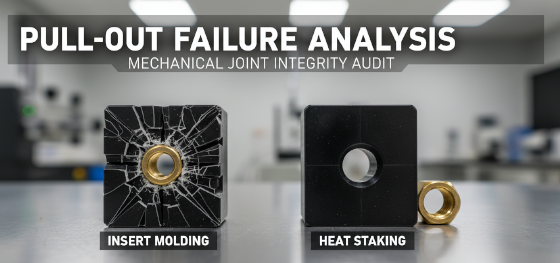
Establishing a failure-proof fastening protocol requires moving beyond "standard" assembly thinking and entering the domain of molecular entrapment. Insert molding offers the absolute apex of pull-out resistance but carries a significant "Cycle Time Tax" due to the manual or robotic loading of hardware into a hot mold. Heat staking, conversely, offers superior manufacturing velocity by decoupling the molding and assembly phases, but it introduces risks of localized material degradation and lower torque limits. Jucheng Precision eliminates manufacturing doubt by performing a surgical audit of your assembly's "Service Stress." We identify whether your hardware needs the encapsulated permanence of an in-mold insert or the cost-effective efficiency of post-mold thermal staking. This guide deconstructs the physics of polymer re-flow, the mathematics of labor amortization, and why our dual-track facility provides the mandatory foundation for your next hardware breakthrough.
Mechanical Discrepancies: Decoding the In-Mold vs. Post-Mold Divide
Strength Sovereignty: Pull-out and Torque-out Audit
Financial Logic: Amortizing Labor vs. Machine Seconds
Polymer Pathology: Amorphous vs. Crystalline Staking Risks
JUCHENG Protocol: Hybrid Assembly Optimization
Mechanical Discrepancies: Decoding the In-Mold vs. Post-Mold Divide
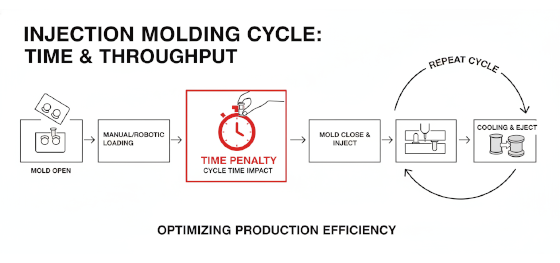
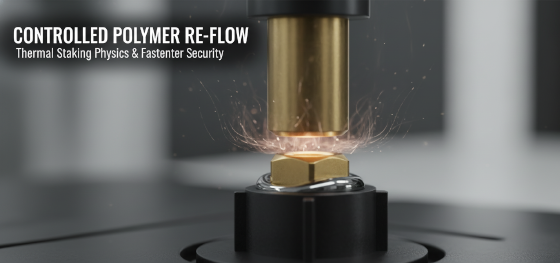
Manufacturing sequence dictates the molecular reality surrounding your metal hardware. The debate of Insert Molding vs Heat Staking begins with the timing of the "Encounter" between polymer and metal. In insert molding, the hardware—typically a knurled brass nut—is placed into the open mold cavity. Molten resin is then injected at pressures exceeding 15,000 psi, flowing into every microscopic valley of the knurling before solidifying. This creates a monolithic bond where the plastic shrinks onto the metal. Heat staking (or thermal/ultrasonic insertion) occurs after the part has cooled and ejected. A pilot hole is molded into the plastic, and a secondary machine uses a heated tip to melt the surrounding polymer as the insert is pressed in. This "Re-melt" phase allows the plastic to flow into the metal's grooves. At Jucheng Precision, we recognize that while both methods achieve a "fit," the in-mold process results in zero air gaps and a denser molecular wrap. Heat staking, if not managed with surgical temperature control, can trap microscopic air pockets or "char" the polymer chains, resulting in a joint that looks correct but is chemically compromised.
Strength Sovereignty: Pull-out and Torque-out Audit
Performance requirements in the automotive and aerospace sectors leave zero margin for "stripped" fasteners. When evaluating Insert Molding vs Heat Staking, engineers must look at the "Force Vector" limits. Insert molding is the undisputed champion of "Pull-out" resistance. Because the molten plastic was forced into the knurls under intense hydraulic pressure, it forms an unbreakable mechanical interlock. In our QC lab, we frequently observe that the plastic part itself will fracture before the insert can be extracted. Heat staking provides approximately 70% to 85% of the strength of an in-mold part. The "Heat-Affected Zone" (HAZ) created during post-mold insertion can sometimes create a brittle ring of plastic around the hardware. If your product is a high-vibration engine component or a load-bearing medical frame, Jucheng Precision recommends the encapsulated security of insert molding. However, for consumer electronics housings where the screw is only removed for occasional maintenance, the "Ductile Grip" of a properly heat-staked insert is more than sufficient, allowing you to save significant capital on production cycle times.
Financial Logic: Amortizing Labor vs. Machine Seconds
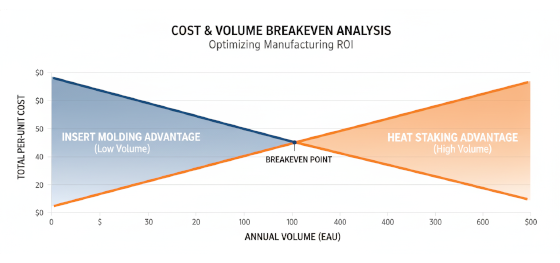
Procurement strategies often collide with the reality of "Machine-Hour Rates." The financial standoff of Insert Molding vs Heat Staking is a battle of amortization. Insert molding requires a technician (or a robot) to stand at the press and load hardware every 30 to 60 seconds. This effectively doubles or triples the "Mold Open Time," which is the most expensive time in the factory. You are paying for a 200-ton machine to sit idle while a human places a $0.05 brass nut. For a 1,000-unit pilot run, this is often the most cost-effective path because it eliminates the need for secondary assembly jigs. However, as your volume spikes toward 100,000 units, the math shifts violently. High-speed "Plain" molding (molding the part with just a hole) allows for 15-second cycles, which slashes the part price. The inserts are then pressed in by a low-cost secondary station or an automated staking line. Jucheng Precision runs these "Financial Sensitivity Analysis" reports for our clients, pinpointing the exact EAU (Estimated Annual Usage) where you should pivot from in-mold to post-mold insertion to maximize your margin.
Polymer Pathology: Amorphous vs. Crystalline Staking Risks
Material chemistry dictates the success of post-molding thermal work. In the battle of Insert Molding vs Heat Staking, amorphous resins like ABS and Polycarbonate are the "Gentle Participants." They have a wide softening range, allowing the staking tip to move through the material smoothly. Crystalline resins like Nylon (PA66) or POM (Acetal), however, are "Violent Reactors." They have sharp melting points; the material is either a rock-solid solid or a runny liquid. Attempting to heat-stake a brass nut into Nylon often leads to "Snotting"—where the plastic turns into a watery mess and flows out of the hole, resulting in a weak, unsightly joint. Jucheng Precision engineers utilize specialized ultrasonic horns and PID-controlled thermal tips to manage these crystalline transitions. If your BOM requires 30% Glass-Filled Nylon, the "Abrasive Sludge" of the melted glass fibers can also wear out staking tips rapidly. We provide the material documentation and process validation to ensure that your chosen resin chemistry supports your fastening strategy without compromising the cosmetic soul of the part.
JUCHENG Protocol: Hybrid Assembly Optimization
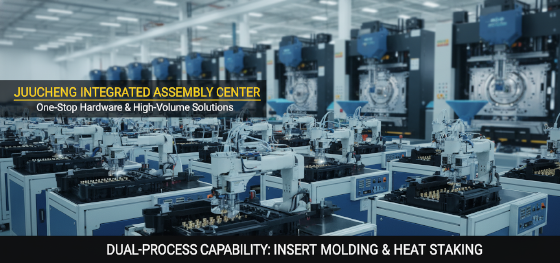
Manufacturing excellence at Jucheng Precision is built on the foundation of technological agnostic advisory. We don't push one method because we lack the other; we house elite Swiss CNC lathes to manufacture custom inserts, scientific injection bays for in-mold work, and automated thermal/ultrasonic lines for post-mold assembly. Our "Stair-Step" protocol allows you to start with insert molding for your first 500 prototypes to ensure maximum strength during testing, then seamlessly transition to high-speed heat staking as you scale into mass production. We provide full material lot traceability and pull-out strength reports for every batch, ensuring your hardware journey is lean, predictable, and market-ready. Stop gambling with fragmented suppliers who can't bridge the gap between metal and plastic. Not sure if your project volume justifies the cycle-time penalty of in-mold inserts? Upload your 3D CAD file to JUCHENG today for a Free DFM Review. Our experts will identify the most profitable Injection molding materials and assembly strategy for your brand, ensuring your transition to production is seamless, strong, and profitable.

