


Tactile perfection in modern hardware is often decided by the invisible integrity of the material interface. When an engineer designs a ruggedized power tool or a high-end medical diagnostic handle, the "looks-like" phase is easily achieved, but the "lasts-like" phase is where the project lives or dies. Most amateur designs fail because they rely purely on the "hope" of chemical adhesion, ignoring the brutal physical forces of repetitive user handling and environmental stress. Navigating this durability gap requires the uncompromising application of overmolding design guidelines. This technical framework dictates how a rigid skeleton (the substrate) must be sculpted to accept a second polymer skin without peeling, delaminating, or flashing. At Jucheng Precision, we recognize that overmolding is essentially an act of "Mechanical Marriage." If the geometry doesn't provide a sanctuary for the second resin to anchor and settle, the resulting part is nothing more than a temporary assembly of two separate pieces. This guide deconstructs the physics of interlocking, the thermodynamics of wall thickness, and the surgical precision of shut-off design to ensure your multi-material project achieves manufacturing sovereignty.
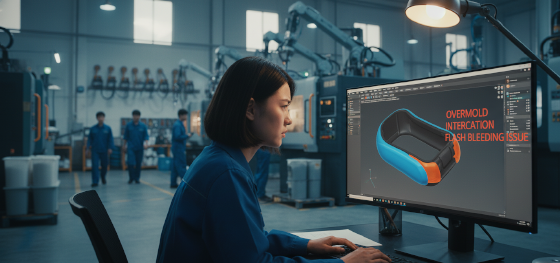
Establishing a retail-ready "Handshake" between disparate polymers requires moving beyond simple CAD surfaces. Every millimeter of your substrate geometry serves as a thermodynamic conductor and a mechanical barrier. The standoff of overmolding vs insert molding often boils down to how well your design manages the transition from a cold rigid core to a molten flexible skin. Jucheng Precision eliminates manufacturing doubt by performing a comprehensive geometric audit before a single grain of steel is etched. We look for "Bleed Zones" where thin elastomers might bypass the tool’s shut-offs and suggest "Anchor Points" to armor your design against high-torque use. This analysis provides the technical data needed to ensure your multi-material enclosures survive the laboratory and dominate the market shelf.
Mechanical Interlocks: Beyond the Chemical Bond
Thermodynamic Balance: Mastering Overmold Wall Thickness
Seam Discipline: Designing the Perfect Shut-off Step
Fluid Logistics: Strategic Gate Placement for Soft Resins
JUCHENG Protocol: The Forensic DFM Design Audit
Mechanical Interlocks: Beyond the Chemical Bond

Chemical adhesion is a science, but mechanical interlocking is an insurance policy. While many TPE/TPU materials are chemically compatible with ABS or Polycarbonate, relying purely on molecular fusion is a risky engineering strategy. Over time, exposure to skin oils, cleaning solvents, or extreme thermal cycling can degrade the chemical bond at the edges. Professional overmolding design guidelines mandate the use of physical traps to permanently shackle the soft resin to the rigid chassis. We recommend integrating "Dovetail Grooves" or "Wrap-around Edges" where the elastomer can physically tuck beneath the substrate's geometry. For high-stress grips, the "Through-Hole Rivet" technique is the undisputed champion; by allowing the overmold resin to flow through a hole in the substrate and solidify on the opposite side, you create a monolithic mechanical anchor that is impossible to remove without destroying the material itself. Jucheng Precision engineers analyze your CAD to identify "Peel-Risk" zones, suggesting these "Geometric Anchors" to ensure your hardware maintains its tactile integrity through years of intense field use.
Thermodynamic Balance: Mastering Overmold Wall Thickness
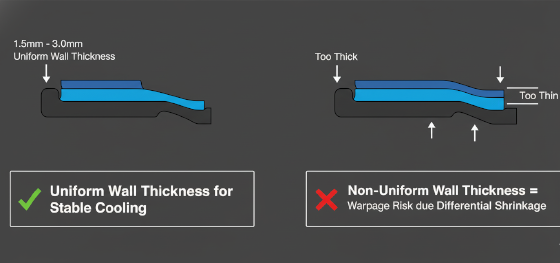
Thermodynamic stability in multi-material molding is dictated by the "Cooling Rate Differential." Designers often mistakenly vary the thickness of the soft overmold to create complex ergonomic shapes. In the uncompromising world of injection molding, this results in "Differential Shrinkage." A section of TPE that is 4mm thick will shrink significantly more than an adjacent 1.5mm section, pulling the entire part out of spec or creating massive internal voids. Elite overmolding design guidelines suggest maintaining an elastomer wall thickness between 1.5mm and 3.0mm. If your design requires a thicker grip, Jucheng Precision advocates for modifying the rigid substrate to create the shape, rather than adding bulk to the soft resin. By keeping the overmold wall uniform, you ensure that the second shot cools at a synchronized rate, preventing the warping and "Bubbling" that ruin the cosmetic soul of high-end consumer electronics. We don't just "cover" your skeleton; we engineer the thermal mass to ensure the skin fits perfectly and stays flat.
Seam Discipline: Designing the Perfect Shut-off Step

Manufacturing "Bleed" is the ultimate sign of amateur tool design. The most difficult challenge in overmolding is preventing the pressurized liquid resin of the second shot from leaking onto the "clean" areas of the substrate. This defect, known as "Flash," is usually the result of a vague, feathered transition between the two materials. A professional overmolding design guidelines approach mandates a "Sharp Step" or "Shoulder" shut-off. Instead of tapering the soft material to a zero-thickness edge, we design a 0.5mm to 1.0mm vertical wall on the substrate. This provides a hard surface for the mold steel to "pinch" against, creating a hermetic seal that prevents the melt from escaping. Jucheng Precision utilizes 5-axis CNC machining to ensure our mold shut-offs are accurate to within five microns. This surgical precision allows us to deliver prototypes with razor-sharp color boundaries, providing the visual authority your brand requires for marketing photography and investor demos. We turn "blurry seams" into "precision boundaries."
Fluid Logistics: Strategic Gate Placement for Soft Resins

Flow dynamics determine whether your overmolded prototype possesses a pristine surface or is marred by "Gate Blush" and weld lines. Because soft elastomers like TPE have high viscosities, the molten front cools rapidly as it travels through the narrow overmold cavity. If the gate is placed poorly, the plastic may "hesitate" or create air traps in critical ergonomic zones. Jucheng Precision utilizes Moldflow simulation to identify the optimal "Inlet Strategy." We generally recommend placing the gate in the thickest section of the overmold to allow for a "Progressive Fill." Furthermore, we avoid placing gates near critical cosmetic faces, utilizing "Sub-gates" or "Edge-gates" that are hidden within the assembly. This strategic logistics ensures that the "Melt Front" remains unified as it passes through your rib structures and around your mounting bosses, resulting in a monolithic skin that is free of the visual noise that signals a low-quality molding operation.
JUCHENG Protocol: The Forensic DFM Design Audit
Manufacturing excellence at Jucheng Precision is built on the foundation of the "Zero-Flash" mandate. We don't just "take orders"; we act as your manufacturing navigator. Our facility, housing over 150 CNC machines and elite multi-shot injection bays, is optimized for high-complexity Injection molding materials integration. When you upload a CAD file to our facility, our veteran engineers perform a comprehensive "Shut-off and Sink Audit." We identify the "Flash Highways" and "Thermal Hot Spots" that threaten your part's yield. We provide red-lined CAD suggestions—recommending a dovetail here or a step-joint there—to ensure your hardware arrives retail-ready. Stop gambling your R&D budget on designs that will inevitably delaminate or bleed. Not sure if your wall thickness is uniform or your shut-off design is optimal? Upload your 3D CAD file to JUCHENG today for a Free DFM Review. Our experts will identify overmolding vs insert molding risks before they cost you money, ensuring your transition from prototype to mass production is seamless, beautiful, and profitable.

