


Your product needs the strength and structure of a hard plastic. But it also needs the soft, comfortable grip of a rubber. Or it needs the durability of a metal thread. How do you combine these fundamentally different materials into one seamless, perfect part?
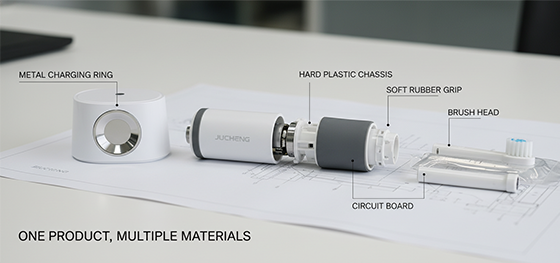
This is one of the most exciting challenges in modern product design. It is about creating hybrid parts that deliver the best of both worlds.
The world of Injection Molding offers two powerful solutions to this challenge. They sound similar, but they are very different processes with different goals. This is a guide to understanding the critical choice between overmolding vs insert molding.
The Goal: Adding a Second Material
Path A: Insert Molding - Giving Plastic a Metal Core
Path B: Overmolding - Giving Plastic a Soft Skin
Making the Right Choice for Your Design
The Goal: Adding a Second Material
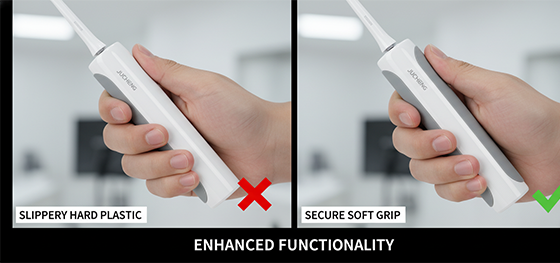
Why would you want to combine materials? The reason is always to add a function that the base plastic cannot provide on its own.
You might need to add a soft, ergonomic grip to a power tool handle. This improves user comfort and safety. You might need to add strong, durable metal threads to a plastic knob so it can be screwed on and off thousands of times without wearing out.
Or you might need to add electrical contacts to a sensor housing. In all these cases, a single material is not enough. You need a team of materials. Insert molding and overmolding are the two primary ways to build that team.
Path A: Insert Molding - Giving Plastic a Metal Core
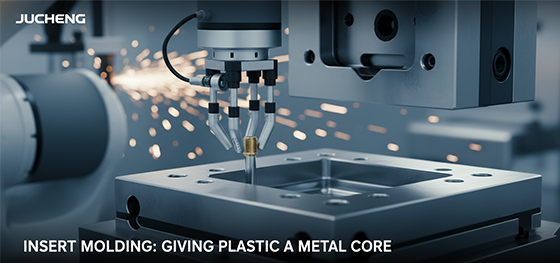
Insert molding is the process of putting a solid, pre-formed object (the "insert") into the mold before the plastic is injected.
The most common inserts are made of metal. Think of threaded brass nuts, stainless steel pins, or electrical contacts.
The process is simple in concept. The mold opens. A robot or a human operator places the metal insert onto locating pins inside the mold cavity. The mold closes. Then, the molten plastic is injected. It flows around the insert, completely encapsulating it.
The result is a single, solid part where the metal insert is now a permanent, integrated feature. The plastic holds the insert with incredible strength. This is an extremely robust and cost-effective way to create durable connection points on a plastic part.
Path B: Overmolding - Giving Plastic a Soft Skin
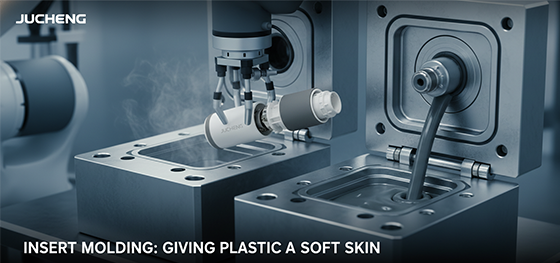
Overmolding is the process of molding one plastic over another. It is almost always used to add a soft, rubbery layer (the overmold) onto a hard, rigid plastic part (the substrate).
This is a two-step process. First, the hard substrate part is created using a standard Injection molding process. Then, this finished part is moved to a second, slightly larger mold.
A second injection molding machine then injects the soft material, usually a TPE or TPU, into the new mold. This soft material flows into the gap between the hard substrate and the new mold, forming the soft outer layer.
For the best results, the two materials must be chemically compatible. A good bond will be a chemical weld between the two plastics, making it impossible to peel them apart. In high-volume production, this is often done in a single machine with a rotating mold, a process called two-shot molding.
Making the Right Choice for Your Design

So, in the overmolding vs insert molding debate, which one is right for your design? The choice is driven by function.
Ask yourself: What am I trying to add to my plastic part?
If the answer is a hard, discrete component like a metal thread, a pin, a connector, or a magnet, then you need Insert Molding.
If the answer is a soft, seamless, ergonomic, or waterproof layer like a grip, a handle, or a flexible button, then you need Overmolding.
Both of these are advanced manufacturing techniques. They require expert knowledge in part design, mold design, and material compatibility. This is a field where working with an experienced partner like JUCHENG is not just helpful, it is essential for success. We can guide you through the complexities of multi-material molding to create a truly integrated and high-performance product.

