


The longest bottleneck in product development is often the tooling phase—the time and cost required to build the high-precision steel molds for Injection Molding. 3D Printed Rapid Tooling has emerged as a crucial technology, moving beyond simple prototyping to create functional elements of the mold itself. This strategic use of additive manufacturing significantly cuts lead time and cost, allowing for faster design iteration and product launch.
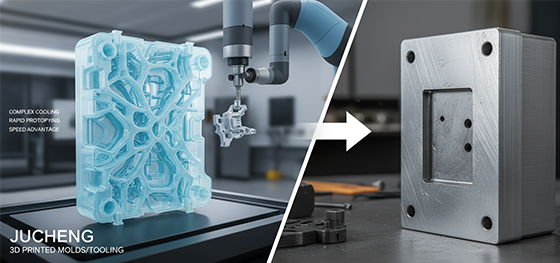
For B2B buyers, understanding these applications is key to optimizing the time-to-market strategy. This guide explores the three most impactful ways that 3D printing is used by professional manufacturers to enhance the efficiency, cooling, and functionality of traditional injection molds.
Strategy 1: Using Plastic 3D Prints for Low-Volume Prototype Molds
Strategy 2: Manufacturing Conformal Cooling Channels with Metal 3D Printing
Strategy 3: Creating High-Performance Metal Mold Inserts
Integrated Tooling Strategy: Combining Additive and Subtractive
Strategy 1: Using Plastic 3D Prints for Low-Volume Prototype Molds
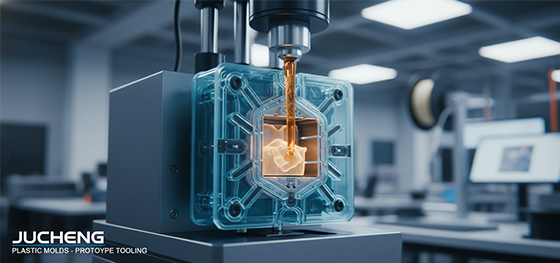
The fastest path to true Injection Molded parts is by using a 3D printed mold, typically made of high-temperature resin or robust engineering plastic:
The Application: This method is used to produce a very small batch (typically 10 to 100 parts) of the final material. It is ideal for final design validation, material testing, or limited-run samples before moving to steel tooling.
Speed and Cost: The turnaround time is drastically reduced—often days instead of weeks. The cost of the mold is orders of magnitude lower than a steel tool, making design iteration with molded parts feasible.
Material Limitations: Plastic molds can only withstand low injection pressures and are typically used with low-melt temperature materials like Polypropylene (PP) or Polyethylene (PE). They are unsuitable for glass-filled or high-temperature resins.
Strategy 2: Manufacturing Conformal Cooling Channels with Metal 3D Printing
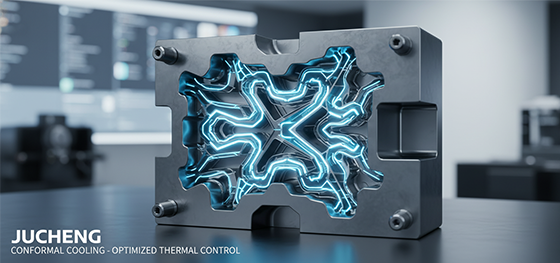
Uneven cooling is the primary cause of warpage, sink marks, and long cycle times in Injection Molding. Conformal cooling channels solve this by maximizing heat removal:
The Challenge: Traditional molds use straight-line drilled cooling channels, which cannot follow the complex contours of the part, leading to hot spots.
The 3D Print Solution: Metal 3D Printing (DMLS/SLM) can create complex, organic cooling channels that perfectly follow (conform to) the mold cavity's surface. This provides uniform cooling, drastically reducing cooling time (by up to 40%) and eliminating warpage.
Hybrid Tooling: The conformally cooled core or cavity is 3D printed in a high-conductivity metal (like Maraging Steel or AlSi10Mg) and then inserted into a traditionally CNC Machined mold base.
Strategy 3: Creating High-Performance Metal Mold Inserts
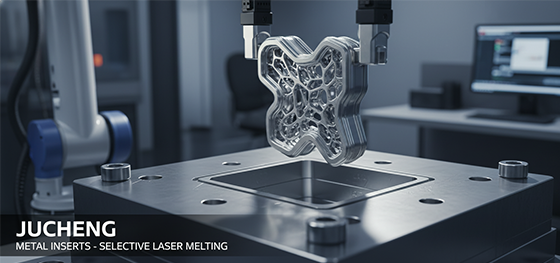
Metal 3D printing is also used to create specialized mold inserts that solve localized functional challenges in high-volume production:
Venting and Porosity: Inserts can be 3D printed with a controlled, porous structure. This allows trapped air to escape the mold cavity during injection (venting) without allowing molten plastic to escape, solving complex filling and flow issues.
Rapid Change Cores: For mold features that are likely to change frequently (such as dates, batch numbers, or slight design variations), 3D printed cores can be designed as low-cost, quick-change inserts that can be easily swapped out of the main mold base.
Low-Volume Tooling: For projects with lifetime volumes too high for a plastic mold but too low for a full steel tool, the entire core and cavity can be 3D printed in a durable aluminum alloy (AlSi10Mg), which bridges the gap in material longevity.
Integrated Tooling Strategy: Combining Additive and Subtractive
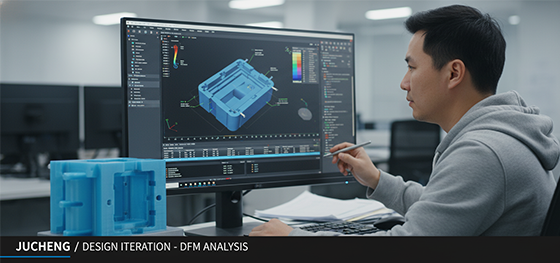
The most advanced 3D Printed Rapid Tooling strategies treat additive and subtractive manufacturing as complementary, rather than competing, processes:
Final Finishing: Metal 3D printed mold inserts often require a final, high-precision pass of CNC Machining on the sealing face or critical features to achieve the required surface finish (Ra value) and tight dimensional tolerances.
Hybrid Manufacturing: The main structure of the mold (the large H-plates and frame) is still produced efficiently via CNC Machining, while 3D printing is reserved for the complex, performance-critical elements (cooling and inserts).
DFM Integration: Working with a single provider that offers both 3D printing and CNC Machining ensures that the DFM (Design for Manufacturing) feedback loop is optimized for the entire hybrid tooling process, minimizing errors and delays.
3D Printed Rapid Tooling is essential for navigating the speed and complexity demands of modern manufacturing. Jucheng Precision Technology offers end-to-end expertise in leveraging metal and plastic 3D printing to create functional mold inserts and conformal cooling channels, drastically reducing cycle times and tooling costs.
Secure the efficiency of next-generation tooling. Contact us today to discuss the optimal hybrid tooling strategy for your Injection Molding prototypes and production runs.

