


While household super glue is used for emergency fixes, the world of B2B manufacturing relies on high-performance structural adhesives. Industrial Adhesive Bonding is a sophisticated engineering process that replaces traditional fasteners like screws, rivets, and welding, offering superior strength, lighter weight, and the ability to join dissimilar materials (like metal to plastic).
The shift to structural adhesives is a critical strategy in aerospace, electric vehicle manufacturing, and complex medical devices. Success requires not just the right glue, but expert control over surface preparation, automated dispensing, and curing. This guide explores the principles of structural bonding and the role of precision manufacturing in ensuring the adhesive joint is the strongest point of your assembly.
The Structural Role: Adhesives vs. Mechanical Fasteners
Choosing the Right Glue: Epoxy, Urethane, and Cyanoacrylate
Surface Preparation: The Mandatory Step for Maximum Bond Strength
DFM for Bonding: Designing Parts for Automated, Reliable Assembly
The Structural Role: Adhesives vs. Mechanical Fasteners

Structural adhesives are engineered to transfer operational stress across the entire bonded area, unlike mechanical fasteners (screws, rivets) which concentrate stress at a single point, often leading to localized material fatigue:
Stress Distribution: Adhesives create a uniform bond line, distributing stress evenly across the joint. This significantly increases the joint's fatigue life and allows for lighter-weight component design, a critical advantage in Aviation Aerospace.
Dissimilar Materials: Structural adhesives are essential for joining materials with different thermal expansion rates (like aluminum metal to plastic). The flexible bond line absorbs the differential movement caused by temperature swings, preventing cracking.
Sealing and Aesthetics: The adhesive joint naturally seals the assembly against moisture and environmental contaminants. Furthermore, the bond is invisible from the exterior, improving the aesthetic quality of the final product.
Choosing the Right Glue: Epoxy, Urethane, and Cyanoacrylate

The choice of structural adhesive depends on the required strength, flexibility, operating temperature, and assembly time:
Epoxies (Structural Adhesives): Two-part systems that offer the highest mechanical strength, chemical resistance, and wide temperature tolerance. Ideal for high-stress joints like motor mounts or structural chassis components. They require a long cure time or controlled thermal curing.
Urethanes (Urethane Adhesives): Offer greater flexibility than epoxies, making them ideal for large-area bonding and joints subjected to continuous vibration or flex. Common in automotive exterior panel bonding.
Cyanoacrylates (CAs or "Super Glues"): Offer extremely fast curing times but lower ultimate shear strength. Used primarily for rapid assembly, tacking, or non-structural light components.
Surface Preparation: The Mandatory Step for Maximum Bond Strength
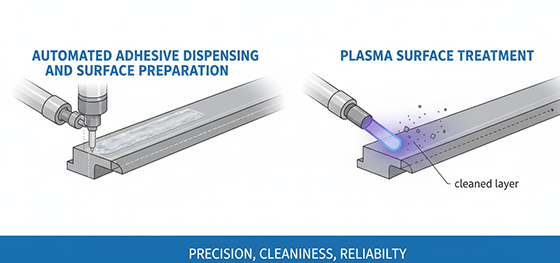
The maximum strength of the adhesive bond is determined entirely by the cleanliness and surface energy of the components being joined. Neglecting this step is the most common cause of adhesive failure:
Cleaning: All parts (whether CNC Machined metal or Injection Molded plastic) must be thoroughly cleaned to remove oil, mold release agents, and dust. Specialized solvents or plasma treatments are used for industrial-grade cleaning.
Surface Activation: For low surface energy plastics (like Polypropylene), the surface must be chemically activated (e.g., plasma or flame treatment) to allow the adhesive to wet the surface and form a chemical bond.
Mechanical Abrasion: For metal surfaces (Aluminum, Steel), light mechanical abrasion (sanding or grit blasting) can increase the surface area and create microscopic anchor points, significantly improving bond strength.
DFM for Bonding: Designing Parts for Automated, Reliable Assembly

Integrating structural adhesives requires Design for Manufacturing (DFM) adjustments to ensure the joint is robust and compatible with automated assembly:
Joint Design: Lap joints and scarf joints offer superior stress distribution over simple butt joints. The joint geometry must maximize the bonding area to achieve the highest possible shear strength.
Automated Dispensing: For high-volume assembly, adhesives are applied using robotic dispensing systems. The part design must include clear, accessible channels or grooves for the robotic nozzle to ensure uniform application and prevent excess material spill.
Component Tolerances: The parts (CNC machined or injection molded) must be manufactured to tight tolerances to ensure a consistent, minimal gap in the bond line, which is critical for achieving the adhesive's specified strength.
Industrial Adhesive Bonding is the future of lightweight, multi-material assembly. Jucheng Precision Technology offers end-to-end expertise in both component manufacturing (CNC Machining, Injection Molding) and post-process preparation (cleaning, activation, automated dispensing), ensuring the ultimate strength and reliability of your final assembly.
Secure lightweight, high-strength structural assemblies. Contact us today to discuss the optimal adhesive bonding strategy for your next complex component.

