


Navigating the "Valley of Death" in hardware development—the gap between a single 3D-printed prototype and a 10,000-unit mass production run—is the most dangerous financial phase for any robotics or MedTech startup. I have seen countless promising innovations stall because traditional injection molding factories reject orders under 2,000 units or demand six-figure tooling fees that drain the R&D budget. In the current competitive market, the distance between a concept and a field-ready fleet must be bridged with capital agility. Utilizing low volume RIM molding has emerged as the definitive solution for manufacturing 100 to 2,000 high-fidelity units without the crushing NRE costs of hardened steel tools. This process allows developers to launch commercial-grade custom reaction injection molding enclosures that possess the unyielding foundations of mass production but with the flexibility of a prototype.
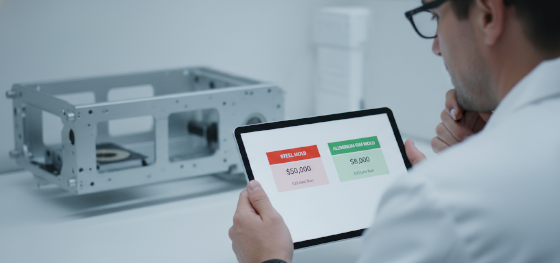
Mechanical integrity at the mid-scale depends on avoiding the "Prototype Look" that can ruin investor demos. When a potential buyer taps on a thin, 3D-printed shell and hears a hollow rattle, the perceived value of the machine evaporates. Jucheng Precision addresses these scaling hurdles by providing On-Demand Manufacturing solutions that utilize high-density polyurethane resins. Jucheng Precision leverages a massive fleet of 150+ CNC machines and 25 5-axis Haas/Mazak units to manufacture the oversized aluminum tools required for Small Batch Plastic Production. By offering a no MOQ policy, Jucheng Precision ensures that your innovation survives the scrutiny of the boardroom and the chaos of the field trials in our Shenzhen hub.
Operating under the global quality mandates of ISO 13485 and ISO 14001, Jucheng Precision acts as the high-tier manufacturing engine for global OEMs. We transform raw liquid chemistry into validated structural hardware in as fast as 15 business days, providing a seamless "Bridge to Production" for complex robotic and medical systems. This guide explores the essential economic sweet spots, the physics of low-stress curing, and the agile tooling strategies required for mastering low volume RIM molding to ensure your technology reaches the market on a lean and unyielding foundation.
content:
The Valley of Death: Why Standard Molding Fails Small Batches?
Technical Data: Comparing Tooling Costs for 100 to 2,000 Units
Agile Tooling: How to Pivot Design Mid-Production Batch?
Scaling Strategy: Moving from 50 Units to 5,000 Parts Seamlessly
FAQ: Real Answers for Lead Times, Sizing, and ROI Modeling
The Valley of Death: Why Standard Molding Fails Small Batches?

Hardware development cycles are often derailed by the binary choice between slow additive manufacturing and high-cost mass production. In the context of low volume RIM molding, this gap is the primary decision driver for procurement leads. I’ve personally seen medical startups spend their entire seed round on a single steel injection mold, only to find a design flaw after the first 100 units. Traditional injection molding requires massive clamping forces and multi-cavity steel tools that are financially ruinous for quantities under 3,000. RIM technology offers a strategic escape from this trap. Because the liquid resin fills the mold at less than 100 psi, Jucheng Precision can produce parts up to 2.5 meters in length using lightweight aluminum tooling that is 70-80% cheaper than steel.
What is the maximum quantity for low volume RIM molding?
While it is ideal for 100 to 2,000 units, the process remains competitive up to 5,000 units for oversized parts where the tooling savings outweigh the piece-price difference.
Structural consistency is the second pillar of the RIM advantage. During a 500-unit Beta trial, every unit must behave identically to provide valid data for your AI algorithms. 3D printing often suffers from batch-to-batch variation and anisotropic weakness along the layer lines. Jucheng Precision utilizes machine-controlled impingement mixing to ensure 100% molecular cross-linking for every part. When I hold a finished RIM fender, the solid density and surface uniformity tell me it’s a production part, not a prototype. This unyielding integrity is essential for industrial robot parts that must handle 24/7 stress cycles without the surface "Chalking" or cracking found in lower-quality resins.
Dimensional stability of the finish is the final aesthetic defense. Traditional painted plastics often outgas, leading to bubbles under the clear coat after a few thermal cycles. Because Jucheng Precision perform vacuum degassing on all liquid components before injection, our parts are 100% dense with zero internal air pockets. This eliminates the surface imperfections that could harbor pathogens in medical environments. By delivering hardware with integrated visual stability, Jucheng Precision ensures your diagnostic scanner or autonomous robot looks as professional on its 500th day as it did on day one, effectively securing the long-term ROI of your hardware investment.
Technical Data: Comparing Tooling Costs for 100 to 2,000 Units

Success in hardware optimization depends on the numbers. If your design assumes the scaling efficiency of a 10,000-unit run but you only need 500 units, your project is financially unviable. Jucheng Precision provides free DFM analysis in 24 hours to help your team find the breakeven point between different molding paths. The following table compares the typical financial variables for a 1.2-meter robotic shell across three different manufacturing tiers.
| Cost Factor | 3D Printing (Industrial) | Low Volume RIM | Injection Molding |
|---|---|---|---|
| Initial NRE Cost | $0 | $5,000 - $12,000 | $60,000 - $150,000+ |
| Lead Time to T1 | 2 - 3 Days | 15 - 20 Days | 60 - 90 Days |
| Unit Price (500 units) | Maximum ($$$$) | Moderate ($$) | Lowest ($) |
| Surface Quality | Rough / Layered | Class-A Mirror | Excellent |
The data proves that low volume RIM molding is the "Sweet Spot" for R&D scaling. While 3D printing is faster for one piece, the piece price never drops, making a 500-unit run financially impossible. Injection molding offers a lower piece price but the tooling debt takes years to pay off. Jucheng Precision’s aluminum RIM tools are engineered to deliver up to 10,000 shots with zero dimensional drift, effectively acting as your permanent production bridge. This capital agility allows our clients to invest their resources in critical software and sensor improvements rather than idle manufacturing infrastructure in the Shenzhen hub.
Agile Tooling: How to Pivot Design Mid-Production Batch?
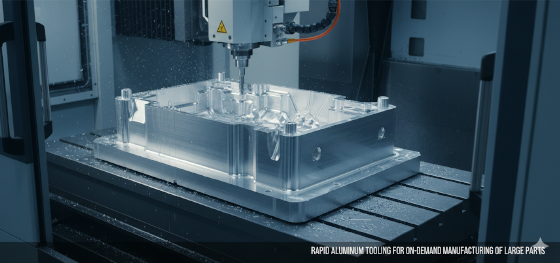
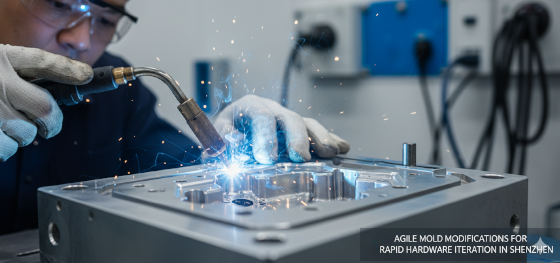
Design changes between Alpha 1 and Alpha 2 trials are a statistical certainty in high-tech robotics. In the context of low volume RIM molding, the ability to modify the tool is just as valuable as the initial speed. Aluminum molds used in the Jucheng hub offer a level of agile tooling that hardened steel cannot match. If a field trial reveals that an internal mounting boss needs to move by 20mm to accommodate a new LiDAR sensor, Jucheng Precision can weld new aluminum onto the mold face and re-machine the feature in our CNC bay within 48 hours. This flexibility ensures that your hardware evolves at the same pace as your code, providing a clear path to market for innovative designs.
Can I change the material stiffness mid-run?
Yes. One of the greatest benefits of the RIM process is the ability to adjust the chemical recipe to change the part from "Rigid ABS-like" to "Flexible PP-like" using the same aluminum tool.
Complexity management is also more affordable in aluminum. For large enclosures with undercuts or integrated cable exits, the mold must move in multiple directions. Jucheng Precision utilize 25 5-axis Haas/Mazak units to machine the mechanical slides and cam-actions required for these complex tools. We ensure that the parting lines and ejector pins are located in non-aesthetic zones, resulting in parts that possess the seamless perfection of high-end consumer electronics. By managing these complex design guidelines in-house, Jucheng Precision provides a single point of accountability for your hardware's entire visual and structural identity, ensuring your pilot fleet is delivered calibrated and ready for power-up.
Internal stress relief of the tool itself is managed through specialized aging cycles. Large aluminum blocks can possess residual stresses from the forging process. Before the critical parting lines and seal tracks are finished, Jucheng Precision performs thermal stabilization on the mold bases. This ensures that the precision foundations achieved in our Shenzhen hub remain stable over thousands of shots. By delivering "Statistically Reliable" tooling, Jucheng Precision ensures that part #100 of your Beta fleet is identical to part #1, providing the geometric evidence required for ISO 13485 and IATF 16949 compliance in the global market.
Scaling Strategy: Moving from 50 Units to 5,000 Parts Seamlessly
The most effective way to manage production risks is to utilize low volume RIM molding as a Bridge to Production. In this scenario, Jucheng Precision manufactures your first 500 units using rapid aluminum tooling while your high-volume hardened steel tool is still being built in parallel. This strategy allows you to begin revenue-generating operations months earlier, effectively paying for your production tooling using the cash flow from your initial launch. For a 2-meter long medical housing, this bridge eliminates the three-month "Hardware Void" where a company has a validated design but no parts to sell to its first customers.
How to ensure the first 5,000 parts are 100% consistent?
Utilize automated high-pressure RIM machinery and in-house digital metrology to track the "Geometric DNA" of every batch produced in our Shenzhen facility.
Material simulation is the second pillar of the bridge strategy. Jucheng Precision formulate polyurethane resins that mimic the exact Shore D hardness, flexural modulus, and impact strength of your intended mass-production plastic, whether it is ABS, PC, or Polypropylene. This ensuring that the user experience is identical whether the part came from a RIM tool or an injection mold. By delivering high-fidelity hardware early, you can secure early-adopter testimonials and finalize your medical device prototyping validation data, providing a solid foundation for your full commercial rollout. Jucheng Precision’s Shenzhen hub is optimized for this high-velocity production, ensuring your innovation stays ahead of the competition.
Operating under ISO 14001 environmental standards, Jucheng Precision ensures that your scaling strategy remains sustainable. Our RIM process operates at 80% lower energy levels than high-heat injection molding, supporting the ESG goals of modern global corporations. We provide a single point of accountability for your hardware needs, from the initial CAD review to the final 4-day rapid delivery of your validated Alpha units. This integrated approach minimizes the logistical risks of your hardware launch, ensuring your innovation survives the transition from concept to commercial success. Contact our Shenzhen factory today for a complete DFM review and build the unyielding foundation your autonomous fleet requires.
FAQ: Real Answers for Lead Times, Sizing, and ROI Modeling
Is the piece price higher in low volume RIM molding?
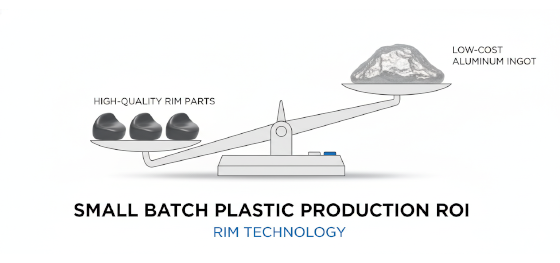
Yes, the per-part cost is higher than injection molding, but the 80% reduction in tooling costs makes it the more profitable choice for under 2,000 units.
What is the typical lead time for a 1-meter aluminum RIM tool?
Aluminum rapid tools of this size are typically completed and delivering T1 samples in 15 to 20 business days.
Can I order just 10 units with zero setup fee?
We have No MOQ, but a small setup fee applies to cover machine calibration and chemical purge to ensure part purity.
How do you handle shipping for 2-meter fragile prototypes?
Jucheng Precision provide custom-fitted wooden flight cases with internal shock-dampening for all international shipments to prevent transit damage.
Does JUCHENG provide the testing reports for regulatory compliance?
Yes. We provide full dimensional CMM reports and material physical property logs for every medical and automotive production batch.
Tooling debt and long lead times are absolute innovation killers for high-end robotic and medical systems. Partnering with Jucheng Precision ensures that your functional iterations are built with the cost-effective polyurethane reaction injection molding and specialized low volume RIM molding knowledge the industry demands. Reach out to our Shenzhen manufacturing hub today for a complete DFM review and build the unyielding foundation your autonomous fleet requires.

