


Biological contamination is an invisible adversary that destroys clinical viability before a product ever leaves the factory floor. When a hardware engineer finalizes the blueprint for an implantable sensor housing, a surgical fluidic manifold, or an invasive catheter component, the physical dimensions of the part are secondary to its hygienic purity. A microscopic dust particle or a trace aerosol of hydraulic oil embedded in the polymer matrix acts as a Trojan Horse, capable of harboring pathogens or triggering severe immune responses in a patient. Navigating this demand for absolute sterility requires the strategic deployment of Medical device cleanroom injection molding. This uncompromising manufacturing environment treats the ambient air as a controlled substance, stripping away the chaotic variables of standard industrial production. Jucheng Precision operates an elite, contamination-free sanctuary within the Shenzhen precision manufacturing hub, providing the technical depth to deliver pristine hardware that satisfies the most brutal regulatory audits. Within the broader framework of Medical Robotics Manufacturing, we bridge the gap between heavy industrial engineering and clinical sterility, ensuring your devices arrive at the hospital safe, sealed, and legally defensible.
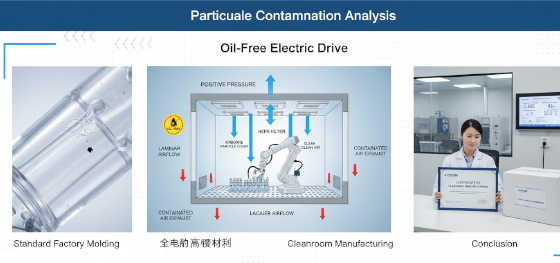
Establishing a failure-proof medical supply chain in 2026 demands the rejection of the standard job shop. Amateurs attempt to mold healthcare components on the same dirty floor where they mold automotive bumpers, relying on post-production washing to fix embedded impurities. This is a strategy for FDA rejection. Jucheng Precision eliminates this risk by building the defense directly into the facility architecture. From HEPA-filtered positive pressure ventilation to full robotic handling, every square inch of our medical bay is designed to exclude human and mechanical debris. This guide deconstructs the physics of particulate control, the mechanical necessity of all-electric presses, and why our cleanroom protocol is the mandatory foundation for anyone developing invasive or fluid-contact hardware.
Atmospheric Defense: Defining ISO Class 8 Cleanroom Standards
Mechanical Purity: Why All-Electric Presses Are Mandatory
Touch-Free Execution: Robotic Extraction to Prevent Bioburden
Material Vulnerability: Processing LSR and Optical Grade PC
JUCHENG Protocol: Environmental Monitoring and ISO 13485 Traceability
Frequently Asked Questions: Cleanroom Injection Molding
Atmospheric Defense: Defining ISO Class 8 Cleanroom Standards
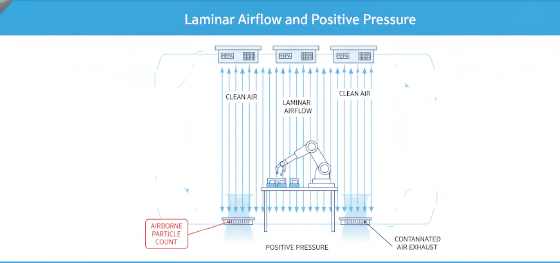
Atmospheric isolation is the foundational pillar of sterile manufacturing. A standard factory environment contains millions of microscopic particles per cubic meter—dust, pollen, skin cells, and exhaust fumes. An ISO Class 8 cleanroom (formerly known as Class 100,000) operates under a strict legal threshold: it must maintain a maximum of 100,000 particles (size 0.5 micrometers or larger) per cubic foot of air. Jucheng Precision achieves this atmospheric sovereignty through a continuous cycle of forced filtration. High-Efficiency Particulate Air (HEPA) filters located in the ceiling push purified air down over the injection molding machines in a laminar flow. Crucially, the entire room operates under "Positive Pressure." This means the air pressure inside the cleanroom is higher than the corridors outside. If a door is opened, the clean air rushes outward, acting as an invisible physical barrier that prevents dirty factory air from entering the sterile zone. We don't just clean the room; we engineer a continuous atmospheric shield that protects your molten polymers from the chaotic reality of the outside world.
Mechanical Purity: Why All-Electric Presses Are Mandatory

Hydraulic fluid is the silent enemy of biocompatibility. Traditional injection molding machines rely on hundreds of gallons of pressurized hydraulic oil to drive the clamping toggles and the injection screw. Over time, these hydraulic lines weep, atomizing microscopic droplets of oil into the air. If these droplets settle on the mold surface or are drawn into the resin hopper, the resulting plastic part is chemically compromised and fundamentally unsterilizable. Our medical cleanrooms exclusively utilize All-Electric injection molding machines. Driven by high-precision servo motors rather than fluid pumps, these machines operate with zero oil leaks, zero aerosolized mist, and significantly lower particulate generation from mechanical wear. Beyond the hygiene benefits, all-electric presses offer sub-micron control over the injection velocity profile, allowing us to mold complex, thin-walled surgical instruments without the pressure spikes that cause flash or material degradation. We prioritize mechanical cleanliness, ensuring the hardware producing your parts is as sterile as the parts themselves.
Touch-Free Execution: Robotic Extraction to Prevent Bioburden

Human operators are the greatest source of contamination in any cleanroom. A single touch from a gloved hand can transfer bioburden—viable microorganisms—onto a surgical implant. To mitigate this biological risk, Jucheng Precision implements a "Touch-Free Execution" protocol. We integrate 6-axis cleanroom-rated robotic arms directly into the injection cell. The moment the mold opens, the robot swiftly extracts the hot plastic component, maneuvers it over a specialized cooling fixture, and places it directly into a sterile thermoformed blister pack or a medical-grade Tyvek bag. The packaging is sealed within the ISO Class 8 environment before a human ever interacts with the payload. This automated logistics chain eliminates the risk of human error, skin-cell shedding, and handling damage. We turn the unpredictable nature of manual labor into a predictable, sterile, and highly efficient robotic ballet, delivering hardware that is clinically ready the moment you break the seal.
Material Vulnerability: Processing LSR and Optical Grade PC

Certain super-polymers are essentially magnets for contamination. Liquid Silicone Rubber (LSR), used extensively for biocompatible seals and respiratory masks, is highly susceptible to particulate inclusion because it cures slowly and has a sticky, tacky nature before vulcanization. Similarly, optical-grade Polycarbonate (PC) used for diagnostic lenses will amplify the visual impact of a single 50-micron dust speck, turning it into a light-scattering flaw that ruins photometric data. Processing these vulnerable materials outside of a cleanroom is a guarantee of massive scrap rates. Our cleanroom infrastructure is specifically designed to support these sensitive chemistries. We utilize closed-loop, desiccant-dried vacuum loading systems that transport resin pellets from sealed bags directly to the machine barrel without ever exposing them to ambient air. We protect the molecular purity of your USP Class VI resins from the moment they arrive on our dock until they are cured into your final medical device.
JUCHENG Protocol: Environmental Monitoring and ISO 13485 Traceability

Manufacturing excellence is built on the foundation of continuous, verifiable data. We do not just claim our cleanrooms are sterile; we prove it second by second. Jucheng Precision employs digital environmental monitoring systems that track airborne particle counts, ambient humidity, and temperature 24/7. This environmental data is logged and tied directly to the production batch record of your parts. Under our ISO 13485 certification, we provide full material lot traceability, ensuring that every diagnostic housing or surgical tool can be traced back to its specific cleanroom shift, operator, and raw material batch. Stop gambling your FDA approval on dirty factory floors. Leverage our decade of cleanroom replication mastery to validate rapidly, launch safely, and scale profitably. Contact our technical team today for a free DFM review and see how we can turn your digital healthcare intent into a sterile, structurally sovereign physical reality.
Frequently Asked Questions: Cleanroom Injection Molding.

Question: What is the difference between an ISO Class 7 and ISO Class 8 cleanroom?
Answer: ISO Class 7 (Class 10,000) is ten times cleaner than ISO Class 8 (Class 100,000), allowing fewer airborne particles. Jucheng Precision typically utilizes Class 8 for molding medical device enclosures and Class 7 for highly invasive or implantable components.
Question: Does cleanroom molding increase the cost of the plastic parts?
Answer: There is a marginal increase in the hourly machine rate to cover the high energy costs of the HEPA filtration HVAC systems and sterile garment protocols, but this is offset by the massive reduction in rejected, contaminated parts.
Question: Do I need cleanroom molding for external medical cart panels?
Answer: Generally, no. Large exterior panels that do not contact patients or fluids are usually produced via standard or RIM molding. Cleanroom environments are reserved for fluid paths, optics, implants, and sterile surgical tools.

