


Selecting the ideal outer barrier to isolate a folded carbon steel enclosure from aggressive atmospheric moisture is a critical milestone in custom sheet metal fabrication. Specifying powder coated sheet metal provides your custom brackets, electrical cabinets, and electronic chassis with an exceptionally tough, impact-resistant finish that far outperforms standard liquid coatings. This dry finishing process utilizes electrostatic forces to apply a uniform layer of protective polymers, creating an integrated shell that prevents rust and retains a professional aesthetic over decades of service.

Wasting money on wet-painted panels that chip, scratch, and corrode around mounting bolts is a major setback for industrial hardware rollouts. Thin liquid paint easily runs along vertical edges, leaving microscopic metal areas exposed to humidity. Transitioning to a dry electrostatic spray system completely eliminates these coverage gaps, delivering a thick, consistent layer of protective polymer even on complex, multi-bent panels.
Let's examine the physical process of dry electrostatic deposition and thermal crosslinking, explore why low-carbon alloys require this heavy-duty protection, and review how aggressive sandblasting prepares the raw plate for maximum paint adhesion.
The Powder Coating Process Explained
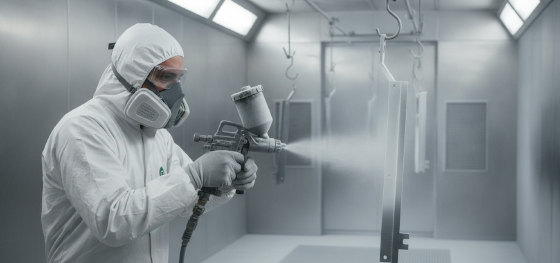
How do dry polymer powders bond and solidify into a hard shell on flat sheets?
The process relies on electrostatic attraction to hold dry powder onto grounded metal, followed by high-temperature baking to melt and chemically crosslink the polymers into a continuous coat.
The process utilizes specialized spray guns to impart a positive electrostatic charge onto dry polymer powder particles. These particles typically consist of thermosetting polymers such as epoxy, polyester, or polyurethane. Because the grounded steel plate attracts the charged cloud, the electrostatic charge ensures that the dry powder clings uniformly across all vertical flanges, sharp corners, and deep recesses.
To achieve a perfect finish, the standard powder coating workflow must follow a strict, multi-stage sequence on the production floor:
Surface Preparation: The bare metal undergoes alkaline degreasing and chemical etching to remove mill oils.
Electrostatic Application: Grounded parts are sprayed with positively charged polymer powders in a clean-room booth.
Thermal Curing: Coated parts are transferred to curing ovens heated to 180 to 200 degrees Celsius.
Crosslinking Reaction: Intense thermal energy melts the dry powder, causing the polymers to flow together and lock.
Why Mild Steel Requires Powder Coating
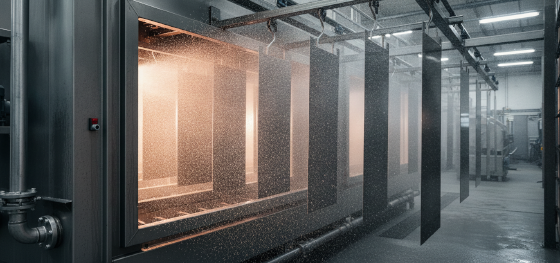
Why is a protective paint layer mandatory for raw low-carbon carbon steel brackets?
Low-carbon steel contains no chromium to build a self-healing passive oxide, exposing the bare metal to rapid atmospheric rust if left uncoated.
To maintain the long-term structural integrity of raw steel parts, understanding why standard mild steel requires powder coated sheet metal protection is vital. While mild carbon steel is highly popular due to its excellent structural stiffness and low cost, it is highly prone to oxidation. Exposure to simple air humidity initiates localized rust that can quickly eat through thin structural walls.
Applying a tough polymer shell completely seals the raw iron from surrounding moisture and oxygen. To ensure a lifetime bond, we first run our raw parts through a multi-stage chemical wash that degreases the metal and applies an iron phosphate conversion coating. This crystalline layer etches the steel surface, providing a highly receptive anchoring foundation for the subsequent polymer spray.
Powder Coating vs. Wet Painting
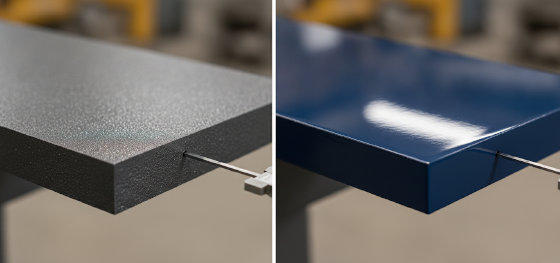
When should a product designer select liquid painting over dry powder systems?
Choose dry powder for industrial brackets requiring extreme impact resistance and thick coatings; select liquid painting for heat-sensitive components, ultra-thin tolerances, or custom Pantone color matching.
Evaluating the differences between dry powder and wet painting reveals distinct mechanical and dimensional properties. Powder systems typically build a thick layer of 60 to 120 microns, providing superior impact resistance and complete coverage over sharp edges. Additionally, because powder coating uses no liquid solvents, it releases zero volatile organic compounds (VOCs), making it highly environmentally compliant.
The physical performance differences between these two common surface finishes dictate their structural suitability:
| Finishing Metric | Electrostatic Powder Coating | Traditional Wet Painting |
|---|---|---|
| Standard film thickness | 60 to 120 microns (Thick protection) | 15 to 30 microns (Thin-film precision) |
| Impact & Scratch Resistance | Outstanding (Resists heavy tooling scratches) | Moderate (Highly prone to chipping) |
| Environmental Compliance | Excellent (Zero VOC emissions) | Poor (Contains hazardous organic solvents) |
| Color & Texture Variety | Wide (Textured, wrinkle, matte, gloss) | Unlimited (Exact custom Pantone matches) |
Preparing the Metal: The Role of Sandblasting
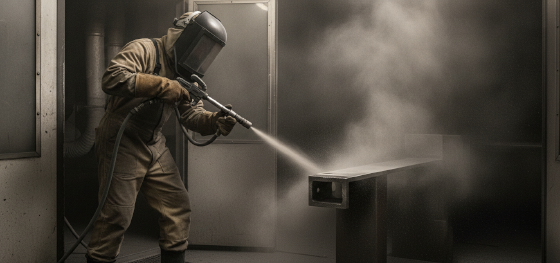
Why is physical sandblasting essential before applying electrostatic powder paint?
Sandblasting removes thick oxide scale, mill rust, and surface contaminants while creating a controlled roughness to mechanically lock the paint layer.
Applying electrostatic spray onto a raw steel plate covered in mill scale is a recipe for paint failure. When a design is modeled without removing this oxidation layer, the final dry coat cannot bind securely to the steel core, causing premature peeling. We utilize high-pressure abrasive media to strip away these contaminants before we paint.
To prepare the surface, we utilize professional sandblasting equipment. Blasting the metal with high-velocity aluminum oxide or garnet media completely strips away mill scale, rust, and surface contaminants. This abrasive impact also creates a microscopically rough profile, providing a mechanical "tooth" that locks the cured polymer layer tightly to the steel body, preventing paint peeling.
High-Quality Custom Powder Coating at Jucheng Precision
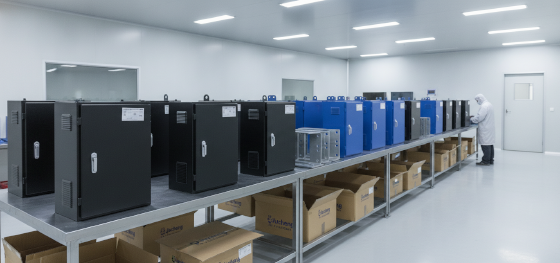
How does Jucheng Precision manage high-durability, cosmetic paint coatings?
We operate advanced, clean-room spray booths and high-capacity curing ovens integrated into our fabrication workflow, checking all alignments before paint.
Integrating this highly resilient, electrostatic sheet metal surface treatment into your turnkey fabrication flow is the single most effective way to eliminate logistical bottlenecks and double-handling shipping bills. Jucheng Precision houses these advanced spray and baking lines inside our 8000-square-meter facility, ensuring that your parts are cut, folded, and completely finished under one roof with extreme quality control.
We process a wide range of materials, including lightweight aluminum, high-yield stainless steel, and easily formable carbon steel during high-precision sheet metal fabrication cycles. Our technical department provides a 24-hour free DFM analysis to check your CAD models, checking tolerances and hinge clearances before production. Supported by our no MOQ policy and rapid delivery guarantee, we manage your project from initial flat pattern cutting to final, high-durability powder coating and assembly.
FAQ: Critical Questions About Powder Coated Sheet Metal
Our engineering team has compiled professional solutions to the most common quality challenges faced during industrial finishing runs:
What causes paint bubbling or "orange peel" defects, and how do we prevent them?
Orange peel refers to an irregular, wavy paint texture that resembles the skin of an orange, typically caused by improper electrostatic current levels, applying the powder too thick, or incorrect oven temperature profiles. We prevent these defects by continuously calibrating our automatic spray guns, monitoring powder thicknesses, and managing oven heat curves in real time.Can galvanized steel panels be powder coated successfully?
Yes, but galvanized sheets require outgassing pre-treatments. The zinc layer on galvanized steel naturally traps micro-bubbles of gas. If you bake the part without preheating, these gases will escape during polymer curing, causing pinholes and bubbles. We preheat all galvanized parts to release these gases before applying the dry powder, preventing outgassing issues.How do you protect mounting holes and threaded PEM hardware from being clogged with paint?
A thick polymer layer will easily clog internal threads, making screw assembly impossible. To protect critical mounting holes and threaded studs, our finishing team utilizes high-temperature silicone plugs and masking caps before spraying. These masks are removed after baking, delivering clean, paint-free threads ready for immediate assembly.How does Jucheng Precision prevent surface defects and maintain coating adhesion?
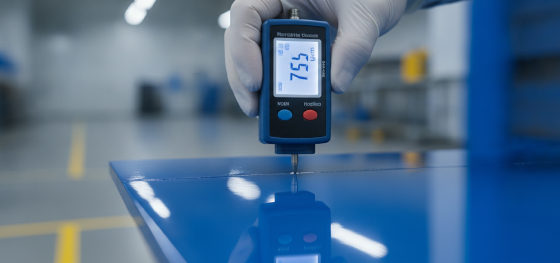
We execute rigorous quality control gates across our finishing line, utilizing advanced cross-hatch adhesion testing (ASTM D3359) to verify polymer bonding and prevent any risk of paint peeling under impact. Our technicians measure film thicknesses using digital magnetic gauges, ensuring that every finished component meets your strict cosmetic and mechanical durability requirements.

