


Watching an autonomous mobile robot (AMR) navigate the high-traffic aisles of a modern fulfillment center reveals the silent mechanical stress placed on its exterior: every turn and sudden stop fights against inertia and the risk of collision. In the diverse landscape of Reaction Injection Molding Application Industries, the demand for hardware that is both feather-light and "Tank-Tough" has never been higher. Standard plastics often shatter or deform permanently when a 200kg robot strikes a warehouse rack, leading to expensive downtime and sensor misalignment. Mastering Reaction Injection Molding for Robotics is the essential strategy for developers who need to protect high-value AI compute stacks while extending battery life through bionic lightweighting.

Mechanical resilience in next-generation automation depends on the material's ability to dissipate energy rather than simply resisting it. Hand-poured resins or thin-walled injection molded parts lack the molecular cross-linking density required for high-cycle industrial use. Jucheng Precision addresses these critical hardware hurdles by providing high-tier Polyurethane Molding Services that utilize low pressure molding liquid dynamics. Jucheng Precision delivers components that feel solid and substantial—possessing a deep "Thud" when tapped—yet weigh 40% less than traditional solid panels. Our Shenzhen hub serves as the high-velocity engine for global robotics OEMs, transforming complex designs into validated, field-ready armor in as fast as 15 business days.
Operating under the global quality mandates of ISO 13485 and ISO 14001, Jucheng Precision acts as the structural engineering partner for the autonomous revolution. Jucheng Precision transforms raw liquid chemistry into high-fidelity Large Scale Plastic Parts, leveraging a fleet of 150+ CNC machines to manufacture the high-tolerance aluminum tools required for Reaction Injection Molding for Robotics. This guide explores the mobility challenges of battery-powered systems, the technical requirements for sensor encapsulation, and the field durability standards necessary to ensure your robotic innovation secures its market window without the burden of hardware failure.
content:
Mobility Challenge: How to Save Battery Life with Lightweight Panels?
Technical Data: Comparing Density and Impact Resistance for Robots
Encapsulation Logic: Protecting LiDAR and AI Brains from Shock
Field Reliability: Why RIM Elastomers Survive Real-World Collisions
JUCHENG Hub: Integrating Metal Frames and Harnesses in Shenzhen
FAQ: Real Answers for Sizing, Weight, and Impact Performance
Mobility Challenge: How to Save Battery Life with Lightweight Panels?

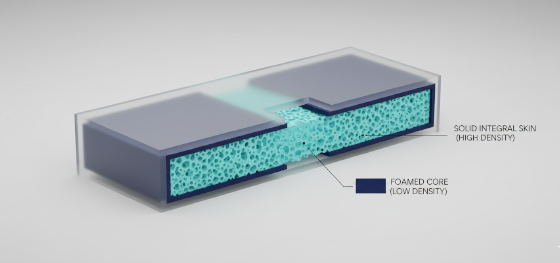
Parasitic weight is the primary enemy of operational uptime for any battery-powered machine. In the application of Reaction Injection Molding for Robotics, the ability to create microcellular polyurethane RIM structures provides a massive advantage for mobile platforms. By adding a blowing agent to the liquid resin, Jucheng Precision creates parts with a dense, unyielding skin and a lightweight, energy-absorbing core. Holding a 1.5-meter long panel in our Shenzhen lab, I am always struck by how it possesses the rigidity of a thick plastic board but the weight of a thin shell. This mass reduction directly translates into lower motor current-draw, allowing your robots to run for two extra hours per charge.
Can foamed RIM parts handle structural loads?
Yes. The "Sandwich Structure" of an integral skin part provides exceptional bending stiffness, allowing the enclosure to support internal electronics and battery brackets without a separate metal sub-chassis.
Laminar flow during the injection phase ensures that these lightweight panels maintain a Class-A surface finish. Traditional high-pressure foaming often results in "Silver Streaks" or surface pockmarks that require hours of hand-sanding. Jucheng Precision utilize 25 5-axis Haas/Mazak units to machine intricate venting channels into our aluminum molds. This allows the air to escape ahead of the expanding resin, resulting in a mirror-smooth surface that is ready for high-gloss automotive painting or custom branding. By delivering hardware that is "Aero-Industrial" in performance, we help our clients build sleeker, faster robots that dominate the fulfillment and logistics sectors.
Thermal expansion stability is the final pillar of the lightweighting strategy. Many lightweight plastics "grow" or buckle when exposed to the heat of a 24/7 operating motor. Jucheng Precision’s RIM polyurethanes are thermoset materials, meaning they are molecularly cross-linked and do not exhibit the same thermal creep comparison failures as thermoplastics. This ensuring that your robot’s panels remain perfectly aligned and rattle-free even after a full shift in a hot warehouse environment. By providing "Statistically Stable" hardware, Jucheng Precision allows your engineering team to focus on the software while the chassis handles the physics of motion.
Technical Data: Comparing Density and Impact Resistance for Robots
Success in hardware validation depends on the data. If your design assumes the toughness of aluminum but you receive the properties of brittle plastic, your field trial will fail. Jucheng Precision provides full material characterization reports to help your engineering team validate their material choices. The following table compares the essential performance metrics of Reaction Injection Molding for Robotics materials against standard industrial alternatives for the current global market.
| Mechanical Metric | Elastomeric RIM (Jucheng) | Molded ABS | Molded Polypropylene |
|---|---|---|---|
| Specific Gravity (g/cm³) | 0.95 - 1.10 | 1.05 - 1.15 | 0.90 - 0.95 |
| Elongation at Break (%) | 150 - 400 | 10 - 40 (Brittle) | 50 - 150 |
| Flexural Modulus (psi) | 50,000 - 300,000 | 300,000 | 180,000 |
| Damping Capacity | Exceptional | Low | Moderate |
The "Damping Capacity" data highlights why RIM is the preferred choice for medical device prototyping requiring robotic assistance. High-frequency vibrations from gearboxes can interfere with sensitive cameras and ultrasound sensors. Our elastomeric RIM formulations act as a shock-proof cocoon, absorbing mechanical noise before it reaches the robot's AI nerves. By delivering hardware that provides its own vibration isolation, Jucheng Precision helps you achieve the "Mechanical Silence" that defines a premium autonomous system.
Encapsulation Logic: Protecting LiDAR and AI Brains from Shock
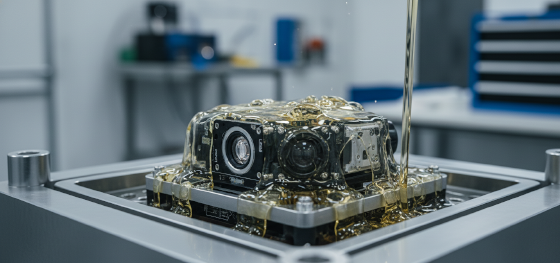
Hardware security for high-value autonomy stacks is often compromised at the mounting joint. If a sensor is simply screwed into a thin plastic shell, every bump on the warehouse floor causes microscopic jitter that confuses the vision software. Jucheng Precision addresses this by utilizing Insert molding and encapsulation in RIM. Because the RIM process happens at low pressure (less than 100 psi), we can safely overmold delicate sensors and PCBs directly into the structural polyurethane skin. This creates a monolithic, shock-proof block where the sensor is "Grown" into the machine, providing a level of Hermetic Sealing and vibration resistance that bolted assemblies cannot replicate.
How to prevent moisture from leaking around sensors?
Jucheng Precision utilize specialized chemical bonding agents on sensor housings to ensure the polyurethane creates a watertight seal at the molecular level, surviving high-pressure cleaning.
Internal cable routing is also optimized through encapsulation. Jucheng Precision can mold internal "Veins"—hollow channels for multi-strand wiring harnesses—directly into the robot's limb or chassis. This protects the "Robotic Nerves" from external abrasion and prevents them from snagging on obstacles during operation. By consolidating the routing, the structural skeleton, and the sensory skin into a single Polyurethane Molding Services cycle, we eliminate dozens of failure points and reduce your total assembly time in our Shenzhen facility, providing a true "Ready-to-Assemble" solution for your innovation.
Precision registration of these encapsulated items is handled by our 150+ CNC machines capacity. We machine hardened steel pins within the aluminum mold to lock every sensor mount and bolt-hole in place with +/- 0.05mm accuracy. This ensures that your LiDAR unit will sit at the perfect angle every time, with no manual shimming required. This "Geometric Certainty" is essential for medical device prototyping where the concentricity between a surgical robot arm and its vision system dictates the clinical safety of the procedure. We provide the unyielding foundations your autonomous fleet requires.
Field Reliability: Why RIM Elastomers Survive Real-World Collisions

Collision events are a statistical certainty for autonomous machinery. Whether it is a "Fender-Bender" in a warehouse or a rock-strike in a vineyard, the material's failure mode dictates the downtime of the robot. In the application of Reaction Injection Molding for Robotics, Jucheng Precision utilize simulating Polypropylene with elastomeric RIM to achieve unbreakable toughness. Unlike standard plastics that shatter into sharp shards, our elastomeric polyurethanes possess a high "Elongation at Break" (up to 400%). When an impact occurs, the material flexes to absorb the energy and then snaps back to its exact CAD geometry, protecting the internal electronics and keeping the robot in service.
Can RIM parts handle extreme cold?
Yes. Unlike standard PP or ABS that becomes brittle at freezing temperatures, our RIM formulations maintain their impact toughness down to -40 degrees Celsius, making them ideal for cold-storage robotics.
Surface "Self-Healing" is a unique benefit of Jucheng’s elastomeric RIM. I’ve seen our robot bumpers take deep scratches from gravel and then "Close Up" over time as the molecular cross-links relax. This environmental resilience ensures that your prototype robot units maintain their high-end brand image throughout a three-month field trial. Jucheng Precision apply VDI 3400 textures directly to the mold surface to further enhance this scratch-resistance, providing a matte-finished, ruggedized skin that hides the inevitable scuffs of industrial labor. This level of durability is why our parts are the preferred choice for heavy-duty AgTech hardware and outdoor logistics scouts.
Chemical immunity is the final layer of field reliability. Autonomous robots are frequently exposed to corrosive oils, greases, and cleaning agents. Standard injection-molded parts suffer from environmental stress cracking when exposed to these chemicals under tension. Because Jucheng Precision’s RIM parts cure in a relaxed state at low pressure, they possess zero internal stress. Combined with our inert chemical recipes, this ensuring that your hardware survives thousands of washdown cycles without a single hairline fracture, a mandatory requirement for ISO 13485 compliance in healthcare robotics.
JUCHENG Hub: Integrating Metal Frames and Harnesses in Shenzhen

Dominating the large-format hardware market requires a partner that doesn't just mold plastic, but integrates complex mechanical systems. Jucheng Precision operates with a 24/7 manufacturing mindset in our Shenzhen precision manufacturing hub, delivering high-tolerance RIM components and structural industrial robot parts with industry-leading speed. Jucheng Precision provide a "Bridge to Production" that ensures your innovations move from concept to pilot run with 100% metallurgical and dimensional confidence. Jucheng Precision provide No MOQ, allowing you to source 1 to 5 units for initial sensor validation without the crushing cost of mass-production tools.
Integrating your structural design with Jucheng Precision’s expertise ensures that your Reaction Injection Molding Application Industries decision is based on performance data, not guesswork. Jucheng Precision offer comprehensive DFM reviews within 24 hours, identifying potential thermal-expansion risks or machining bottlenecks in your design before they become field failures. Whether you are building an autonomous medical assistant or a heavy-duty industrial mobile base, Jucheng Precision provides the rigid, precise, and *chemically optimized* foundations that keep your innovation moving through the high-speed cycles and the years of hard labor.
The facility is equipped with dedicated high-pressure RIM assembly cells and dedicated quality labs, allowing Jucheng Precision to manage the entire hardware lifecycle in one location. Jucheng Precision manage the complexity of multi-material bonding and automotive-grade finishing so your engineering team can focus on the motion control and the AI. By combining Shenzhen's speed with industrial-grade material verification and global quality standards, Jucheng Precision remains the preferred partner for the world's most aggressive hardware challenges. Contact the Shenzhen hub today to start your next 4-day rapid delivery project.
FAQ: Real Answers for Sizing, Weight, and Impact Performance
What is the maximum part size for a robotic RIM shell?
We regularly produce monolithic structural fenders and hoods up to 2,500mm in length with consistent wall thickness.
How do you handle the mounting of heavy motors in RIM parts?
We encapsulate large aluminum or steel mounting plates directly into the resin for unyielding torque resistance.
Can Jucheng Precision provide EMI shielding for robotic enclosures?
Yes. We apply conductive silver or nickel-based sprays to the internal skin of our RIM parts to meet EMC standards.
Is the piece price higher than injection molding?
For quantities under 2,000 units, the total project cost is 60-80% lower than injection molding due to the massive savings on aluminum tooling.
What is the typical lead time for a fleet of 20 Alpha prototypes?
From final CAD to delivered parts, the typical lead time is 15 to 20 business days in our Shenzhen facility.
Mechanical instability and high tooling debt are absolute innovation killers for high-end robotic systems. Partnering with Jucheng Precision ensures that your functional iterations are built with the unyielding polyurethane reaction injection molding and specialized Reaction Injection Molding for Robotics knowledge the industry demands. Reach out to our Shenzhen manufacturing hub today for a complete DFM review and build the unyielding foundation your autonomous fleet requires.

