


Kinetic inertia remains the silent predator of high-speed surgical autonomy. In the hyper-agile operating rooms of 2026, a robotic arm that is over-engineered with heavy 316L stainless steel suffers from sluggish micro-movements, excessive motor strain, and dangerous momentum during emergency stops. For MedTech innovators, the primary adversary is no longer software latency—it is the physical mass of the structural skeleton. Navigating this requirement for extreme strength-to-weight ratios requires the strategic deployment of Titanium machining for surgical robots. This elite metallurgical discipline provides components that possess the yield strength of hardened steel while slashing the mass penalty by forty-five percent. Furthermore, titanium exhibits an unparalleled indifference to human tissue and aggressive hospital sterilization chemicals. Jucheng Precision operates as a high-fidelity manufacturing sanctuary in the Shenzhen precision manufacturing hub, providing the 5-axis CNC depth needed to conquer this notoriously difficult alloy. Within the broader framework of Medical Robotics Manufacturing, we bridge the gap between "aerospace strength" and "clinical sovereignty," ensuring your mechanical joints and effector linkages perform with zero backlash and zero bio-rejection.
Establishing a resilient surgical supply chain demands the absolute rejection of "General Purpose" machining logic. Amateurs often treat a block of titanium like a standard piece of aluminum, ignoring its disastrously low thermal conductivity. Attempting to cut this metal without specialized carbide tooling and high-pressure coolant strategies guarantees that the heat will destroy the cutter, work-harden the part surface, and induce microscopic residual stresses that ruin the bearing tolerances. Jucheng Precision eliminates these "Machining Disasters" by enforcing a strict "Cold-Cut" protocol across our 150+ machine campus. Whether you are developing a bionic hip replacement actuator or a micro-scale laparoscopic scissor, our facility provides the material science and metrological rigor required for FDA and CE Mark market entry. This guide deconstructs the physics of titanium heat generation, the clinical necessity of Grade 5 selection, and why JUCHENG’s "Zero-Contamination" protocol is the mandatory foundation for anyone developing life-critical hardware.
Mass Reduction: The Strategic Advantage Over Stainless Steel
Biological Integration: Decoding Grade 2 vs. Grade 5
Thermal Isolation: The Physics of Titanium Machining Heat
Coolant Warfare: Mastering Through-Spindle Hydrodynamics
JUCHENG Protocol: ISO 13485 Traceability for Exotic Alloys
Frequently Asked Questions: Titanium Surgical Hardware
Mass Reduction: The Strategic Advantage Over Stainless Steel
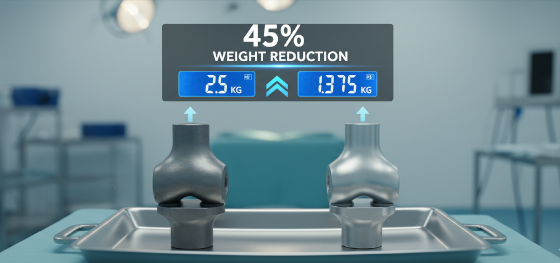
Structural efficiency dictates the motor selection and power draw of the entire robotic system. When engineers calculate the "Moment of Inertia" for a fast-moving robotic wrist, the density of the component material is the dominant variable. While 316L stainless steel provides excellent corrosion resistance, its density (8.0 g/cm³) acts as a massive anchor. Titanium operates at a density of roughly 4.4 g/cm³. By switching to titanium, a 2-kilogram robotic linkage instantly drops to 1.1 kilograms. This 45% mass reduction allows the robot to accelerate faster, stop on a dime without shaking, and utilize smaller, cooler-running harmonic drives. Furthermore, titanium exhibits "Paramagnetism," meaning it is largely unaffected by magnetic fields. This allows surgical robots equipped with titanium effectors to operate flawlessly in close proximity to active MRI machines without becoming a dangerous projectile or interfering with the imaging telemetry. We don't just "cut weight"; we enable a higher tier of bionic agility.
Biological Integration: Decoding Grade 2 vs. Grade 5
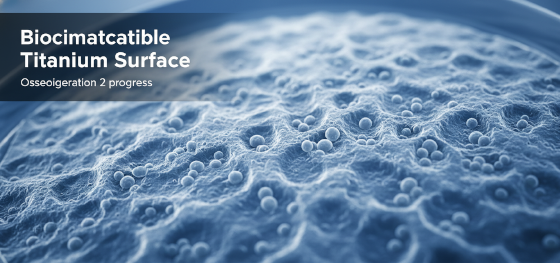
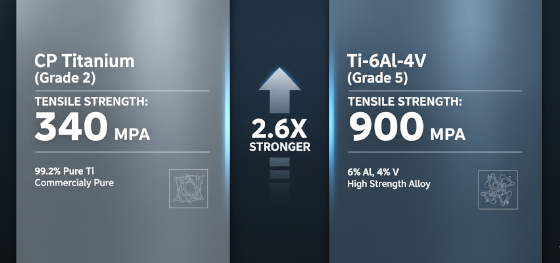
Chemical purity governs the material's relationship with the human immune system. Not all titanium is created equal. Commercially Pure (CP) Titanium, known as Grade 2, is unalloyed. It is highly ductile, extremely biocompatible, and actively promotes "Osseointegration"—the direct structural connection between living bone and the metal surface. Grade 2 is the undisputed king of permanent implants like bone screws and pacemaker housings. However, its yield strength (around 340 MPa) is insufficient for load-bearing robotic arms. For the structural joints and high-torque actuators of a surgical robot, Jucheng Precision exclusively machines Titanium Grade 5 (Ti-6Al-4V). This alloy, infused with 6% Aluminum and 4% Vanadium, pushes the yield strength to an astonishing 880+ MPa. It retains the biocompatibility necessary for operating room use while providing the rigid, indestructible spine needed for a machine that must repeatedly exert precise force on human tissue. We navigate the "Strength vs. Purity" matrix to ensure your hardware is clinically appropriate.
Thermal Isolation: The Physics of Titanium Machining Heat
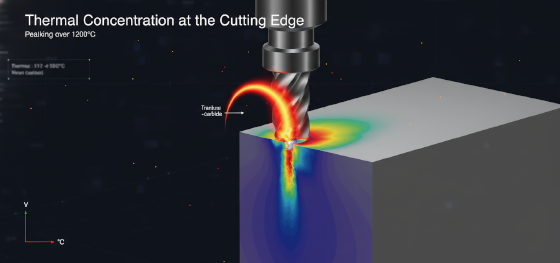
Thermodynamic hostility is the primary reason machine shops fail at titanium. Metals like aluminum and brass are excellent thermal conductors; when a CNC end-mill cuts them, the heat generated by the friction dissipates quickly into the surrounding metal block and the chips flying away. Titanium is an incredible thermal insulator. It stubbornly refuses to absorb the heat of the cut. Consequently, up to 80% of the cutting heat is concentrated directly onto the edge of the cutting tool. If an amateur shop runs the spindle too fast, this concentrated heat (often exceeding 800°C) will instantly melt the carbide cutter, weld the titanium to the tool, and cause "Work-Hardening" on the part surface. Once the surface work-hardens, the next pass of the tool will shatter. Jucheng Precision engineers eliminate this "Thermal Trap" by utilizing specialized, positive-rake cutting tools running at very low surface speeds (SFM) but high feed rates (Chipload). We cut the metal before it has time to realize it's being heated, preserving the microscopic integrity of your bearing seats and mounting flanges.
Coolant Warfare: Mastering Through-Spindle Hydrodynamics
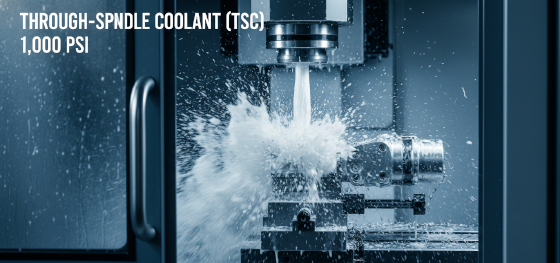
Fluid dynamics must overpower thermal accumulation. Because titanium traps heat at the cutting edge, external "flood" coolant systems are often useless; the boiling coolant creates a vapor barrier that prevents fresh liquid from reaching the tool. Jucheng Precision combats this by deploying 5-axis machines equipped with 1,000 PSI Through-Spindle Coolant (TSC) systems. We blast specialized, mineral-free synthetic cutting fluids directly *through* the center of the tool bit. This high-velocity hydraulic jet shatters the vapor barrier, instantly quenching the cutting edge and violently evacuating the sticky titanium chips before they can be re-cut. This "Coolant Warfare" ensures that your robotic joints are machined with an SPI-level surface finish (Ra < 0.4µm), free of the thermal smearing or microscopic galling that would otherwise act as a sanctuary for bacterial growth.
JUCHENG Protocol: ISO 13485 Traceability for Exotic Alloys
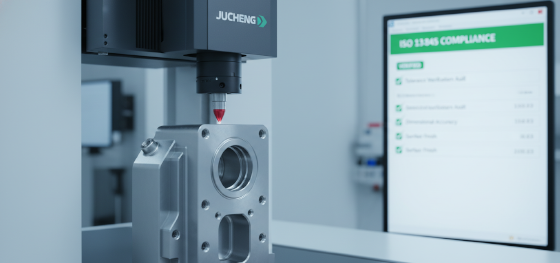
Manufacturing excellence at Jucheng Precision is built on the foundation of the documented pedigree. We recognize that an "Aerospace Grade" titanium billet is worthless in the medical sector without a verifiable audit trail. Our facility operates under a strict ISO 13485 quality management system, providing full material lot traceability and Certificate of Analysis (COA) records for every batch of Grade 5 alloy we process. We maintain dedicated "Medical-Only" CNC bays to ensure zero cross-contamination from non-biocompatible metals. Stop gambling your high-stakes surgical launch on machine shops that treat titanium like a generic metal. Leverage our decade of thermal and subtractive mastery to validate rapidly, scale responsibly, and maintain a zero-defect supply chain. Contact our technical team today for a free DFM review. Our experts will identify the optimal machining roadmap for your brand, ensuring your transition from prototype to clinical trial is seamless, compliant, and structurally invincible.
Frequently Asked Questions: Titanium Surgical Hardware
Question: What tolerances can JUCHENG hold on a Grade 5 Titanium robotic joint?
Answer: Utilizing our rigid 5-axis CNC centers and stringent thermal control, we routinely hold concentricity and diameter tolerances of +/- 0.005mm (0.0002") to ensure zero backlash in harmonic drive assemblies.
Question: How do you ensure the titanium surface is medically safe after machining?
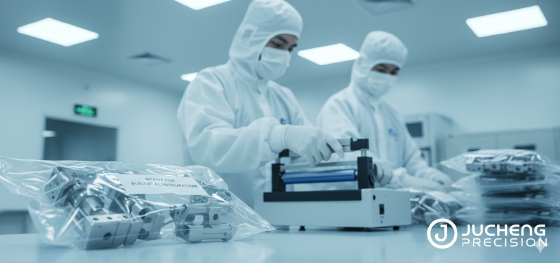
Answer: We employ a strict ultrasonic cleaning and chemical passivation protocol (using nitric or citric acid) to remove any free iron deposited by the cutting tools, restoring the natural, biocompatible titanium oxide layer.
Question: Is it possible to 3D print titanium instead of machining it?
Answer: Yes. Jucheng Precision offers DMLS (Direct Metal Laser Sintering) for titanium, which is ideal for complex, organic "bionic" structures that are impossible to CNC machine. However, critical bearing surfaces will always require secondary CNC finishing for tight tolerances.

