
Custom Sheet Metal Designs: From Prototype to Production
Views: 1 Author: Allen Xiao Publish Time: 2026-06-25 Origin: Site


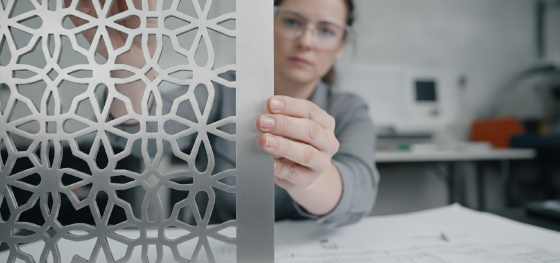
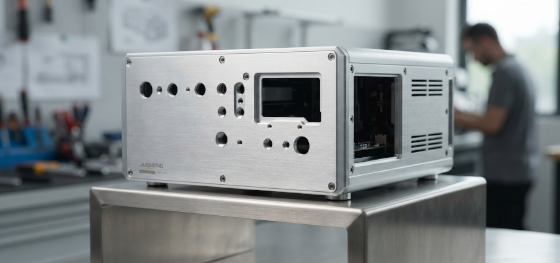
Escaping the geometric limitations of off-the-shelf components is the first major milestone in modern product development. Developing custom sheet metal designs allows engineering teams to construct bespoke components that fit precise physical footprints, optimize internal thermal convective airflow, and manage structural loads without wasting space. For hardware developers in high-growth sectors, this structural customization is the key to building lightweight, durable, and commercially viable hardware.
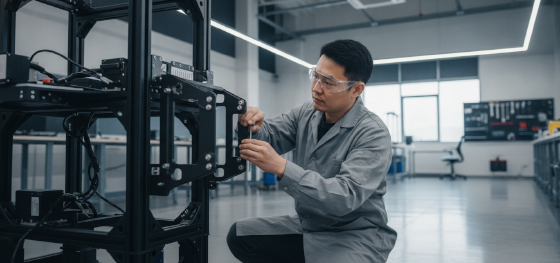
Relying on standard catalog brackets often compromises your product's physical footprint, forcing you to design complex, unnecessary workarounds that increase assembly times. Standard enclosures also lack the precise mounting configurations needed for modern PCB tracks and advanced sensors. Moving to a tailored, cold-worked sheet metal strategy provides complete design freedom, ensuring that your external housing integrates seamlessly with your internal electrical components.
Let's analyze how custom metalwork optimizes advanced medical and robotic assemblies, explore how rapid prototyping allows you to test geometries quickly, and review the best strategies to scale your designs from first articles to low-volume production.
content:
The Rise of Bespoke Sheet Metal in Medical and Robotics
Rapid Prototyping: Testing Your Custom Design Quickly
Seamless Scaling to Low-Volume Manufacturing
JUCHENG: Your Premier Partner for Custom Sheet Metal Projects
FAQ: Critical Questions About Custom Sheet Metal Designs
The Rise of Bespoke Sheet Metal in Medical and Robotics
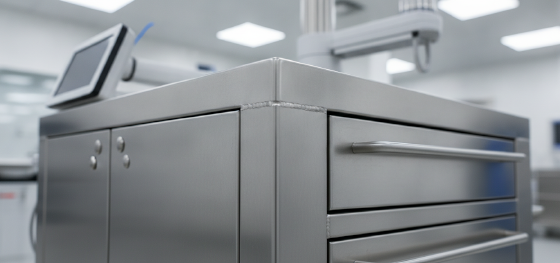
Why do medical and robotics developers avoid standard catalog brackets?
Medical and robotic hardware demands extremely high spatial efficiency, specific anti-corrosion properties, and robust EMI shielding that only custom-formed panels can provide.
Integrating specialized components into complex medical devices and autonomous machines requires a profound reliance on custom sheet metal designs. A standard rectangular casing is highly cost-effective, but robotic systems demand bespoke components with complex geometries to protect sensitive sensor arrays and high-torque motors. We design custom robotic chassis frames that maximize internal volume while resisting heavy outdoor vibrations.
In the healthcare sector, sterile hygiene is paramount. Standard plastics are highly prone to surface cracking under chemical disinfectants. To meet strict sanitation rules, we fabricate bespoke medical housings and carts from high-grade stainless steel or aluminum. These materials feature smooth, non-porous surfaces that can withstand continuous high-pressure washes and chemical sterilization without rust.
Rapid Prototyping: Testing Your Custom Design Quickly
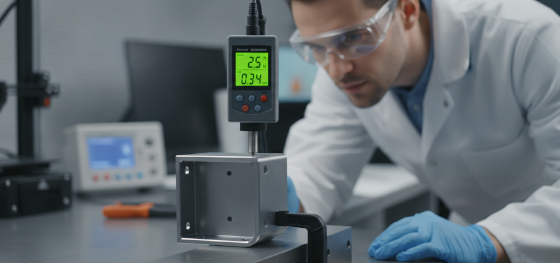
How do designers validate custom sheet metal geometries before mass production?
We execute software-driven rapid prototyping to cut flat blanks and bend flanges without expensive custom tooling, allowing for immediate geometric adjustments.
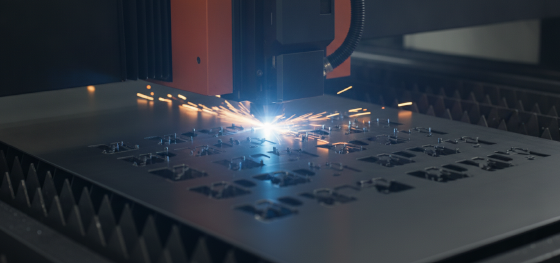
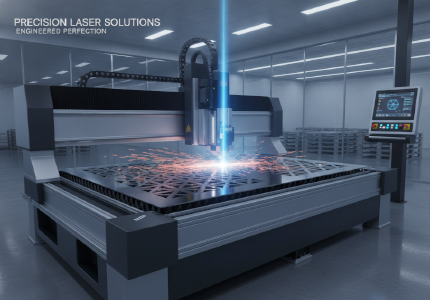
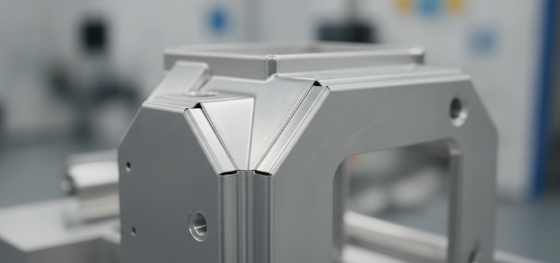
Before committing significant capital to mass production, validating your physical part geometry is essential. Our rapid prototyping cell utilizes high-power fiber lasers and CNC press brakes to slice and fold custom parts directly from your CAD profiles. This software-driven process bypasses the need for custom stamping dies, keeping initial test costs exceptionally low.
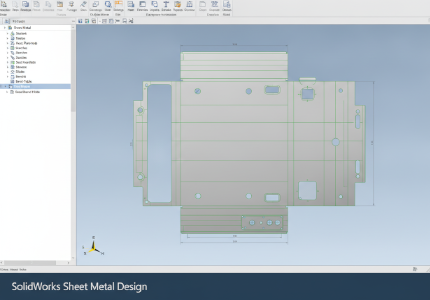
This hands-on prototyping phase allows designers to verify actual material behavior, check for flange-to-edge clearances, and run physical fitment tests. If a mounting hole is misaligned by a fraction of a millimeter, we can correct the digital flat pattern instantly. This iterative loop ensures that your custom parts are fully optimized for manufacturability before scaling.
Seamless Scaling to Low-Volume Manufacturing
What is the most cost-effective path to scale custom assemblies from prototypes to production?
We transition parts to low-volume manufacturing using modular tooling and progressive nesting, minimizing raw material waste and setup times.
When your custom hardware moves from first articles to ongoing production, managing the unit cost becomes the primary design driver. Running laser cutting and CNC bending is perfect for batches under 100 units. However, once you scale, transitioning to automated low-volume manufacturing ensures that you achieve high consistency and low per-piece costs.
We manage this transition by utilizing modular tooling and high-speed CNC punching presses. This structural scalability ensures that your custom components are fabricated with zero dimensional drift between batches. By reusing the flat CAD layouts verified during the prototyping phase, we ensure that your low-volume production units match the physical characteristics of your approved prototypes.
JUCHENG: Your Premier Partner for Custom Sheet Metal Projects
How does JUCHENG guarantee tight tolerances and clean cosmetic finishes on bespoke metal parts?
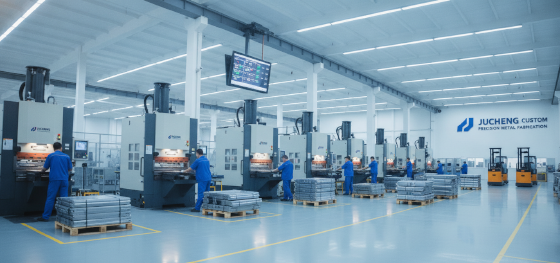
We operate high-power fiber laser cutters, CNC press brakes, and automated insertion lines managed by skilled technicians, checking all alignments before assembly.
Integrating these structural parameters, modular interfaces, and custom finishes into your early sheet metal design cycle is the single most effective way to eliminate production defects. JUCHENG integrates these advanced geometric and material validations into our digital manufacturing network, ensuring that your CAD files translate into fully finished, durable custom brackets with extreme dimensional precision.
We process a wide range of raw sheets, including lightweight aluminum, high-yield stainless steel, and formable carbon steel, matching each to its mathematically calculated springback allowances. Our technical department provides a 24-hour free DFM analysis to check your CAD models, checking tolerances and tool clearances before production. Supported by our no MOQ policy and rapid delivery guarantee, we manage your project from initial flat pattern cutting to final packaging and assembly.
FAQ: Critical Questions About Custom Sheet Metal Designs

Why is anodizing preferred over powder coating for custom aluminum robotics parts?
Anodizing is an electro-chemical process that grows an integrated oxide layer directly on the aluminum surface, providing extreme wear resistance and custom metallic colors without adding physical thickness. Powder coating applies a thick, plastic layer that can chip off under heavy friction and can alter the tight tolerances of interlocking robotic joints.
How do you design a custom stainless steel medical enclosure to resist aggressive chemical corrosion?
We recommend utilizing medical-grade SUS316 stainless steel, which contains molybdenum to resist chemical pitting. After fabrication, we run the parts through chemical passivation washes to remove any embedded iron particles, restoring the chromium oxide passive layer to ensure maximum corrosion resistance.
What causes bend line cracking during the prototyping of high-strength alloys?
Cracking occurs when a tight bend is executed parallel to the rolling grain direction of the plate, or when the inner radius is set below the material's physical limits. We prevent this during our nesting phase by orienting all major bend lines perpendicular or diagonal to the grain, and maintaining a generous minimum bend radius.
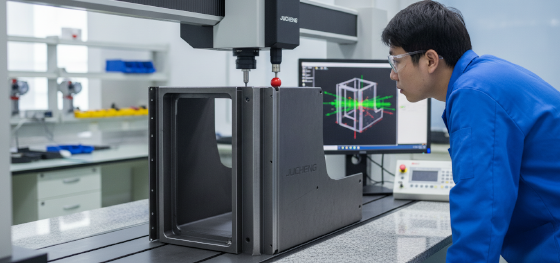
How does JUCHENG prevent tolerance errors in high-precision custom sheet metal designs?
Our quality control department checks every custom model during our complimentary DFM stage. If your design features slots that are too close to a bend, or flanges that are too short to form safely, we suggest clear modifications like adding relief slots or adjusting tolerances, delivering high-precision, ready-to-assemble custom components.

ㆍPrivacy: We respect your privacy. Here you can find an example of a non-disclosure agreement. By submitting this form, you agree to our terms & conditions and privacy policy.
