


Securing high-traffic commercial sites, critical infrastructure, and upscale architectural projects demands a major departure from flimsy traditional wire mesh. Utilizing heavy-gauge panels allows facility managers to achieve unmatched anti-climb safety, complete visual privacy, and a modern, high-end aesthetic that stands up to severe vandalism. However, placing large solid barriers outdoors introduces complex aerodynamic forces that can easily rip anchors out of concrete foundations if the structure is poorly engineered.
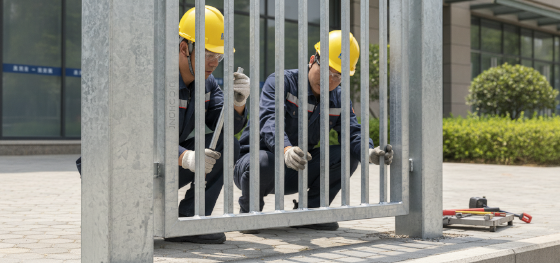
Traditional wooden and vinyl barriers suffer from rapid weathering, rotting, and cracking under intense UV exposure and seasonal temperature swings, leading to high maintenance costs. Transitioning to a rugged, cold-worked steel framework completely eliminates these cyclic degradation issues, providing a permanent security shield that remains structurally flat and visually pristine over decades of harsh outdoor service.
Let's examine why modern solid panels are rapidly replacing old-school fencing, analyze how custom laser perforation balances privacy with extreme wind loads, and review the specialized powder finishes required to survive continuous coastal humidity.
content:
Why Sheet Metal is Replacing Traditional Fencing
Using Laser Cutting for Custom Fence Patterns
Weatherproofing: Galvanized Steel and Powder Coating
Large-Scale Sheet Metal Fabrication at JUCHENG
FAQ: Critical Questions About Sheet Metal Fence Designs
Why Sheet Metal is Replacing Traditional Fencing
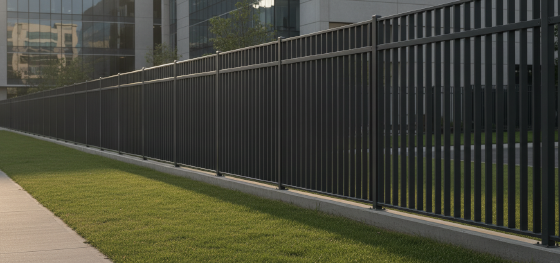
What makes flat metal panels superior to traditional chain-link or wooden barriers?
Flat metal panels provide absolute visual privacy, a solid barrier that is virtually impossible to climb or cut with hand tools, and a premium modern appearance.
Integrating custom geometry and geometric stability into exterior boundaries has driven a massive surge in modern sheet metal fence designs across both commercial and industrial developments. While chain-link fencing is cheap, it offers zero privacy and is easily breached with standard bolt cutters. Wood and composite slats warp over time, losing their color and requiring constant staining.
A solid metal barrier resolves these structural weaknesses. By utilizing cold-rolled or hot-dip coated steel plates, we construct rigid, modular panels that absorb high impacts without denting or twisting. This provides a strong physical and psychological deterrent, keeping secure facilities, storage yards, and utility substations completely safe from unauthorized entry.
Using Laser Cutting for Custom Fence Patterns
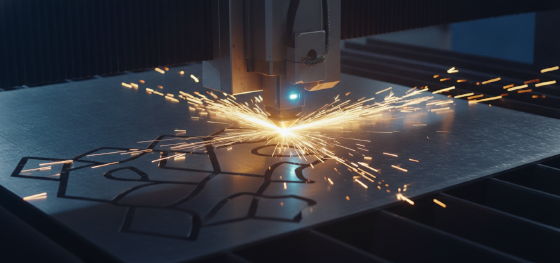
How do customized laser patterns balance visual privacy with extreme wind resistance?
Laser cutting allows us to design precise geometric slots and perforations that let wind pass through safely, reducing the lateral drag on structural posts while preserving privacy.
When engineers evaluate sheet metal fence designs for wind resistance, they must analyze the aerodynamic drag coefficient. A solid, unperforated metal sheet acts as a giant sail in high winds. During seasonal storms, the massive lateral pressure can easily warp the panels or snap the anchor bolts out of their concrete footings, leading to structural failures.
We resolve this aerodynamic risk by utilizing high-precision fiber laser cutting to create custom open patterns. Designing a series of geometric slots, repeating slats, or abstract organic shapes allows high-velocity wind to flow through the panel smoothly. By maintaining an engineered balance of 30% to 50% open area, we drastically cut wind drag while keeping the interior of your facility shielded from direct sightlines.
Weatherproofing: Galvanized Steel and Powder Coating
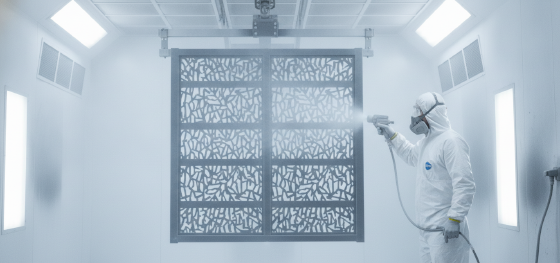
How do you protect outdoor metal panels from rapid atmospheric rust and UV fading?
We utilize a dual-layer defense, starting with a corrosion-resistant galvanized steel base, followed by electrostatic powder coating to seal the surface from moisture.
Because outdoor panels are exposed to continuous rain, UV rays, and temperature swings, choosing the correct material state is critical. Standard untreated steel will rust within days. To prevent oxidation, our panels are fabricated from high-quality galvanized steel. This material features a metallurgical zinc coating that provides sacrificial protection, actively preventing rust from spreading even if the surface is scratched in the field.
We then apply an advanced electrostatic powder coating. This process sprays dry plastic powder over the chemically etched metal, curing it in high-temperature ovens to form a thick, continuous barrier. This tough plastic skin resists chipping, impacts, and intense UV exposure, preventing color fading and maintaining a premium satin-matte finish over decades. Here is a direct overview of standard outdoor panels:
| Panel Material | Recommended Thickness | Primary Finish Choice | Optimal Wind Load Range |
|---|---|---|---|
| Galvanized Carbon Steel | 2.0 mm - 3.0 mm (14 to 11 GA) | Electrostatic outdoor powder coat | High (Requires structural support posts) |
| Marine-Grade Aluminum | 3.0 mm - 4.0 mm (8 GA) | Chemical conversion film + powder coat | Moderate (Lightweight, low inertia) |
| Stainless Steel (304 / 316) | 1.5 mm - 2.5 mm (16 to 12 GA) | Bead-blasted satin or passivation | Very High (Elite structural limits) |
Large-Scale Sheet Metal Fabrication at JUCHENG
How does JUCHENG handle large-format, high-volume production of architectural panels?
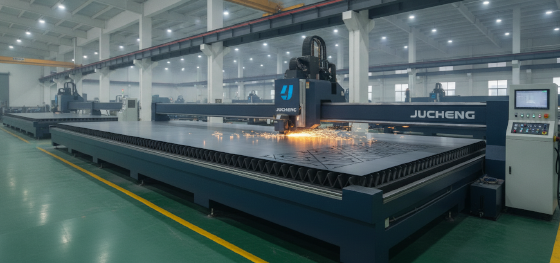
We operate oversized 6-meter fiber laser cutting beds and high-capacity press brakes, processing massive, continuous metal sheets with extreme accuracy.
Fabricating architectural panels requires heavy industrial equipment that can process large-format sheets without warping. Standard, small-scale laser cutters cannot handle 4-meter or 6-meter continuous fence profiles, forcing builders to weld separate smaller sections together, which ruins cosmetic uniformity. At JUCHENG, our oversized fiber laser cutting beds solve this scale bottleneck.
Integrating thermal expansion allowances into your early sheet metal design is vital when dealing with long, uninterrupted spans. Our engineering department provides a 24-hour free DFM analysis to check your CAD models, ensuring that mounting holes and interlocking brackets incorporate slotted tolerances to absorb thermal movement. Supported by our no MOQ policy and rapid delivery guarantee, we manage your commercial projects from initial design unfolds to final, large-capacity powder coating.
FAQ: Critical Questions About Sheet Metal Fence Designs
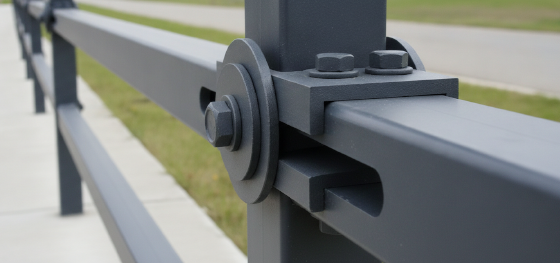
How do you design mounting brackets to handle thermal expansion in long fences?
Metal naturally expands and contracts during seasonal temperature swings. If you bolt panels tightly to rigid posts without movement allowances, the entire fence line will warp, buckle, or shear the fasteners. We prevent this by cutting slotted mounting holes that allow the panel to slide slightly along its horizontal axis, absorbing thermal expansion safely.
What causes paint peeling on galvanized steel panels, and how do we prevent it?
The slick zinc layer on galvanized sheets can contain trace oils that prevent standard paint from bonding. To ensure a lifetime bond, we run our galvanized panels through a multi-stage iron phosphate chemical wash to degrease and etch the zinc surface, providing a highly receptive anchoring layer for our electrostatic powder coatings.
Why is a closed-cell rubber seal required for modular gate frames?
Hollow gate profiles can trap water inside their cavities, initiating rapid interior rust. Installing custom closed-cell rubber gaskets and designing drainage holes at the lowest point of the frame ensures that any internal condensation drains out immediately, keeping the core of your security gates completely dry.
Does JUCHENG fabricate structural posts for these sheet metal fence designs?
Yes, we provide full structural solutions. We cut and weld thick-walled steel tubes to serve as mounting uprights, custom-punching matching bolt configurations to simplify your on-site installation. Our technical team works directly with your engineers during our complimentary DFM stage, ensuring every bracket and support post is optimized for wind load and long-term durability.

