


Managing active thermal convection in closed electronics chassis or architectural facades is a delicate balance of physical trade-offs. Implementing a precise perforated metal sheet design allows engineers to customize mechanical ventilation paths, optimizing airflow efficiency while maintaining high structural panel stiffness. For hardware developers, this geometric pattern configuration is the primary method to prevent electronic processors from overheating while blocking external debris from entering sensitive internal circuits.

Designing simple solid plates often results in severe heat buildup that can compromise your electronics, while over-perforating a structural bracket can cause it to sag or warp under load. When a panel is modeled without calculating open-area percentages or webbing clearances, it leads to high reject rates and slow, expensive production runs. Proactively coordinating hole spacing and cutting paths is the best way to secure your product's physical performance.
Let's compare staggered and straight hole alignments, analyze how to calculate precise open-area ratios, and review the cost-efficiency differences between high-speed mechanical punching and laser cutting.
content:
Staggered vs. Straight Hole Patterns
Calculating Open Area Percentage for Ventilation
Laser Cutting vs. CNC Punching for Perforated Sheets
Custom Perforated Panels Fabricated by JUCHENG
FAQ: Critical Questions About Perforated Metal Sheet Design
Staggered vs. Straight Hole Patterns

What are the primary geometry options when nesting venting hole arrays?
The most common configurations are 60-degree staggered patterns, which optimize mechanical strength, and straight patterns, which align holes along parallel horizontal and vertical axes.
Understanding how hole nesting geometries dictate panel rigidity is essential to designing high-yield components. For most industrial and architectural projects, designers deploy staggered patterns. Arranging holes at a 60-degree offset maximizes the solid metal webbing between cavities, ensuring that the sheet maintains uniform strength under bending stresses.
Conversely, straight patterns align holes in neat, uniform grids. While straight-row configurations are highly aesthetic and ideal for custom grilles or speaker covers, they feature continuous solid lanes that are highly prone to buckling under press brakes. Designers must specify thicker materials when utilizing straight patterns to prevent local panel warping.
Calculating Open Area Percentage for Ventilation
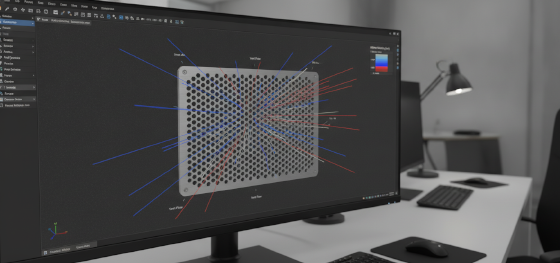
How do you calculate the ratio of empty space to solid metal on a perforated sheet?
The open-area ratio is calculated as the total area of the punched holes divided by the total area of the sheet, typically expressed as a percentage.
Calculating the open area ratio is the most critical stage of perforated metal sheet design, directly controlling both airflow and panel rigidity. A high open area percentage maximizes airflow efficiency, preventing thermal choking inside high-voltage cabinets, but can make the sheet highly flexible and difficult to bend without warping.
For a standard 60-degree staggered round hole pattern, the formula is calculated as $0.9069 times (D/P)^2$, where "D" is the hole diameter and "P" is the pitch (the distance between hole centers). Maintaining an open area of 40% to 60% represents the sweet spot for most electronic enclosures, providing excellent convective cooling while retaining enough solid material to handle mechanical stress:
| Hole Diameter (D) | Pitch (P) | Nesting Alignment | Resulting Open Area |
|---|---|---|---|
| 2.0 mm | 3.0 mm | 60-degree Staggered | Approx. 40.3% (Excellent for shielding) |
| 3.0 mm | 4.0 mm | 60-degree Staggered | Approx. 51.0% (Optimized for venting) |
| 4.0 mm | 5.0 mm | 60-degree Staggered | Approx. 58.0% (High airflow) |
Laser Cutting vs. CNC Punching for Perforated Sheets

Which fabrication process is more cost-effective for producing perforated sheets?
CNC punching is significantly faster and cheaper for standardized high-density hole patterns, while laser cutting is preferred for complex, custom geometric layouts.
To optimize your manufacturing budget, selecting the correct cutting method is critical. Utilizing a laser cutter to slice out thousands of tiny, identical circular holes is highly inefficient. The continuous dwell time of the laser concentrates extreme thermal energy, which can warp thin panels and slow down production speeds.
For high-density grids, mechanical CNC punching is the undisputed standard. Utilizing multi-pin punches on a turret press allows us to stamp out dozens of holes in a single mechanical stroke. However, if your design requires complex, non-standard shapes or varies across custom panels, laser cutting remains the preferred choice because it requires zero custom tool tooling investments, allowing for instant adjustments.
Custom Perforated Panels Fabricated by JUCHENG

How does JUCHENG manage high-precision perforated panels with flat surfaces?
We operate high-power fiber lasers, CNC turret presses, and advanced roller levelers managed by skilled technicians, ensuring every finished grille remains flat.
Integrating these open area ratios, slot patterns, and tooling clearances into your early sheet metal design cycle is the single most effective way to eliminate production defects. JUCHENG integrates these advanced geometric and material validations into our digital manufacturing network, ensuring that your CAD files translate into fully finished, durable venting grilles with extreme dimensional precision.
We process a wide range of raw sheets, including lightweight aluminum, high-yield stainless steel, and formable carbon steel. Our technical department provides a 24-hour free DFM analysis to check your CAD models, checking flatness and structural clearances before production. Supported by our no MOQ policy and rapid delivery guarantee, we manage your project from initial flat pattern cutting to final packaging and assembly.
FAQ: Critical Questions About Perforated Metal Sheet Design
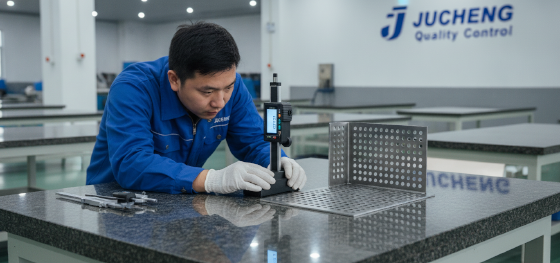
How do you calculate the minimum solid border width required around a perforated array?
To prevent the sheet from warping during forming, we recommend maintaining a solid, unperforated border along all outer edges. This solid margin must be at least twice the material thickness plus the inner bend radius, ensuring that the bending tooling clamps down on solid metal rather than weak perforated lanes.
What causes sheet warping during dense punching runs, and how is it corrected?
Punching thousands of holes concentrates immense shear stresses in the metal sheet, causing it to curl upward. To restore absolute flatness, we run the punched sheets through multi-roller leveling machines. These rollers apply controlled, alternating bending forces to relieve the internal shear stresses, ensuring the finished grilles remain flat.
Can perforated sheets block electromagnetic interference (EMI) successfully?
Yes. Conductive perforated sheets (such as aluminum or nickel-plated steel) act as integrated Faraday cages. If the diameter of the venting holes is significantly smaller than the wavelength of the target electromagnetic radiation, the panel will block the interference completely while allowing air to flow freely.
How does JUCHENG support custom perforated metal sheet design specifications?
Our technical department reviews your CAD designs during our complimentary DFM stage. If your venting array features patterns that risk bending cracks, or open areas that compromise structural load limits, we suggest clear modifications like shifting hole centers or adjusting border widths, delivering safe and highly durable enclosures.

