


Experiencing a sudden mechanical "Stiction" during the demolding of a 2-meter long medical housing in the current market reveals a critical design oversight: the neglect of taper physics. In the world of polyurethane reaction injection molding, the part does not just sit in the mold; it chemically bonds and mechanically shrinks as it cures. If the vertical walls are designed at a true 90-degree angle, the force required to eject the part will exceed the material's green strength, leading to surface tearing or structural cracks. Achieving a zero-defect surface finish on Large Scale Plastic Parts requires a mastery of Draft angles for reaction injection molding to ensure that the atmospheric vacuum is broken instantly as the mold opens, preserving the high-gloss aesthetics of your innovation.
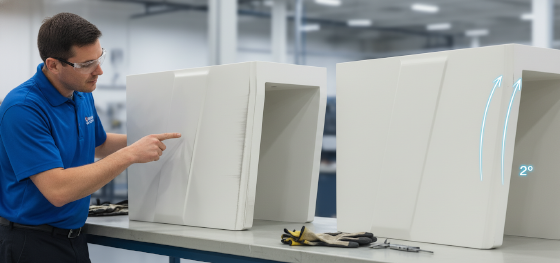
Ejection reliability for next-generation robotics depends on the internal vs. external wall draft physics. Unlike traditional injection molding where parts are small and easy to "pop" out, RIM parts often feature massive surface areas that generate significant frictional resistance. Jucheng Precision addresses these mechanical hurdles by providing a free DFM analysis in 24 hours for every project. Jucheng utilizes its capacity of 150+ CNC machines to manufacture aluminum tools that incorporate precise taper geometries, ensuring that your Polyurethane Molding Services results are as functional as they are beautiful.
Operating within the Shenzhen precision manufacturing hub, Jucheng Precision acts as the high-tier engineering consultant for global OEMs. We transform complex bionic CAD files into validated, easy-to-eject hardware in as fast as 15 business days. This guide explores the essential baseline draft standards, the texture-to-draft ratio, and the zero-draft management with side-actions required for manufacturing hardware that survives the scrutiny of clinical trials and the high-speed demands of industrial automation.
content:
Baseline Standards: Why 1 to 2 Degrees Rules RIM?
Shrinkage Physics: Internal vs. External Wall Draft Logic
Technical Data: Comparing Texture Depth and Required Draft
Undercut Management: Solving Zero-Draft Aesthetic Challenges
JUCHENG Hub: Mastering Part Release in the Shenzhen facility
FAQ: Real Answers for Part Sticking and Taper Standards
Baseline Standards: Why 1 to 2 Degrees Rules RIM?
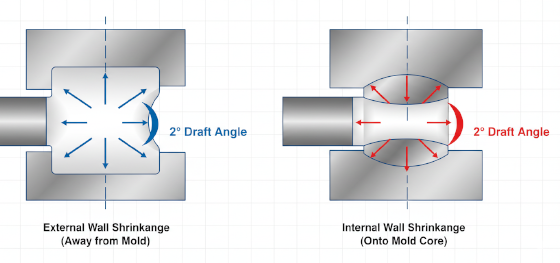
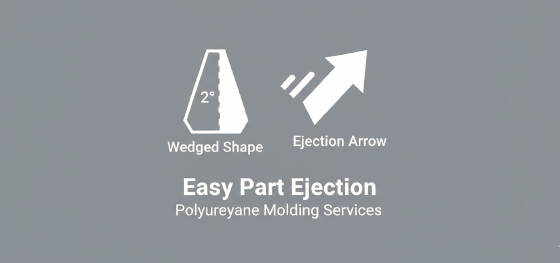
Structural integrity during demolding is governed by the ability to release surface tension. In Draft angles for reaction injection molding, the standard recommendation of 1 to 2 degrees is the minimum required to prevent "Drag Marks." As the prototype robot part cures, it forms a tight seal against the aluminum mold walls. Without a taper, the part must slide across the entire height of the wall to escape, creating microscopic scratches that ruin the Ra 0.8 surface finish. Jucheng Precision enforces a 1.5-degree minimum for external walls to ensure that once the part moves only 0.1mm, it is physically separated from the tool surface, eliminating the risk of aesthetic failure.
What happens if the part has zero draft?
The mold's ejector pins will push through the soft polyurethane material rather than lifting the part, resulting in permanent damage to the component and potentially the aluminum tool.
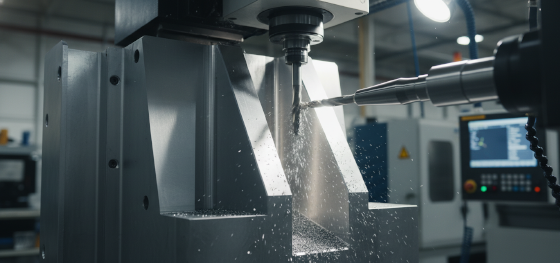
Geometric complexity increases the need for generous draft. For large diagnostic equipment enclosures with deep vertical ribs, Jucheng Precision often recommends increasing the draft to 3 degrees. Deep features create more surface area and higher friction. By utilizing 25 5-axis Haas/Mazak units, we machine these high-taper cavities with absolute precision, ensuring that the draft is uniform across the entire depth. This level of technical oversight is essential for maintaining the unyielding foundations required for hospital-grade hardware, where any surface imperfection can become a reservoir for pathogens.
Material formulation also dictates the required taper. Rigid polyurethane RIM resins, which simulate the stiffness of ABS, are less forgiving than elastomeric formulations. A rigid part has zero flexibility to "give" during ejection; therefore, the draft must be perfect. Jucheng’s engineering team analyzes your material choice during the DFM phase, adjusting the draft requirements to match the Shore D hardness of your resin. This customized approach ensures that your Alpha and Beta trial units are delivered with a "Production-Ready" surface quality that secures investor confidence and passes regulatory scrutiny.
Shrinkage Physics: Internal vs. External Wall Draft Logic
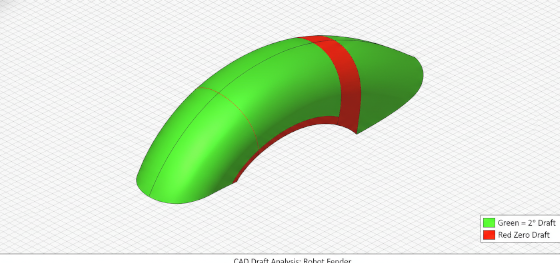
Managing the direction of material movement is the most significant challenge in Draft angles for reaction injection molding. Polyurethane resins exhibit predictable shrinkage as they transition from a liquid to a solid state. External walls shrink away from the mold cavity, making them relatively easy to release even with minimal draft. However, internal walls—such as those forming a battery compartment or an electronic bay—shrink onto the mold core. This creates a mechanical "Vice-Grip" effect that can lock a prototype robot chassis to the tool. Jucheng Precision requires a minimum of 3 degrees of draft for all internal core features to compensate for this unyielding grip.
How to prevent parts from sticking to the mold core?
Utilize a combination of high-taper internal draft (3 degrees+) and automated HVLP release-agent spraying to neutralize the mechanical clamping force of the shrinking polymer.
Core temperature management further complicates this internal shrinkage. If the internal mold core runs hotter than the external cavity, the material will cure faster and tighter around the metal. Jucheng Precision utilizes integrated thermal sensors and specialized water-cooling circuits within our 7075 aluminum tools to maintain a constant thermal equilibrium. By controlling the heat, we ensure the shrinkage rate is uniform, preventing the "Internal Stress" that leads to warpage and making the part release predictably from the internal cores. This thermal discipline is a core requirement for ISO 13485 compliant medical hardware.
Ejection pin placement must be coordinated with these draft zones. Jucheng Precision places ejector pins directly beneath the highest-friction areas—the internal walls and deep ribs. By providing a direct axial force at the point of maximum resistance, we ensure the part is lifted evenly. Our Shenzhen hub utilizes 3D flow simulation to identify these "High-Friction Nodes" before the tool is cut, ensuring your Polyurethane Molding Services project moves from CAD to T1 samples without the catastrophic delays of a stuck mold. We deliver the rigid, precise foundations that your high-speed autonomous fleet requires.
Technical Data: Comparing Texture Depth and Required Draft
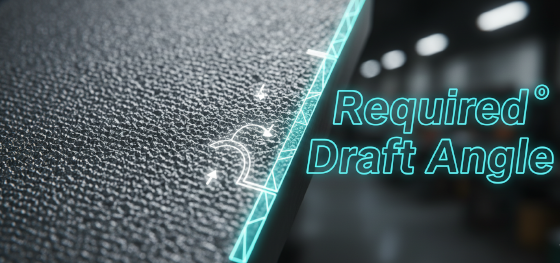
Success in ergonomic design depends on the interplay between surface grain and ejection taper. If your design specifies a VDI 30 matte finish for a medical console handle, the "Micro-Hooks" of the texture increase the surface area by up to 500%. This additional friction must be offset by increased draft. Jucheng Precision provides full material and texture characterization reports to help your industrial designers specify the correct angles. The following table illustrates the texture-to-draft correlation required for high-fidelity RIM parts in the current market.
| Surface Finish | Texture Depth (Microns) | Recommended Draft | Aesthetic Goal |
|---|---|---|---|
| Ra 0.8 (Mirror) | 0.8 μm | 1.0° - 1.5° | High-Gloss Automotive |
| VDI 24 (Fine Satin) | 1.6 μm | 2.0° - 2.5° | Handheld Medical Devices |
| VDI 30 (Grit) | 3.2 μm | 3.5° - 4.5° | Industrial Robot Bumpers |
| Leather Grain (MT) | 25 - 50 μm | 5.0° - 8.0°+ | High-End Ergonomics |
The data proves that texture depth is the primary driver of draft requirements. For heavy-duty industrial robot parts requiring an aggressive non-slip texture, a 5-degree draft is not "Over-Engineering"; it is a functional requirement. Jucheng Precision utilize 5-axis CNC laser texturing to apply these grains with absolute uniformity. By maintaining the correct draft angle, we ensure the peaks of the texture are not flattened or "smeared" during ejection, maintaining the sharp, high-quality tactile feedback that defines a premium autonomous platform.
Undercut Management: Solving Zero-Draft Aesthetic Challenges
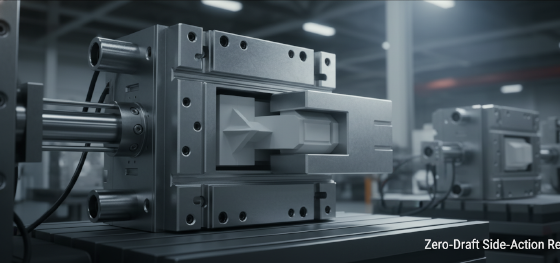
Achieving the sleek, perfectly vertical aesthetic of modern consumer electronics often requires "Zero-Draft" faces. In Draft angles for reaction injection molding, a zero-draft wall is technically an undercut. Jucheng Precision handles these zero-draft management with side-actions challenges by utilizing mechanical slides and cam-actions within the aluminum tool. These components move perpendicular to the ejection direction, physically retracting away from the part before it is lifted. This allows you to maintain the 90-degree look for your medical scanner's front bezel without risking surface scuffing during demolding.
Are side-actions expensive for large parts?
Yes. Side-actions add NRE cost and complexity; Jucheng recommends using them only for critical aesthetic faces where a taper would ruin the industrial design.
Agile tooling modifications allow Jucheng to test "Minimal-Draft" scenarios. Because our molds are machined from high-strength aluminum rather than hardened steel, we can start with a 0.5-degree draft and gradually increase it if the material exhibits stiction during the T1 cycle. This iterative approach allows us to push the boundaries of what is possible in Large Scale Plastic Parts design. If a design requires a vertical sensor window, Jucheng Precision can often find a geometric compromise—such as a "Stepped Parting Line"—that eliminates the need for an expensive side-action while maintaining the zero-draft appearance.
Integrated hardware alignment is the final goal of draft mitigation. For robots requiring sub-millimeter fitment between multiple molded panels, Jucheng Precision machines "Self-Aligning" draft features into the part edges. These features use a high-taper "Lead-In" followed by a precision zero-draft landing. This ensures that the panels "Snap" together with a perfectly flush seam, providing the high-end retail appearance required for investor demos and trade shows. By managing these complex mechanical interfaces in our Shenzhen hub, we deliver hardware that is ready for 24/7 industrial use without the gaps and rattles of low-tier prototypes.
JUCHENG Hub: Mastering Part Release in the Shenzhen facility
Dominating the hardware market requires a partner that doesn't just mold plastic, but understands the mechanical physics of ejection. Jucheng Precision operates with a 24/7 manufacturing mindset in our Shenzhen precision manufacturing hub, delivering high-tolerance RIM components and structural industrial robot parts with industry-leading speed. JUCHENG provides a "Bridge to Production" that allows you to move from a single hand-finished prototype to a commercial deployment of 5,000 units with consistent metallurgical and dimensional quality. JUCHENG has No MOQ, allowing you to source 1 to 5 units for initial draft validation without the crushing cost of mass-production tools.
Integrating your structural design with JUCHENG’s expertise ensures that your hardware survives the regulatory audit season and moves into mass adoption. JUCHENG offers a free DFM analysis in 24 hours, identifying potential "Draft-Traps" or ejection risks in your design before they become field failures. Whether you are building an autonomous medical assistant or a heavy-duty industrial mobile base, Jucheng Precision provides the rigid, precise, and easily demolded foundations that keep your innovation moving through the high-speed cycles and the years of hard labor.
Our facility is equipped with oversized hydraulic presses and dedicated quality labs, allowing JUCHENG to manage the entire hardware lifecycle in one location. JUCHENG manages the complexity of multi-material bonding and automotive-grade finishing so your engineering team can focus on the motion control and the AI. By combining Shenzhen's speed with industrial-grade material verification and global ISO 14001 standards, JUCHENG remains the preferred partner for the world's most aggressive Polyurethane Molding Services challenges. Contact us today to start your next project.
FAQ: Real Answers for Part Sticking and Taper Standards
What is the minimum draft angle for a 500mm deep RIM part?
We recommend a minimum of 2.0 to 2.5 degrees for deep cavities to prevent the vacuum effect during ejection.
Does the material color affect the required draft?
No, but dark colors and high-gloss finishes reveal scuff marks more easily, requiring a more conservative draft approach.
Can JUCHENG machine zero-draft vertical ribs?
Only if they are very shallow (under 10mm). For deeper structural ribs, a minimum of 1 degree is mandatory for release.
How do you handle draft for soft-touch elastomeric parts?
Flexible parts are more forgiving of draft because they can deform during release, but they still require 1 degree to prevent surface tearing.
What is the lead time for a 1-meter draft-optimized tool?
Aluminum rapid tools with complex draft and side-actions are typically completed in 15 to 20 business days.
Tooling stiction and surface scuffs are absolute innovation killers for high-end robotic systems. Partnering with Jucheng Precision ensures that your functional iterations are built with the unyielding polyurethane reaction injection molding and specialized Draft angles for reaction injection molding knowledge the industry demands. Reach out to our Shenzhen manufacturing hub today for a complete DFM review and build the unyielding foundation your autonomous fleet requires.

