


Integrating robust, smoothly operating doors and secure access panels into custom enclosures requires careful attention to dynamic mechanical clearance. Specifying professional sheet metal hinge and latch installation during the layout phase ensures that your cabinet doors maintain absolute parallel alignment over thousands of open-and-close cycles, while preventing structural deformation under heavy field stress. This advanced hardware integration represents a critical milestone in custom sheet metal fabrication, directly determining whether your completed box-build functions flawlessly or suffers from door sag in the field.
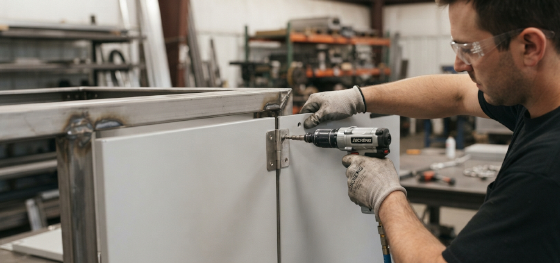
Suffer from heavy cabinet doors that sag, bind on their frames, or fail to latch tightly under environmental vibrations? When moving parts are modeled without planning for cumulative tolerance stack-ups, hinge pin clearances, or structural bracket reinforcement, it leads to rapid mechanical wear and compromised dustproof seals. Proactively integrating material-specific springback variables, specialized door reinforcement plates, and robust hinge selections is the best way to secure your product quality.
Let's examine why moving parts present severe assembly challenges, compare the cost-quality trade-offs of welding versus mechanical fastening for hinges, and review how to select proper hardware to prevent heavy doors from sagging over years of service.
The Challenge of Moving Parts in Assembly
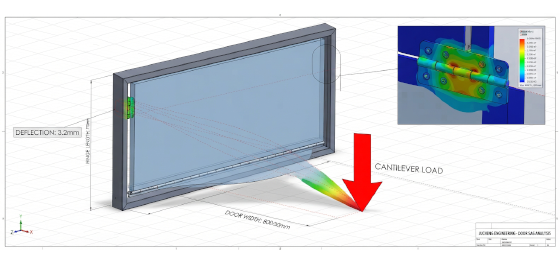
Why does integrating moving doors introduce high risk of geometric variations?
Moving doors act as cantilevers, concentrating physical load on the hinges and magnifying any minor structural bending variations, which can cause the door to sag and bind against the frame.
When designing complex enclosures, managing the door-to-frame clearances is critical. If your flat pattern unfolding software neglects minor material thickness or springback variations, the folded flange angles will drift. This minor angular drift is magnified across the wide span of a door panel, causing the outer edge to droop.
This drooping is known as door sagging. It prevents the locking latches from aligning with their matching slots, and leaves uneven gaps that compromise your dustproof seals. To prevent these failures, we recommend maintaining a uniform perimeter clearance of at least 1.5mm to 2.0mm around the door skin, absorbing cumulative bending variations safely.
Installation Methods: Fastening vs. Spot Welding
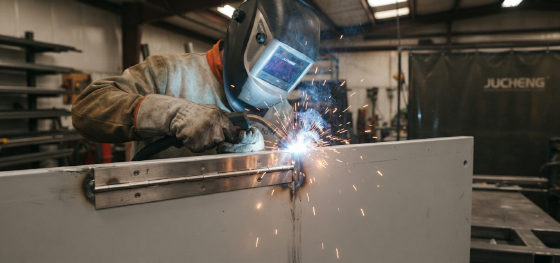
What is the cost-quality trade-off between welding and mechanical fastening for hardware mounting?
Spot welding provides extreme, permanent shear strength and zero protruding heads but can warp thin sheets, while mechanical fastening prevents heat damage but requires thread preparation.
Selecting the optimal mounting method dictates both your processing speed and final cosmetic quality. Resistance spot welding is the industry standard for permanently mounting heavy steel hinges. It fuses the metal instantly, creating a clean, permanent joint with zero external hardware protrusions. However, welding can cause thermal warping on thin sheets, and is restricted to compatible alloys.
Conversely, mechanical fastening utilizing screws or rivets operates entirely at room temperature, completely preventing heat warping and allowing secure joints on pre-painted or anodized sheets. To prevent threads from stripping in thin panels, we utilize automated hardware presses to install self-clinching threaded PEM nuts or standoffs directly into pre-punched holes. This cold-joining method ensures high-strength threads that can handle repeated door adjustments.
Preventing Door Sagging with Proper Hinge Selection
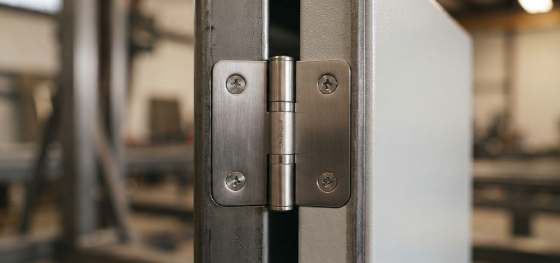
How can engineers prevent heavy cabinet doors from sagging over years of continuous field use?
We recommend designing thick-gauge steel reinforcement plates directly behind the hinge mounting pockets and specifying high-load structural hinges like continuous piano hinges.
Heavy door panels exert intense cantilever forces on the thin sheet metal skin, which can cause the metal to stretch and sag over time. To prevent this, our engineers design specialized structural reinforcements. We weld thick steel reinforcement plates directly behind the hinge mounting zones, providing a robust, multi-layer core that prevents the thin outer skin from flexing under weight.
Selecting the correct hinges is also critical to structural stability. For lightweight electronic cases, standard lift-off or slip-joint hinges are highly cost-effective and easy to integrate. However, for heavy-duty power cabinets and tall industrial enclosures, specifying continuous piano hinges or robust, dual-bolt heavy-duty hinge profiles is essential to distribute the weight evenly, eliminating doors from sagging.
| Hinge Class | Installation Processing Path | Typical Load Capacity | Best Application Match |
|---|---|---|---|
| Slip-Joint (Lift-off) | Pre-coat masking + mechanical fastening | Low to Moderate (Lightweight panels) | Modular server racks, electronic cases |
| Continuous Piano Hinge | Resistance spot welding or mechanical rivets | High (Distributes stress over long seams) | Large communication cabinets, outdoor boxes |
| Heavy-Duty Butt Hinge | Structural MIG welding + reinforcement plates | Very High (Elite structural limits) | Military shelters, medical diagnostic doors |
Precision Mechanical Assembly at Jucheng Precision
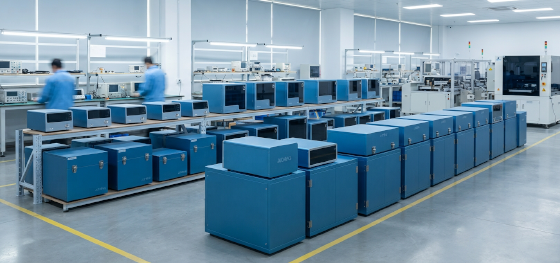
Sourcing high-integrity moving components requires absolute dimensional control on the shop floor. Jucheng Precision operates advanced, clean-room assembly bays equipped with highly calibrated alignment fixtures. This integrated setup allows our technicians to mount complex hardware, check gasket compression ratios, and test latch swing strokes under one roof, ensuring that every finished cabinet aligns perfectly with zero door-binding or sagging.
Every custom order is managed under a unified quality system certified to ISO 9001 and IATF 16949 standards, ensuring that high-speed stamping, laser cutting, and sheet metal fabrication runs meet strict medical, automotive, and aerospace regulations. We provide certified dimensional inspection reports to verify the mechanical clearance of every batch. Supported by our flexible no MOQ policy and rapid delivery turnaround, we manage your project from initial flat pattern cutting to final, fully integrated packaging with zero dimensional drift.
FAQ: Critical Questions About Sheet Metal Hinge and Latch Installation
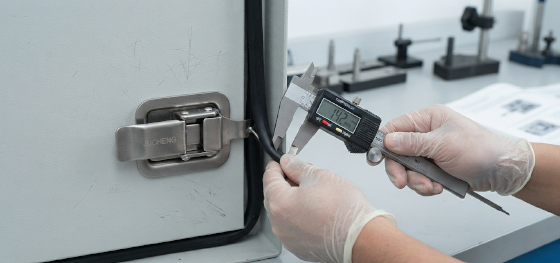
Our engineering team has compiled professional, concise solutions to the most common quality challenges faced during structural box-builds:
Can hinges be installed before powder coating?
No, because raw powder will clog the hinge pivot axle. We recommend masking the mounting holes before painting, and then performing post-coat damage-free assembly.How do we prevent heavy enclosure doors from sagging over time?
We weld thick steel reinforcement plates directly behind the hinge mounting pocket to distribute the cantilever load across a wider surface area, preventing structural fatigue.What is the typical clearance tolerance required between the door and the frame?
We recommend maintaining a uniform perimeter gap of 1.5mm to 2.0mm to absorb cumulative bending variations without binding, ensuring smooth, aligned closures.How does Jucheng Precision ensure that the sheet metal hinge and latch installation process remains highly consistent?
We utilize automated laser blanking to cut hinge pockets within ±0.1mm, and verify final swing alignments using digital coordinate gauges under our strict sheet metal design quality control checks.

