


Designing highly complex brackets or multi-flanged electronic enclosures requires a deep understanding of structural and financial limits. Calculating the exact sheet metal bending cost of your components is a critical milestone in custom sheet metal fabrication, directly determining whether your low-volume production run remains highly cost-effective or exceeds your targeted budget. This specialized forming process relies on high-pressure press brakes and custom-matched punch and die sets to permanently deform flat blanks into rigid three-dimensional structures.
Suffer from unexpected tooling fees and bloated per-part prices on your short-run hardware designs? When drawings are modeled without analyzing physical press clearances, backgauge limits, or standard die openings, it forces fabricators to execute multiple tooling setups, driving up manual labor costs. Proactively optimizing your flange geometries to utilize standard, in-stock tooling is the best way to secure your product margins.
Let's explore the physical trade-off between setup labor and actual bending speed, analyze how standard dies compare to expensive custom molds, and review the structural design rules to prevent tight tolerances from unnecessarily inflating your manufacturing bills.
Setup Time vs. Actual Bending Time
Why do pre-production setup times heavily dominate the overall bending price?
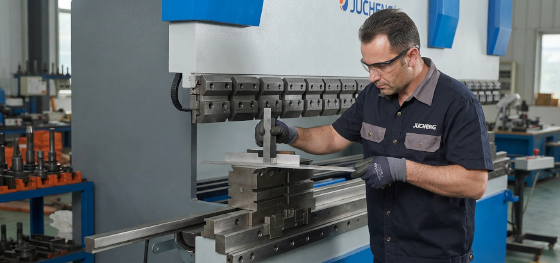
Changing heavy steel punches, aligning multi-stage V-dies, and programming multi-axis backgauges requires intensive manual labor, dwarfing the millisecond strike of the press brake itself.
To optimize your manufacturing budget, understanding the "setup-to-run" ratio is critical. If your prototype features eight distinct folds with varying bend radii, the operator must execute multiple complex setup times to reload different tooling sets. During these adjustment periods, the multi-ton press brake sits completely idle, meaning you are paying premium hourly rates for manual labor rather than automated machine throughput.
Conversely, the actual physical bend takes mere milliseconds to complete once the machine is fully calibrated. For a production batch of 1,000 identical parts, the initial setup labor is easily amortized across the entire run, dropping the per-part bending price to mere pennies. This is why standardizing your design parameters to use a single bend radius is the most powerful method to slash your overall processing bill.
Standard Tooling vs. Custom Tooling
What is the cost difference between standard air bending dies and custom-made forming molds?
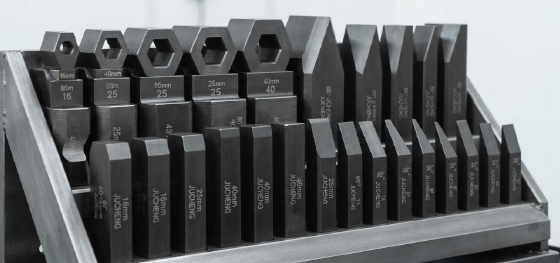
Standard tooling utilizes in-stock, universally compatible punches and V-dies with zero mold charges, while custom tooling requires expensive, long-lead machining to fabricate specialized shapes.
To minimize upfront tooling charges, designers must distinguish between standard and non-standard press brake configurations. Professional sheet metal shops maintain a vast inventory of standard tooling, including acute, gooseneck, and straight punches paired with various V-die openings. Designing your flanges to match these in-stock profiles completely bypasses any mold-making requirements, allowing us to process your parts immediately.
However, if your design requires specialized, high-density features (such as custom ribbed channels or continuous curl hems), standard dies will collide with the returning metal. In these scenarios, fabricating custom tooling is required. This custom mold-making process introduces high NRE fees and extends your lead times by weeks, making it highly impractical for agile prototyping and low-volume manufacturing runs unless the production volume is high enough to justify the capital expense.
| Tooling Metric | Standard Universal Tooling | Custom-Machined Molds (NRE) |
|---|---|---|
| Upfront Mold Cost | Zero (Universally compatible inventory) | High (Typically 500 to 3,000 USD) |
| Tooling Lead Time | Instant (Pre-loaded carousels) | 2 to 4 weeks (Requires CNC milling & grinding) |
| Bending Form Flexibility | Standard acute, 90-degree, and gooseneck channels | Complex ribbed, teardrop hems, customized louvers |
| Best Application Volume | 1 to 5,000 units (Prototyping & low-volume) | 10,000+ units (High-volume continuous runs) |
How Tolerances and Multiple Bends Drive Up the Price

Why do tight angular tolerances and complex multi-bend parts exponentially increase bending rates?
Tight tolerances require continuous manual checking and manual compensations to manage material springback, while multiple consecutive bends increase the risk of part rejection.
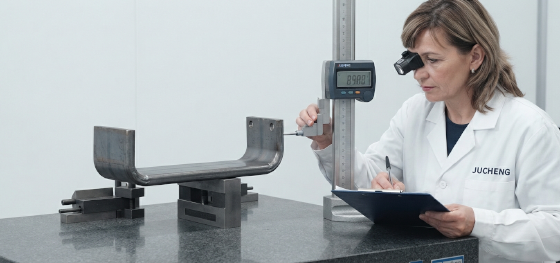
In precision metal forming, demanding tight angular tolerances (such as ±0.5 degrees) is a primary cost driver. When a flat blank is folded, it experiences natural elastic recovery, commonly known as springback. Because different batches of raw sheets possess minor thickness and hardness variations, the springback angle behaves unpredictably.
To meet ultra-tight tolerances, benders must utilize advanced press brakes with integrated laser angle-measuring systems, or have operators physically measure and manually adjust the punch stroke for every single bend. This intensive quality check slows down the cycle speed, driving up labor expenses. Furthermore, every consecutive bend on a single component increases the cumulative tolerance stack-up, raising the risk of physical distortion and part rejection, which inevitably inflates your overall manufacturing bill.
Lower Your Bending Costs with JUCHENG's CNC Press Brakes

How does JUCHENG minimize bending expenses while maintaining high geometric precision?
We operate advanced multi-axis CNC benders integrated with an extensive standard tooling library, automating all backgauge adjustments and springback calculations.
Why pay premium prices for fragmented processing? At JUCHENG, we manage cutting, bending, and powder coating under one roof, keeping your overall sheet metal fabrication cost remarkably low. Our advanced press brakes utilize dynamic hydraulic compensation and automated backgauges to execute complex, multi-bend sequences in a single setup, ensuring that your parts are cut, formed, and finished with extreme consistency.
We process a wide range of materials, including lightweight aluminum, high-yield stainless steel, and easily formable carbon steel during high-precision sheet metal fabrication cycles. Our technical department provides a 24-hour free DFM analysis to evaluate your CAD models, checking flange-to-edge clearances and tooling access before production. Supported by our no MOQ policy and rapid delivery guarantee, we manage your project from initial flat pattern cutting to final, high-durability packaging and assembly.
FAQ: Critical Questions About Sheet Metal Bending Cost
Our engineering team has compiled professional solutions to the most common budgeting challenges faced during industrial press brake operations:
How is sheet metal bending cost typically calculated by fabricators?
The total price is calculated by combining a fixed setup fee (to cover tool loading and machine programming) with a variable per-bend rate (the actual press strokes). For prototypes and small batches, the setup fee dominates the total price, while for high-volume orders, the low per-bend rate represents the primary cost, making large runs highly economical.Why does a smaller bend radius increase custom manufacturing costs?
Forcing a sheet into an inner radius that is smaller than the material's physical ductility limit concentrates intense tensile stress on the outer fibers, causing micro-cracking and material failures. This increases scrap rates and forces the shop to run secondary annealing heat treatments to soften the metal before forming, driving up your final unit cost.Does JUCHENG charge extra tooling fees for standard sheet metal bending?
Absolutely not. JUCHENG maintains an extensive in-house library of standard, high-grade punches and V-die sets for various thicknesses and radii. If your designs utilize standard industrial dimensions, we can fold your custom brackets and enclosures immediately, allowing you to bypass any custom tooling or NRE mold expenses completely.How does JUCHENG prevent thickness variations from affecting the sheet metal bending cost?
We bypass the inaccuracies of standard theoretical tables by physically measuring every incoming batch of raw sheet stock using calibrated digital micrometers. Our team inputs these measured values into our CAD unfolding systems, ensuring that our progressive calculations and tool setups are perfectly matched to the actual metal thickness, eliminating dimensional springback variations.

