


Speed is often the ultimate saboteur of precision, but in the case of Multi Jet Fusion, it is the primary engine of reliability. For years, the additive manufacturing world was trapped in a "one-laser-point-at-a-time" bottleneck, making the 3D printing process feel like an agonizingly slow crawl for anything beyond a single visual mock-up. Everything changed when the power of an inkjet array was combined with the raw energy of infrared lamps. This is the industrial genesis of mjf 3d printing. It is not a technology designed for hobbyists to tinker with on a desk; it is a manufacturing beast built for the factory floor, capable of churning out functional, end-use nylon parts with a speed and structural consistency that renders traditional injection molding tooling obsolete for mid-sized production batches.
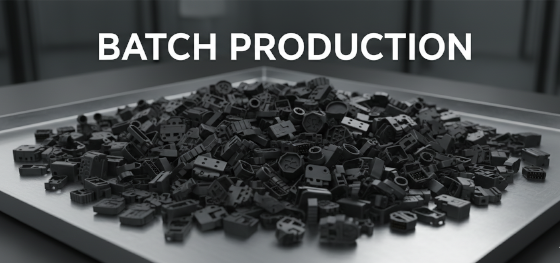
Consider the frustration of a hardware engineer who needs five hundred structural brackets. Machining them from solid blocks is an exercise in material waste; 3D printing them via standard laser sintering takes a week of machine time. Multi Jet Fusion sweeps away these constraints by reimagining the build plate as a dynamic chemical canvas. At JUCHENG, we have integrated MJF technology into our core agile manufacturing workflow to bridge the gap between "Revision 3" and market launch. By mastering the delicate balance between the detailing agent’s cooling effect and the fusing agent’s thermal absorption, we deliver parts that don't just look functional—they are functional. This guide strips away the academic fluff to explore the thermodynamic grit and economic logic that make MJF the strategic champion of the modern supply chain.
Isotropic strength is no longer a theoretical dream. When you eliminate the "layer weakness" that plagues almost every other additive method, you unlock a new dimension of mechanical safety. Whether you are building a rugged drone chassis that must survive high-velocity impacts or a medical fixture that requires absolute dimensional stability across thousands of cycles, the logic of fusion is your best ally. Let us break down the physical laws of infrared orchestration and see how JUCHENG turns nylon powder into industrial armor.
Infrared Orchestration: The Chemistry of the Fusing Agent
Uniform Integrity: Solving the Z-Axis Weakness
Batch Velocity: Why Packing Density Rules the ROI
Aesthetics in Black: Beyond the Natural Grey Finish
Functional Frontiers: Parts That Live in the Field
Technical Sanctuary: JUCHENG’s Approach to Scalable Solutions
Infrared Orchestration: The Chemistry of the Fusing Agent
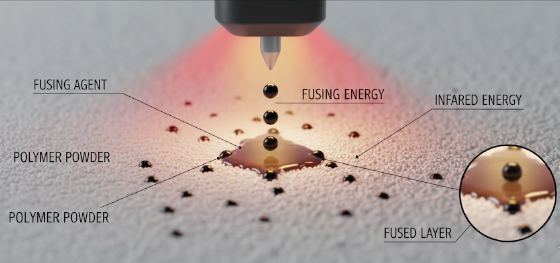
Look closely at the print bed during an MJF cycle and you won't see a single laser beam. Instead, you see a massive array of inkjet heads sweeping back and forth, depositing millions of microscopic droplets across a bed of Nylon 12 powder. This is where the thermal magic happens. One set of nozzles applies the "Fusing Agent"—a black, heat-absorbing liquid—exactly where the part's geometry needs to be solid. Another set of nozzles sprays a "Detailing Agent" around the edges of the part. This detailing agent acts as a cooling shield, preventing the heat from bleeding into the surrounding loose powder, which ensures that your sharp corners stay sharp and your holes stay round.
Once the agents are applied, a high-power infrared lamp passes over the entire bed. Because the fusing agent is black, it absorbs the infrared energy at an incredible rate, causing the underlying powder to melt and fuse instantly. The white powder, untouched by the black agent, reflects the heat and remains cool and loose. This chemical selectivity allows mjf 3d printing to achieve a level of detail resolution (down to 0.5mm features) that was previously the sole domain of light-cured resins. But unlike resins, the result here is a rugged, industrial thermoplastic. At JUCHENG, we meticulously calibrate these agent deposition rates to match the specific "thermal signature" of your part’s volume. A thick block of nylon requires a different cooling strategy than a delicate lattice. By orchestrating this infrared event at the droplet level, we create components that are structurally dense and free from the internal voids that plague lower-tier 3D solutions.
Uniform Integrity: Solving the Z-Axis Weakness
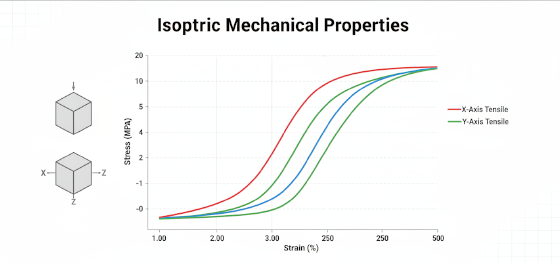
Traditional additive manufacturing has an Achilles' heel: anisotropy. In FDM or SLS, the part is almost always weaker along the vertical axis because the bonds between layers are purely mechanical or rely on a slow thermal soak. If you pull on a typical 3D printed part, it will likely "delaminate" or snap between the layers. This makes engineering calculations a nightmare, as you must orient the part carefully to avoid stress on the weak Z-axis. MJF technology effectively erases this problem. Because the entire bed is pre-heated to a near-melting state and the fusion event is so rapid and intense, the new layer of powder melts *into* the previous layer at a molecular level.
The result is an isotropic part—a component with nearly identical tensile strength and elongation values in all three dimensions. In a JUCHENG MJF part, the Z-axis maintains over 95% of the strength found in the X and Y planes. This uniform integrity is a total game-changer for functional hardware. You can design complex fluid manifolds, pneumatic grippers, or engine brackets with total confidence that they won't shear apart under pressure. This mechanical predictability is why MJF has moved from the prototype lab directly onto the production assembly line. We treat your nylon parts with the same structural reverence as we do our CNC-milled aluminum, providing the verified strength needed for parts that must perform in the real world, not just sit on a shelf.
Batch Velocity: Why Packing Density Rules the ROI
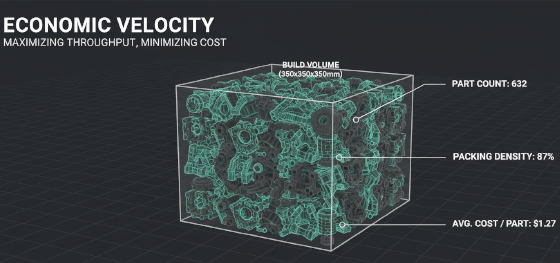
Data dictates the budget. In most manufacturing, doubling the quantity of parts doubles the production time. MJF breaks this linear cost curve. Because the machine fuses an entire "slice" of the build volume in a single pass of the infrared lamp, the number of parts on that slice has zero impact on the time. Whether there is one gear or one hundred gears on a single layer, the lamp takes exactly the same amount of time to cross. This makes MJF the high-speed champion of additive production. The real profit for our clients is found in "3D Packing Density."
At Jucheng Precision, our engineers use advanced nesting algorithms to stack hundreds of parts into a single three-dimensional build volume. We fill the space with the same efficiency as a professional Tetris player. This allows us to amortize the setup and machine time across a massive number of units, driving the per-part price down to levels that compete directly with injection molding for quantities up to 1,000 units. But there is a second, hidden economic advantage: the elimination of tooling. Without a $20,000 steel mold to pay for, your first fifty parts cost the same as your five-hundredth part. This "Tooling-Free" agility allows you to launch products faster and iterate on the design without the crushing financial penalty of a mold revision. MJF isn't just a way to make parts; it is a way to manage your capital risk during the most volatile phase of your product’s lifecycle.
Aesthetics in Black: Beyond the Natural Grey Finish

Raw parts coming off an MJF machine have a characteristic "charcoal grey" appearance and a slightly grainy texture, similar to a fine-grit sandpaper. While this matte finish is excellent for industrial tools because it hides fingerprints and minor scratches, it may not meet the cosmetic requirements of a premium consumer electronic device. However, because MJF nylon is a porous material before it is fully sealed, it is the perfect substrate for secondary finishing. At JUCHENG, we transform these raw components into professional-grade ebony hardware through an integrated post-processing workflow.
The first step is automated bead-blasting to remove any loose powder and homogenize the surface texture. From there, we move to high-temp dyeing. Unlike paint, which sits on top of the surface and can chip off, our specialized dyes penetrate deeply into the nylon fibers. This results in a permanent, deep-black finish that won't flake, even if the part is subjected to heavy wear. For our most demanding clients, we offer "Vapor Smoothing." By exposing the nylon parts to a chemical vapor in a controlled chamber, we melt the microscopic peaks of the surface grain, creating a smooth, semi-gloss finish that looks and feels like an injection-molded part. This treatment also seals the surface, making it liquid-resistant and easy to sanitize. We don't just ship you a 3D print; we ship you a finished product that is ready for the consumer’s hand.
Functional Frontiers: Parts That Live in the Field
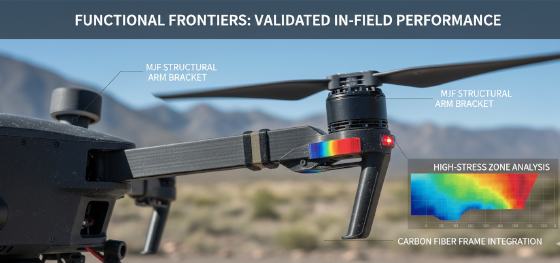
Where does the theory of mjf 3d printing meet the reality of service? You will find JUCHENG’s MJF components in the most demanding field conditions. In the automotive sector, MJF is used for functional ducting, complex cable clips, and under-the-hood brackets that must withstand the constant vibration and heat of a running engine. The high heat-deflection temperature of Nylon 12 ensures that these parts don't warp or soften when the engine bay warms up. In the robotics industry, the lightweight nature of nylon is utilized for end-of-arm tooling and protective covers for articulated joints.
For the medical sector, we produce specialized orthopedic braces and prosthetic components that are customized to the patient's anatomy. The isotropic strength of MJF is critical here; a prosthetic must be able to handle loads from every direction without failing. Because the material is biocompatible and resistant to most cleaning chemicals, it is a safe and durable choice for clinical environments. We treat every "End-Use" part with a different level of technical oversight. We perform 100% inspection on critical mating surfaces and provide material certifications to ensure that the batch you receive today is identical in performance to the batch you receive next year. MJF has effectively ended the era of "only for looks." It has ushered in the era of functional additive survival.
Technical Sanctuary: JUCHENG’s Approach to Scalable Solutions

Choosing a partner for Multi Jet Fusion is not just about choosing a machine—it is about choosing a quality ecosystem. Many service bureaus treat MJF as a high-speed commodity, throwing parts into the bin with minimal oversight. Jucheng Precision operates differently. We view additive manufacturing as a high-integrity 3D printing process that requires the same level of documentation and technical rigor as our 5-axis CNC department. We provide a full DFM (Design for Manufacturability) review for every MJF project, identifying thin walls or trapped volumes that could lead to part failure.
Our facility is optimized for the rapid turnaround that agile hardware teams require. With a massive dedicated MJF capacity, we can deliver batches of 500 parts in less than a week. We combine this speed with a rigid quality assurance framework, utilizing CMM and 3D scanning to verify that your complex geometries haven't drifted during the cooling phase. When you partner with JUCHENG, you aren't just buying a part; you are buying the engineered certainty that your small-batch production is stable, scalable, and safe. Whether you are building the next generation of industrial sensors or a revolutionary new sports wearable, our MJF protocols clarify and elevate your most challenging designs. Contact Jucheng Precision today for a technical DFM review and see how our fusion protocols can armor your next production breakthrough.

