


Nylon is a paradox. It is one of the toughest, most wear-resistant polymers in our arsenal. But it is also famously unstable. It can literally change its size and shape depending on the weather.
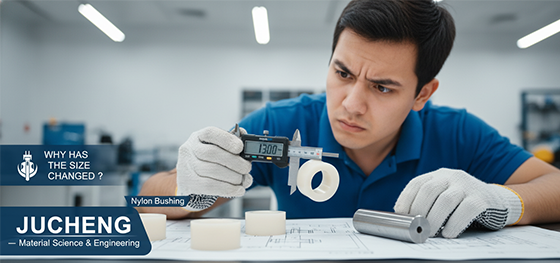
For an engineer designing a high-precision part, this paradox is a huge challenge. How can you trust a material that will not hold its tolerance?
The secret is not to fight nylon's nature, but to understand and manage it. The art of nylon cnc machining is a game of moisture management. This guide will show you how the experts tame this powerful but temperamental beast.
Nylon's Greatest Strength: Unbelievable Toughness
Its Hidden Enemy: Moisture Absorption
Choosing Your Nylon: PA6 vs. PA66
Taming the Beast: A Manufacturer's Approach
Nylon's Greatest Strength: Unbelievable Toughness
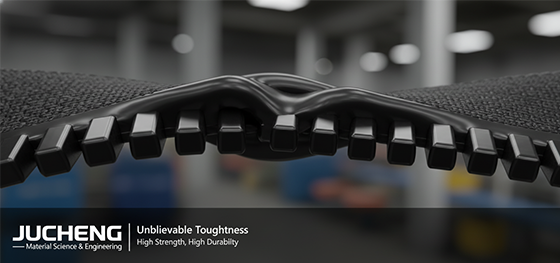
First, let's talk about why engineers love nylon. Its primary superpower is its toughness. It is incredibly durable and resistant to wear, abrasion, and repeated impacts.
It has a low coefficient of friction, making it great for moving parts. This is why nylon is a dominant material for making high-wear components like gears, bearings, bushings, and rollers. It is one of the most trusted of all CNC machining materials for mechanical applications.
When reinforced with glass fibers (GF-Nylon), it becomes extremely strong and rigid, with good heat resistance. This makes it a popular choice for replacing metal parts in demanding under-the-hood automotive applications.
Its Hidden Enemy: Moisture Absorption
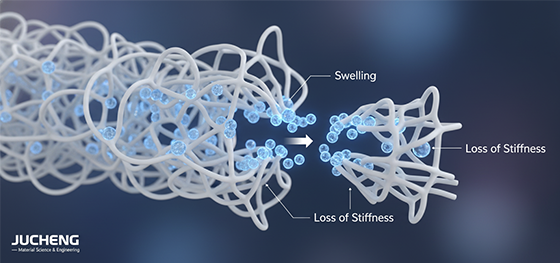
But nylon has a secret weakness. A hidden enemy. It is "hygroscopic." This means it acts like a sponge. It loves to absorb moisture from the surrounding air.
This is not just a surface effect. The water molecules are absorbed into the very structure of the polymer. And when this happens, two bad things occur.
First, the part swells. A nylon part can change its dimensions by 1% to 2% or even more, depending on the humidity. A hole that was a perfect 10.00mm in a dry workshop might become 10.15mm on a humid day. For a high-precision part, this is a catastrophic failure.
Second, its mechanical properties change. The absorbed water acts as a "plasticizer," making the nylon softer, weaker, and less stiff. A part that was strong and rigid in a dry environment can become soft and flimsy in a wet one.
This is nylon's paradox. You choose it for its strength, but its environment can steal that strength away.
Choosing Your Nylon: PA6 vs. PA66
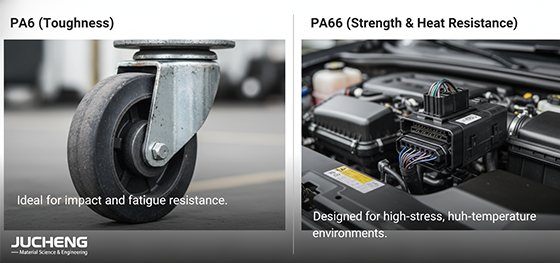
The world of nylon is dominated by two main types. PA6 and PA66. The "PA" stands for Polyamide, which is the chemical name for nylon.
PA6 is the general-purpose workhorse. It is slightly softer, has better impact resistance, and is a little less expensive. It is a great choice for parts that need maximum toughness.
PA66 is the high-performance option. It is stiffer, stronger, and has a higher melting point and better heat resistance. It is the top choice for more demanding structural parts, especially in the automotive industry. However, it also tends to absorb moisture slightly faster than PA6.
| Property | Nylon 6 (PA6) | Nylon 66 (PA66) |
|---|---|---|
| Toughness | Excellent | Very Good |
| Stiffness & Strength | Good | Excellent |
| Heat Resistance | Good | Excellent |
| Moisture Absorption | High | Very High |
Taming the Beast: A Manufacturer's Approach
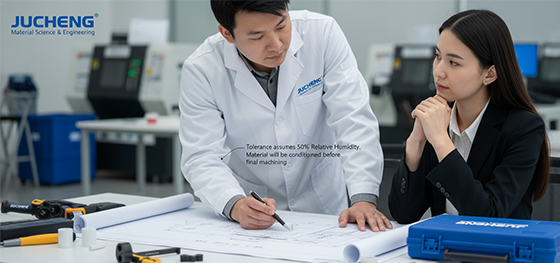
So how do we, as manufacturers, tame this beast? How do we perform nylon cnc machining to create a precise and stable part? It is a game of moisture management.
First, we control the raw material. It must be stored in a dry environment. Sometimes, it must be baked in an oven before machining to remove any absorbed moisture.
Second, we communicate with the designer. This is critical. We must understand the environment where the final part will be used. Will it be in a desert or on a boat? A good DFM review for a nylon part must include a discussion about humidity. The tolerances on the drawing should be specified for the part's final, "conditioned" state, not its "dry as-machined" state.
For some very high-precision applications, we might machine the part, then intentionally let it sit and absorb moisture to stabilize, and then perform a final, light finishing pass on the CNC machine to bring it to its final, perfect dimension. This is an advanced technique for expert manufacturers.
Nylon is a truly amazing material. Its toughness is legendary. But it must be treated with respect and a deep understanding of its nature. Partnering with a manufacturer who understands this is the key to unlocking nylon's full potential without falling into its dimensional traps.

