


The 18/8 designation (18% Chromium, 8% Nickel) is the backbone of high-performance fabrication, scientifically known as 304 Stainless Steel. It is the go-to choice for components that demand an exceptional blend of corrosion resistance, formability, and mechanical strength—from medical device components to demanding automotive parts.
While 304 is ubiquitous, its high nickel content and unique structure present significant challenges in CNC machining and welding. This guide, compiled by the certified experts at Jucheng Precision Technology, provides B2B buyers with the technical insight needed to successfully source and manage projects utilizing this critical material.
content:
The Material Core: Understanding 304's Austenitic Structure
The Machining Challenge: Overcoming 304's Work Hardening
Welding Protocol: TIG Strategy and Corrosion Control
High-Stakes Applications: Compliance in Medical and Automotive
The Material Core: Understanding 304's Austenitic Structure

The key to 304's performance is its austenitic (face-centered cubic) crystal structure. This structure is stable down to very low temperatures, which grants it several desirable mechanical properties critical for precision manufacturing:
High Ductility and Toughness: 304 stainless steel is extremely ductile, meaning it can be severely deformed without fracturing. This makes it ideal for forming processes like Sheet Metal Bending and Deep Drawing.
Non-Magnetic: In its standard annealed condition, 304 is non-magnetic, a crucial factor for components used near sensitive electronic or medical equipment (like MRI scanners) where magnetic interference must be avoided.
Corrosion Resistance: The 18% chromium content enables the formation of a robust, self-healing chromium oxide layer, providing excellent resistance to a wide variety of atmospheric and chemical corrosion.
The Machining Challenge: Overcoming 304's Work Hardening

While 304 is highly formable, its high nickel content makes it notoriously difficult to machine. It exhibits rapid **work hardening**—the material quickly becomes harder and stronger as it is cut—which dulls the cutting tool rapidly:
The Technical Solution: Expert CNC machine shops counteract work hardening by using specialized, highly rigid tooling (like our 5-axis machines) and employing a **low-speed, high-feed** strategy. This ensures the cutting edge stays engaged and cuts beneath the rapidly hardening layer.
Tooling Necessity: Machining 304 requires dedicated tools with positive rake angles and highly effective, high-pressure coolant delivery to manage the heat generated at the cutting interface.
Avoiding Rubbing: Allowing the tool to rub (insufficient feed rate) causes immediate, severe work hardening, making subsequent cuts almost impossible and generating dangerous heat.
Welding Protocol: TIG Strategy and Corrosion Control
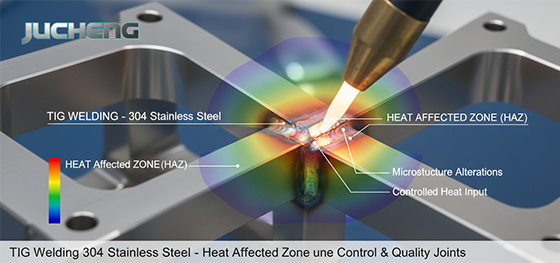
304 stainless steel is generally considered easy to weld, but the key challenge is controlling the heat input to prevent "weld decay" (the temporary loss of corrosion resistance in the heat-affected zone or HAZ):
The TIG Advantage: TIG (Tungsten Inert Gas) welding is preferred for 304 due to its precise heat control, minimizing the size of the HAZ and thus reducing the risk of sensitization.
Weld Decay: If the HAZ is held at high temperatures for too long, the chromium and carbon combine, "robbing" chromium from the matrix and leaving the area vulnerable to intergranular corrosion. Low-carbon variants (like 304L) are often specified for heavy-section welding.
Post-Weld Passivation: After welding, the weld area must be chemically treated (passivated) to remove contaminants and quickly reform the protective chromium oxide layer, a critical step often required for regulatory compliance.
High-Stakes Applications: Compliance in Medical and Automotive

304 stainless steel is the foundation for numerous high-reliability components, and its use necessitates strict adherence to industry-specific quality management systems (QMS):
Medical Devices (ISO 13485): Used for surgical tools, external housings, and internal components due to its corrosion resistance and biocompatibility. The manufacturing process demands full material traceability and mandatory post-weld passivation protocols.
Automotive (IATF 16949): Used extensively in exhaust systems and structural components where its high heat tolerance and corrosion resistance are essential. The QMS requires strict process control to ensure part consistency and structural integrity over the vehicle's lifespan.
Aerospace: High-strength, corrosion-resistant components for structural brackets and fluid systems, often requiring high-precision 5-axis CNC Machining to meet complex designs and tight tolerances.
Sourcing 18/8 stainless steel components demands a partner who understands the material’s unique challenges. Jucheng Precision Technology’s certified expertise in overcoming work hardening during CNC Machining and managing heat during welding ensures your components are manufactured to the highest structural and cosmetic standards.
Secure compliant, high-quality stainless steel parts. Contact us today to leverage our 5-axis CNC Machining, advanced Sheet Metal Fabrication, and certified finishing services.

