


The traditional heavy aluminum fixture is a relic of an era when manufacturing was slow and rigid. In the modern, high-velocity landscape of 3D printing industry applications, the bottleneck to a successful product launch isn't the CNC spindle speed—it's the three-week wait for a toolroom to mill a custom holding device. Every day a production line sits idle because of a missing inspection gauge or a broken assembly nest is a day of lost capital. This is the strategic vacuum filled by 3d printed jigs and fixtures. It is a technical pivot that allows engineers to treat factory-floor hardware with the same iterative agility as a prototype. By replacing heavy, expensive metal plates with topologically optimized, high-strength polymers, companies can slash lead times from weeks to hours while radically improving the physical safety of their workforce.

JUCHENG has spent a decade integrating additive technology into the heart of lean manufacturing environments. We understand that a jig is more than a holder; it is a precision interface that must survive oil, heat, and constant impact. A poorly designed fixture leads to "scrapped work" and repetitive strain injuries for the operator. Our facility utilizes advanced MJF and industrial FDM systems to produce functional tooling that bridges the gap between 3-axis limitations and ergonomic necessity. This guide moves past the basic visual mockups to explore the structural physics of carbon-fiber reinforcement, the economic logic of setup liquidation, and why JUCHENG’s integrated approach to 3d printed jigs and fixtures is the mandatory final link in a truly agile supply chain.
Profitability on the assembly floor is won by removing friction from the human-machine interaction. You aren't just buying a plastic block; you are engineering a custom environment that prevents human error and accelerates throughput. Whether you are building a complex alignment nest for an aerospace manifold or a simple drill guide for a consumer appliance, the logic of the print is your greatest competitive asset. Let us break down the technical pillars of industrial additive tooling and see how JUCHENG transforms digital vision into a structural, shop-floor reality.
Ergonomic Sovereignty: Protecting the Operator’s Performance
Material Fortification: Why Carbon-Fiber and ASA Rule the Floor
Geometric Freedom: Designing Conformal Grippers for Robotics
Economic Recalculation: Comparing CNC Aluminum vs. 3D Printed Jigs
JUCHENG’s Integrated Standard: Validating the Functional Tool
Ergonomic Sovereignty: Protecting the Operator’s Performance
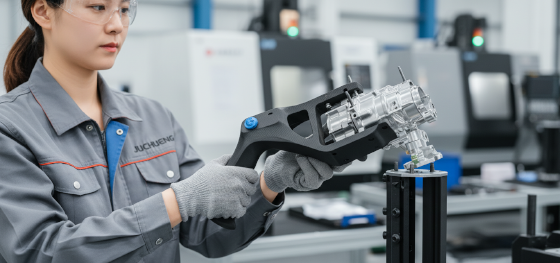
Fatigue is a silent saboteur of quality. In high-volume assembly environments, the weight of a hand-held inspection tool or a manual drill jig directly impacts the rejection rate. Traditionally, these tools were milled from aluminum or steel because it was the only way to ensure rigidity. However, a 5kg aluminum jig handled by an operator eight hours a day leads to fatigue, slower cycle times, and an increased risk of Repetitive Strain Injury (RSI). 3d printed jigs and fixtures allow for a radical rethink of human-centric design. By utilizing lightweight but stiff polymers, JUCHENG can reduce the mass of a hand-held tool by up to 70%.
We go beyond simple weight reduction by engineering "Organic Grips." Because 3D printing allows for complex, anatomical shapes at no extra cost, we can design handles that fit the natural contours of the human palm, reducing the clamping force required by the operator. This "Ergonomic Sovereignty" means your assembly line moves faster and with fewer errors. We can also integrate "No-Mar" surfaces—utilizing soft TPU inserts inside a rigid nylon frame to prevent the fixture from scratching a high-polish automotive trim or a sensitive medical device. By designing the tool for the human hand, JUCHENG ensures that your factory’s most valuable asset—its workforce—remains efficient and safe throughout the entire production shift.
Material Fortification: Why Carbon-Fiber and ASA Rule the Floor
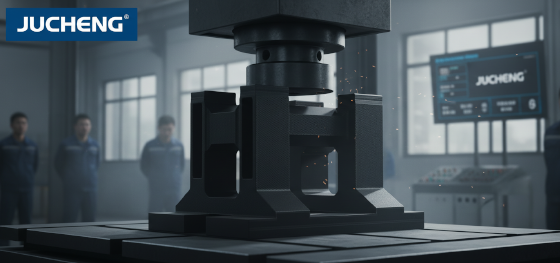
The primary criticism of plastic tooling is that it "won't survive" the harsh environment of a metalworking shop. This is a technical misconception born from experience with low-grade hobbyist materials. Industrial 3d printed jigs and fixtures at JUCHENG are constructed from reinforced composites that possess metal-like stiffness. Our primary weapon for structural fixtures is Nylon-CF (Carbon-Fiber Reinforced Polyamide). This material utilizes microscopic carbon fibers to provide a tensile modulus that rivals soft aluminum, ensuring the jig doesn't deflect when a drill bit or a high-torque wrench is applied.
For outdoor environments or components exposed to intense sunlight and temperature shifts, we utilize **ASA** (Acrylonitrile Styrene Acrylate). Unlike standard ABS, which yellow and become brittle under UV radiation, ASA is a weather-resistant survivor. We use it to build inspection gauges for automotive exterior body panels and agricultural machinery. These "Material Fortifications" allow our fixtures to survive thousands of wash-down cycles, chemical exposure to coolants, and constant mechanical impacts. We treat material selection as an engineering audit; if a jig needs to hold an H7 bore during a heavy assembly press-fit, we select the composite with the necessary compressive strength. This level of technical oversight ensures your plastic tooling performs as a structural partner, not just a temporary mockup.
Geometric Freedom: Designing Conformal Grippers for Robotics

Traditional machining is a slave to the "Line-of-Sight." If a milling tool cannot reach it, the jig cannot hold it. This results in boxy fixtures that often fail to secure organic or complex 3D shapes effectively. 3D printing industry applications in the robotics sector exploit a different logic: "Conformal Geometry." We can print robotic grippers (End-of-Arm Tooling) that are the exact negative of your part’s complex surfaces. This allows for a much more secure "wraparound" grip, eliminating the part-slippage that leads to assembly line shutdowns.
JUCHENG’s engineers utilize topological optimization to design grippers that are not only perfectly contoured but also hollowed for weight savings. We integrate internal air channels for vacuum suction directly into the structure of the part—a feat that would require complex drilling and manifold assembly in metal. This integration reduces the mass of the robot's arm, allowing it to move faster and stop with more precision. For a high-speed automotive assembly line, saving 200ms on every robotic cycle translates to thousands of extra units per year. By leveraging the geometric freedom of additive manufacturing, we deliver "Digital Grippers" that are faster, safer, and much more accurate than their legacy metal counterparts, locking in the efficiency of your automated systems.
Economic Recalculation: Comparing CNC Aluminum vs. 3D Printed Jigs
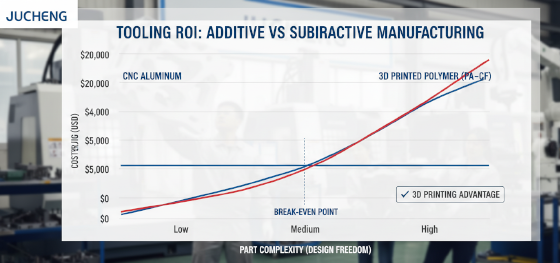
Economics govern the factory floor, and the cost structure of 3d printed jigs and fixtures is radically different from traditional tool-room work. When you mill a jig from a solid block of aluminum, you are paying for three things: the raw metal, the 5-axis machine time, and the highly skilled labor of the machinist. If the design changes, the entire cost is lost. Additive manufacturing replaces this with a "Complexity-Agnostic" cost model. Whether a jig has a simple flat face or a complex internal lattice, the print cost is primarily based on material volume and time.
At Jucheng Precision, we perform a "Total Cost of Quality" (TCQ) audit for our clients. We often find that while a CNC-machined jig might be more durable over a five-year lifespan, the agility of 3D printing provides a better ROI for iterative production. You can replace a worn 3D printed part five times for the cost of one aluminum part. This allow you to update your tooling as your product design evolves, avoiding the "Sunk Cost" trap that forces companies to stick with outdated designs because their tooling was too expensive to replace. For low-to-medium volume production, the 3D printed path is a financial shield, preserving your capital for market development rather than shop-floor metal. We help you find the "Breakeven Moment," ensuring your tooling budget is optimized for the actual lifecycle of your product.
JUCHENG’s Integrated Standard: Validating the Functional Tool
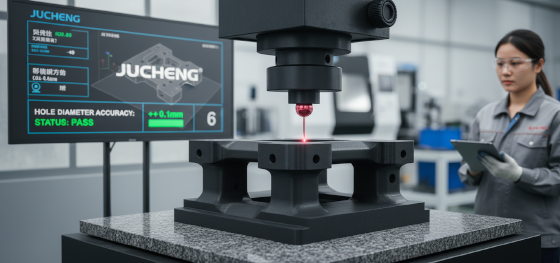
The final hallmark of a professional manufacturing partner is the transition from "model" to "verified tool." A jig is only useful if its dimensions are a technical truth. Jucheng Precision operates a unified quality ecosystem where our additive and subtractive departments share the same high-resolution metrology lab. We don't just "hit print" on your 3d printed jigs and fixtures; we validate them against your master CAD data.
We utilize high-precision CMM (Coordinate Measuring Machine) probes and laser scanners to provide a 100% inspection report for every critical jig. We verify the "True Position" of every locating pin and the "Surface Profile" of every conformal face. This transparency is vital for our aerospace and automotive partners who must prove their assembly line consistency to external auditors. When you receive a tooling package from JUCHENG, you aren't just getting plastic shapes; you are getting verified engineered solutions that are ready to go to work. We bridge the gap between lean manufacturing theory and physical, shop-floor excellence. Whether you are scaling up a new assembly line or looking to optimize a legacy production cell, our expertise in high-performance additive tooling ensures your vision is delivered with absolute integrity. Contact Jucheng Precision today for a technical DFM review and see how our 3D printed fixture protocols can clarify and armor your next factory breakthrough.

