


Forget the vibrating plastic boxes found on hobbyist desks. In a high-stakes industrial facility, extrusion-based additive manufacturing is a different breed of beast altogether. Most people recognize the 3D printing process through the lens of PLA figurines, but fdm 3d printing (Fused Deposition Modeling) at the professional tier is about metal replacement, weight reduction, and chemical survival. It is the only additive technology capable of handling ultra-polymers like PEEK and Ultem—materials that can survive under the hood of a race car or inside the fuselage of a jet. When a design requires a functional jig or a flight-certified bracket in seventy-two hours, industrial FDM is the tactical weapon of choice.
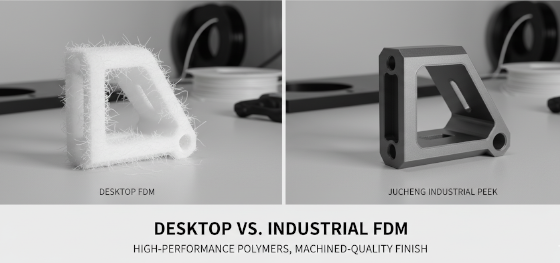
At JUCHENG, we have evolved our FDM capabilities to bridge the gap between "rough prototype" and "production hardware." We understand that for an aerospace engineer or a robotics developer, a part is only useful if it maintains its dimensions under load. Success in industrial extrusion is not found in the speed of the nozzle, but in the thermal sovereignty of the build chamber. If the environment isn't perfectly controlled, high-performance resins will warp, delaminate, and fail. This guide moves past the basic tutorials to explore the thermodynamics of crystalline polymers, the critical importance of Z-axis bond integrity, and why JUCHENG’s focus on engineering-grade materials ensures your hardware thrives where standard plastics melt.
Efficiency in additive manufacturing starts with heat management. You aren't just stacking layers; you are managing a cooling rate that defines the part’s mechanical destiny. Whether you are building an end-of-arm tool for an automated assembly line or a lightweight satellite component, the logic of the melt is your greatest asset. Let us examine the technical pillars of industrial FDM and see how it redefines the survival of your most ambitious structural designs.
Thermal Sovereignty: The Heated Chamber Advantage
Crystalline Ambition: Printing and Machining PEEK
Flight-Certified Integrity: Ultem and Aerospace Safety
Layer Adhesion Physics: Managing the Z-Axis Vulnerability
JUCHENG’s Functional Standard: Beyond Support Removal
Thermal Sovereignty: The Heated Chamber Advantage

The primary barrier that separates industrial fdm 3d printing from consumer-level machines is the management of ambient air. When a thermoplastic is extruded at 300°C into a room-temperature environment, it experiences an immediate thermal shock. This causes the polymer chains to shrink unevenly, leading to "curling" at the base and internal stresses that can rip the part apart before the print is even finished. In common materials like ABS, this is a nuisance; in high-performance materials like PEEK, it is a dealbreaker.
JUCHENG utilizes high-tier industrial machines equipped with actively heated build chambers. These enclosures function as a convection oven, maintaining a stable temperature—often exceeding 150°C—throughout the entire build cycle. By keeping the part near its glass transition temperature (Tg), we ensure that the material remains in a relaxed state. This eliminates the risk of warping and allows for the production of large-scale parts that maintain their dimensional accuracy across a half-meter build plate. This thermal discipline is the only way to achieve the +/- 0.1mm tolerances required for industrial fixtures. We don't fight the physics of shrinkage; we control the environment so that shrinkage happens predictably and uniformly, ensuring that your "Revision A" part fits the assembly as perfectly as the digital model.
Crystalline Ambition: Printing and Machining PEEK
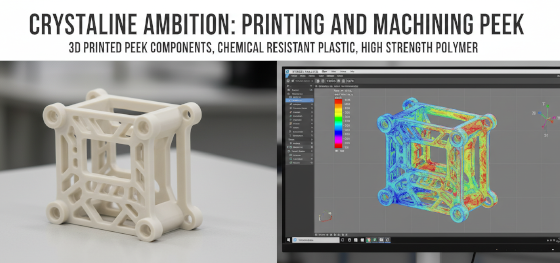
PEEK (Polyetheretherketone) is the "Holy Grail" of FDM materials. It offers a tensile strength that competes with die-cast aluminum and a chemical resistance that allows it to survive in subsea oil wells and medical autoclaves. But PEEK is a semi-crystalline polymer. To reach its full strength, the material must form a specific crystalline structure as it cools. If it cools too fast, it stays amorphous—appearing dark and translucent, but lacking the mechanical toughness required for engineering use.
At JUCHENG, our expertise in PEEK Machining and printing is built on a deep understanding of this "Crystalline Ambition." We use specialized nozzles and high-wattage heaters to manage the transition from molten filament to a stabilized solid. When the settings are correct, the part develops a characteristic tan/beige color, indicating a high degree of crystallinity. For parts that require extreme precision, we often combine FDM with secondary CNC finishing. We print the part slightly oversized and then use our 5-axis mills to refine bearing seats or seal grooves to +/- 0.01mm. This hybrid approach allows you to exploit the lightweight geometry of 3D printing while maintaining the surgical accuracy of traditional machining. It is the ultimate metal-replacement strategy for the modern factory floor.
Flight-Certified Integrity: Ultem and Aerospace Safety

In the aerospace and defense sectors, a material is only as good as its certifications. This is where Ultem (PEI) earns its dominance. Ultem 9085 and Ultem 1010 are high-performance resins specifically engineered for the FST (Flame, Smoke, and Toxicity) requirements of the aerospace industry. If a fire breaks out in a cabin, an Ultem part will not only resist burning but will also refuse to emit toxic fumes—a mandatory safety feature for commercial flight.
JUCHENG utilizes these flight-certified polymers to produce lightweight ducting, electrical junction boxes, and interior fasteners. The primary benefit here is the weight-to-performance ratio. By replacing a heavy metal bracket with a topologically optimized Ultem part, we help aircraft manufacturers shave kilograms off their payload, translating directly into fuel savings. We manage the entire documentation trail for these parts, ensuring that the material batch used in the fdm 3d printing cycle matches the requirements of your regulatory audits. We don't just ship plastic shapes; we ship compliant flight hardware that has been verified for both structural and chemical safety.
Layer Adhesion Physics: Managing the Z-Axis Vulnerability
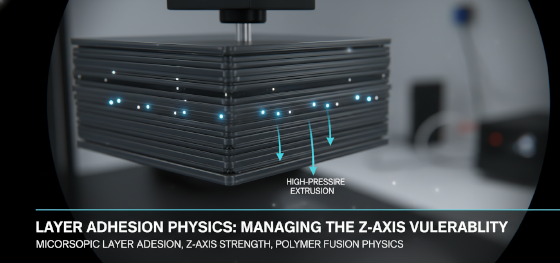
Critics of FDM often point to its "Anisotropy"—the fact that parts are weaker along the vertical Z-axis because the bonds between layers are purely mechanical. On a hobbyist machine, a part might split apart like a stack of Legos. Industrial fdm 3d printing solves this through "Thermal Saturation." By keeping the build chamber hot, we ensure that the previously deposited layer remains at a temperature where it can chemically bond with the fresh, molten plastic coming out of the nozzle.
We further enhance this bond through optimized tool-path engineering. JUCHENG’s CAM engineers utilize "Cross-Hatch" and "Contour-First" strategies to ensure that the stresses of the cooling plastic are distributed evenly across the part’s geometry. We also increase the "Extrusion Multiplier" to slightly over-fill the gaps between layers, creating a denser, more cohesive structure. This technical attention to detail ensures that our FDM parts achieve up to 85% of the strength of an injection-molded part in the Z-axis, a level of integrity that allows them to be used for functional end-of-arm tooling and industrial grippers. We move beyond visual mockups to deliver components that can survive millions of work cycles in a robotic cell.
JUCHENG’s Functional Standard: Beyond Support Removal
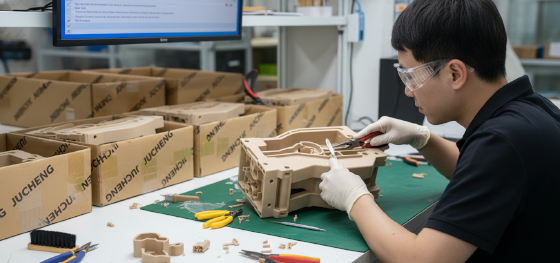
A raw print is rarely the final product. The difference between a "prototype" and a "product" is the quality of the finish. At Jucheng Precision, we operate an integrated post-processing lab where FDM parts are refined through various mechanical and chemical methods. We understand that for an end-use part, the "stair-step" texture of the layers can be a liability for hygiene and aesthetics.
Our workflow includes automated "Bead Blasting" to homogenize the surface and "Solvent Smoothing" for specific materials to achieve a glass-like finish. We also manage the complex task of "Internal Support Removal." For parts with intricate internal channels, we utilize soluble support materials that can be dissolved in a chemical bath, leaving the internal cavities perfectly clean. Every batch of parts is verified through our CMM quality protocol, ensuring that the fdm 3d printing process has delivered the exact geometry required for your assembly. When you partner with JUCHENG, you aren't just buying a 3D print; you are buying an engineered solution that has been validated for performance. Contact our team today for a technical DFM review and see how our industrial extrusion protocols can clarify and secure your next structural challenge.

