


Theory is a dry bone that requires the flesh of physical reality to become wisdom. In the rapidly advancing landscape of 3D printing industry applications, the academic sector has moved far beyond the novelty of desktop PLA printers. We are witnessing a transition from simple classroom visual aids to high-fidelity, mission-critical components built for university research labs and global student competitions. This is the tactical world of 3d printing in education. It is a sector where the "fail fast" mentality of Silicon Valley meets the technical rigor of a PhD thesis. By granting students and researchers access to industrial-grade metals and high-performance polymers, we are effectively shortening the distance between a chalkboard formula and a flight-certified rocket engine.
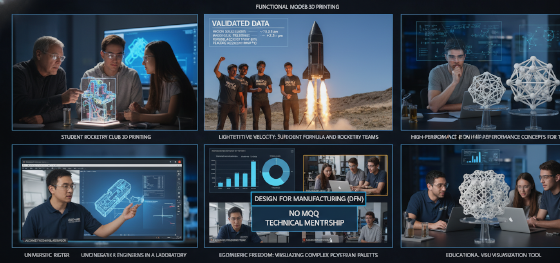
JUCHENG operates as a technical sanctuary for the world’s most ambitious educational institutions. We recognize that a student team building an electric Formula racing car or a graduate researcher developing a new cardiovascular pump doesn't just need a "plastic part"—they need a functional surrogate that survives real-world physics. By providing access to our advanced DMLS titanium and MJF nylon fleet with no minimum order requirements, we empower the next generation of engineers to iterate with absolute professional integrity. This guide moves past the basic school tutorials to explore the logic of material fidelity in research, the importance of DFM mentorship, and why JUCHENG’s commitment to academic innovation ensures your institutional designs move from a digital hypothesis to a tangible, verified success.
Profitability in education is measured by the acceleration of the learning curve. You aren't just buying a 3D print; you are buying the ability to validate complex engineering assumptions before a research budget is exhausted. Whether you are building a cube-sat prototype or an intricate fluid dynamics model, the logic of the print is your most persuasive teaching tool. Let us break down the technical pillars of academic additive solutions and see how JUCHENG transforms digital data into educational certainty.
Academic Rigor: Beyond Desktop Models in the Laboratory
Competitive Velocity: Supporting Student Formula and Rocketry Teams
Material Diversity: Navigating High-Performance Polymers for Theses
Geometric Freedom: Visualizing Complex Mathematical Concepts
JUCHENG’s Institutional Standard: No MOQ and Technical Mentorship
Academic Rigor: Beyond Desktop Models in the Laboratory
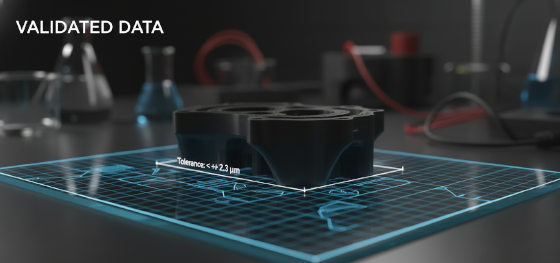
The primary limitation of 3d printing in education has historically been the "Visual Bias"—the tendency to use 3D printing only for non-functional shapes. Desktop FDM machines are excellent for teaching the basics of XYZ movement, but they fail when the research requires material purity and dimensional lock. Modern engineering theses often involve fluid manifolds, sensor housings, or custom laboratory fixtures that must interface perfectly with existing scientific equipment. A part that warps by 0.5mm is a failure that can invalidate months of experimental data.
JUCHENG bridges this gap by offering industrial-grade SLA and SLS capabilities to the academic community. We provide the technical rigor required to produce "Transparent Micro-Fluidics" using high-clarity resins, allowing researchers to visually track particle movement at the micron level. We also assist PhD candidates in the development of custom soft-robotic actuators using high-elongation TPU powders. By moving the student’s design from a toy machine to an industrial center, we provide the "Mechanical Honesty" needed for peer-reviewed research. We treat these academic projects with the same technical reverence as our commercial aerospace contracts, ensuring that the physical surrogate in the lab behaves exactly as the mathematical model predicted. This elevation of standards ensures that the engineers of tomorrow are trained on the high-fidelity hardware of today.
Competitive Velocity: Supporting Student Formula and Rocketry Teams
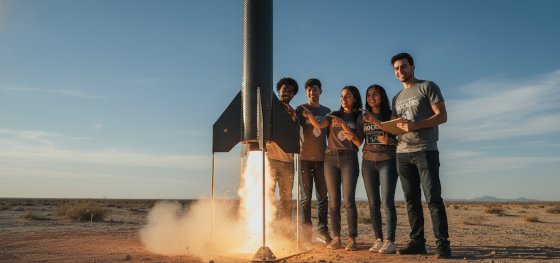
Nowhere is the impact of 3d printing in education more visceral than in student design competitions like Formula SAE (FSAE) and the Spaceport America Cup. These teams are essentially mini-professional racing and aerospace startups. They face the same constraints as Boeing or Ferrari: they must reduce weight, optimize aerodynamics, and survive extreme mechanical stresses, all on a student budget. JUCHENG has become a vital strategic partner for these teams by offering rapid turnaround on functional "Mission-Critical" parts.
We specialize in producing complex air intake manifolds and cooling ducts using MJF (Multi Jet Fusion) nylon. These parts are 50% lighter than traditional aluminum fabrications and can survive the 100°C temperatures of a racing engine bay. For rocketry teams, we utilize metal 3d printing to produce lightweight titanium mounting nodes that can survive the violent vibration of a launch. Our ability to deliver these complex, "one-piece" assemblies in as little as 48 hours allows student teams to iterate their designs based on test-track feedback. If a wing mount fails during a Tuesday testing session, JUCHENG can have a redesigned, reinforced version in the student's hands by Friday. This speed-to-solution is what defines the winning edge in modern engineering education, teaching students that additive manufacturing is a tactical tool for real-world survival, not just a prototyping convenience.
Material Diversity: Navigating High-Performance Polymers for Theses
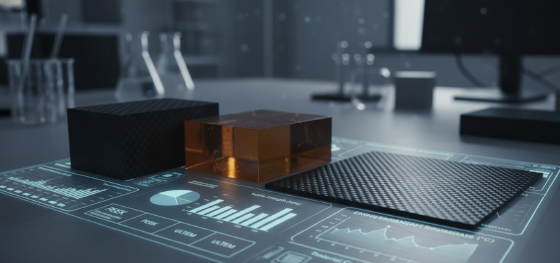
An engineering thesis often explores the "Edge Cases" of material science. A student might be researching the chemical resistance of polymers in harsh environments or the dielectric strength of insulators in high-voltage arrays. 3D printing in education reaches its maximum utility when it offers a diverse material palette that mirrors the industrial reality. JUCHENG provides students with access to materials that are traditionally difficult to source in small quantities, such as PEEK 3D Printing and Ultem 3D Printing.
Providing these high-performance options allows researchers to validate their designs under extreme conditions. For example, we assist university groups in machining and printing PEEK components for deep-sea underwater drones that must resist both crushing pressure and saline corrosion. By offering over 30 different 3D printing materials, we ensure that the academic community isn't limited to "simulated" performance. We provide the "Real Deal"—the same aerospace-grade resins and medical-grade titanium powders used by Tier 1 suppliers. This material diversity empowers researchers to push the boundaries of their fields, providing the physical evidence needed to support groundbreaking scientific claims. We bridge the gap between the classroom and the industrial laboratory, ensuring that every student project is backed by a professional-grade molecular foundation.
Geometric Freedom: Visualizing Complex Mathematical Concepts
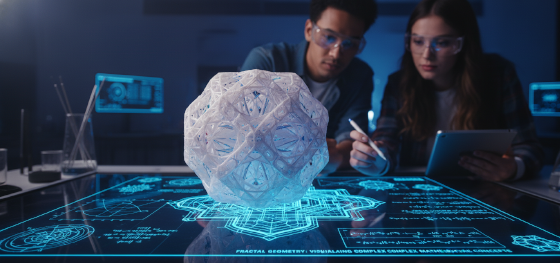
Mathematics is often a purely abstract struggle until it is manifested in three dimensions. For students of topology, generative design, and complex geometry, 3D printing is the ultimate translation tool. We utilize high-resolution SLA to print complex "TPMS" (Triply Periodic Minimal Surfaces) and intricate lattice structures that are the subject of modern structural research. These shapes, which resemble alien organic structures, are designed to maximize surface area and minimize mass.
Traditional manufacturing can never build these shapes; they are born in the void. By providing these physical models, JUCHENG helps students visualize how a Gyroid or Schwarz-P structure behaves under load or how it facilitates fluid mixing. This tactile learning is essential for mastering "Design for Additive Manufacturing" (DfAM). We allow students to hold their mathematical visions in their hands, feeling the rigidity of a lattice or the flow of a curved channel. This visual and tactile clarity accelerates the understanding of complex spatial relationships, providing an educational ROI that a textbook can never match. We don't just print models; we manifest the "Impossible Geometry" of the future, giving the students the physical vocabulary to discuss the next era of engineering design.
JUCHENG’s Institutional Standard: No MOQ and Technical Mentorship
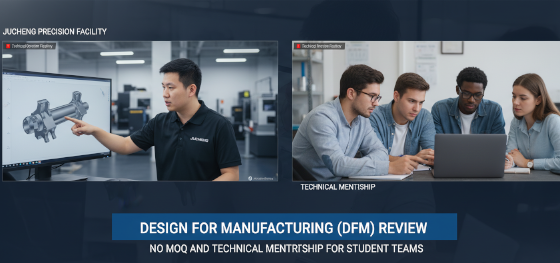
The final hallmark of our commitment to 3d printing in education is the removal of the "Minimum Order" barrier. Most industrial shops refuse to touch a student project because the volume is too low to justify the setup time. Jucheng Precision operates differently. We recognize that today’s student with a single 3D print is tomorrow’s lead engineer at a major aerospace firm. We have a "No MOQ" policy for educational and research projects, ensuring that even a single, tiny micro-connector receives the same technical attention as a high-volume production run.
Beyond the machines, we provide "Technical Mentorship." Every student project submitted to JUCHENG undergoes a professional DFM review. Our engineers provide feedback on wall thickness, support placement, and material choice, teaching the students the practical realities of industrial manufacturing. We provide full material traceability and CMM inspection reports, giving researchers the data they need for rigorous academic publishing. When you partner with JUCHENG, you aren't just getting a part; you are getting a verified engineering solution that has been audited for technical survival. We don't just support education; we integrate with it, providing the industrial-scale capacity and engineering rigor needed to launch the breakthroughs of tomorrow. Contact Jucheng Precision today for a technical review of your university project and see how our academic additive protocols can clarify and elevate your next discovery.

