


A great product is not born from a great design alone. It is born from a conversation. A conversation between the designer's vision and the material's voice.
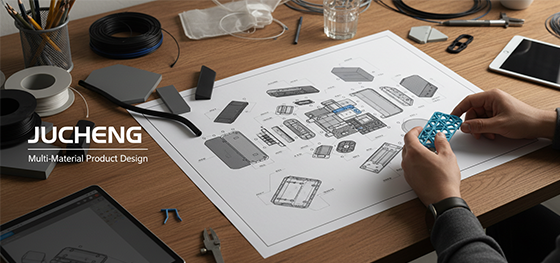
In the world of Industrial 3D Printing, that conversation has become incredibly rich and exciting. The palette of available 3D printing materials is no longer just a few basic plastics. It is a vast library of polymers and metals, each with its own unique personality and potential.
This is not a guide to every material. It is a guide to thinking like a modern designer. It is about how to choose, combine, and apply these materials to create a product that is more than the sum of its parts.
Building Your Foundation: Structural Plastics
Creating a Window: Transparent Materials
Adding a Soft Touch: Flexible Materials
Reaching for the Extreme: High-Performance Polymers
Unleashing the Power of Metal
Building Your Foundation: Structural Plastics

Every product needs a skeleton. A core structure that provides strength and rigidity. For this, you need a material that is tough and durable.
In industrial 3D printing, the undisputed workhorse for this job is Nylon (Polyamide, PA). Printed with processes like SLS or MJF, Nylon parts are incredibly tough. They can bend significantly without breaking and can withstand repeated impacts.
This makes Nylon the perfect choice for functional prototypes and end-use parts like enclosures, drone frames, and jigs and fixtures. For even more stiffness, we can use Glass-filled Nylon. The tiny glass fibers inside the plastic act like a rebar, making the part much more rigid under load.
Creating a Window: Transparent Materials
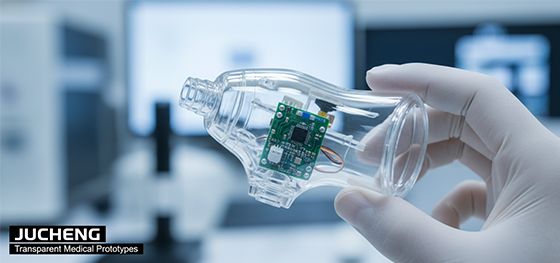
What if your product needs a window? Or a lens? Or a fully transparent housing to show off its internal components?
For this mission, we turn to the world of Vat Polymerization. Using a special Clear Resin with an SLA 3D printing process, we can create parts with excellent optical clarity.
Right off the printer, the part is translucent. But the real magic happens in post-processing. Our skilled technicians can carefully sand and polish the part through a multi-stage process. The result is a component that is as clear as glass or injection-molded Polycarbonate.
This allows designers to create stunning visual prototypes, light pipes for complex electronic assemblies, and custom optical components.
Adding a Soft Touch: Flexible Materials
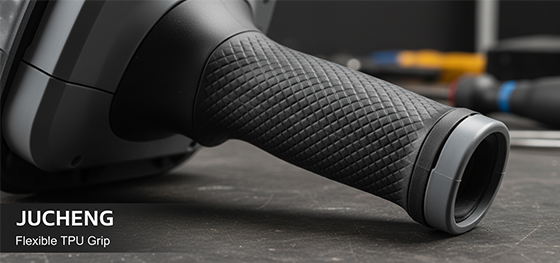
A great product often engages more than just the eyes. It engages the sense of touch. A soft, grippy handle can make a tool feel more secure and comfortable.
For this, we use flexible, rubber-like materials. The most common are Thermoplastic Polyurethanes (TPU) and Thermoplastic Elastomers (TPE).
These materials can be printed using processes like SLS or MJF. They produce parts that are highly durable, tear-resistant, and can be repeatedly stretched and compressed. This is perfect for creating functional seals, gaskets, soft-touch buttons, and ergonomic grips.
It is even possible to create a multi-material part, with a rigid Nylon body and a flexible TPU grip, all printed in a single assembly. This opens up huge possibilities for advanced product design.
Reaching for the Extreme: High-Performance Polymers
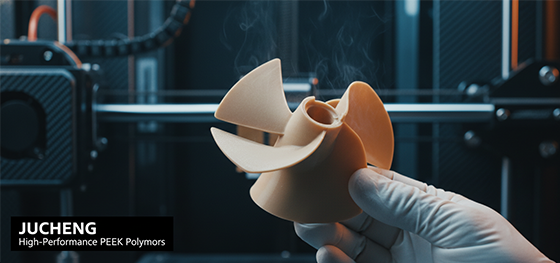
What if your part lives in the brutal world of a hot engine bay or a corrosive chemical bath? This is where the elite, high-performance polymers come in.
Materials like PEEK and Ultem (PEI) can be printed using specialized, high-temperature industrial FDM machines. These materials offer incredible resistance to heat and chemicals, far beyond what standard plastics can endure.
Printing these materials is a challenge. It requires a machine with a heated chamber and very high nozzle temperatures. But the result is a part that can often replace metal components, offering a significant weight saving without compromising on performance in extreme environments.
Unleashing the Power of Metal
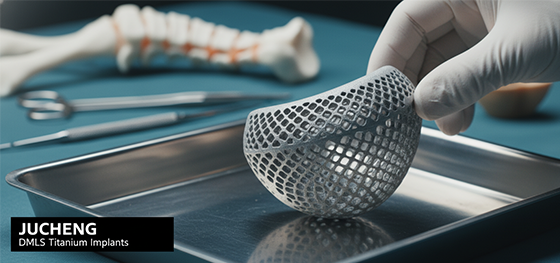
Finally, we have the power of metal itself. Industrial 3D printing is not just about plastics.
Using Direct Metal Laser Sintering (DMLS), we can create fully dense parts from a range of powerful metal powders. Titanium (Ti64) for its unmatched strength-to-weight ratio in aerospace. Stainless Steel (316L) for its corrosion resistance in medical and marine applications. Aluminum (AlSi10Mg) for lightweight thermal management.
This technology is a game-changer. It allows designers to create organic, lightweight metal structures that are impossible to manufacture with traditional CNC machining. It is the key to creating the next generation of high-performance products. A skilled manufacturing partner like JUCHENG can help you navigate this vast palette, advising on the perfect material to bring your specific vision to life.

