


You hear "3D printing" everywhere. It conjures images of small desktop machines printing toys and trinkets. Erase that image from your mind. That is not our world.
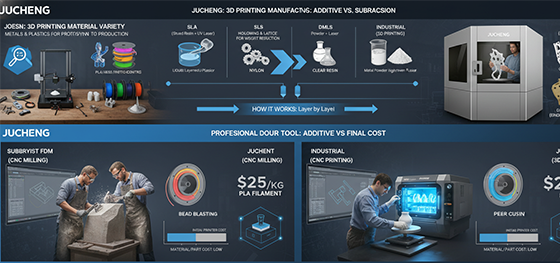
In professional product development, we operate in a different universe. Our world is Industrial 3D Printing, also known as Additive Manufacturing. This is not a hobby. It is a powerful, precise, and strategic manufacturing tool. It involves large, highly advanced machines creating functional, end-use parts from certified metals and high-performance polymers.
This is a manufacturer's guide to that professional world. We will go beyond the hype and explore the real processes, materials, and design rules that turn a digital file into a high-quality, functional part. At JUCHENG, our factory is equipped with these industrial-grade machines. This is the world we understand, and this guide is our perspective from the factory floor.
content:
Understanding Your Process Options
Navigating Your Material Choices
Thinking in Layers: Smart Design Rules
A Realistic Look at Tolerances
Finishing the Job: Post-Processing
Choosing Your Tool: Additive vs. Subtractive
Breaking Down the Final Cost
Seeing it in Action: Industry Applications
Understanding Your Process Options
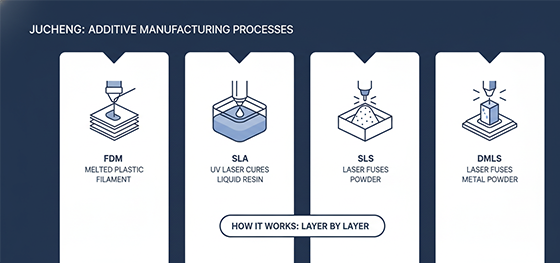
All 3D printing builds parts layer by layer. But the method of creating those layers defines each 3D printing process. We can group them by the type of raw material they use.
Vat Polymerization is a process that starts with a vat of liquid photopolymer resin. Stereolithography (SLA) is the classic example. It uses an ultraviolet laser to precisely trace the shape of a layer, curing the liquid resin into a solid. A similar, faster technology is digital light processing 3d printing (DLP). Instead of a single laser point, DLP uses a digital projector to flash an image of the entire layer at once. This allows it to cure a whole layer in just a few seconds, making it incredibly fast for small, intricate parts.
Powder Bed Fusion works with a bed of fine polymer powder. Selective Laser Sintering (SLS) uses a powerful CO2 laser to fuse the powder particles together. HP's Multi Jet Fusion (MJF) is a different take. It uses an inkjet array to print a detailing agent and a fusing agent onto the powder, then uses a heat lamp to fuse the layer. Both create very tough, functional parts from materials like Nylon.
Metal 3D Printing, like Direct Metal Laser Sintering (DMLS) or Selective Laser Melting (SLM), operates on a similar principle but with metal powder. A high-power fiber laser melts and fuses the metallic powder in a controlled atmosphere, creating fully dense, solid metal parts.
Material Extrusion, or FDM, is the most well-known process. It melts a filament of thermoplastic and draws the part, layer by layer. While common in desktop machines, industrial FDM printers are very different. They are enclosed, heated machines that can print with high-performance materials like PEEK and Ultem.
Navigating Your Material Choices

The true power of industrial 3D printing lies in the vast library of 3D printing materials. These are not just simple plastics; they are advanced polymers and metal alloys designed for serious engineering.
Metals are a key category for high-strength applications. We can print parts in Titanium (Ti64), known for its incredible strength-to-weight ratio, making it ideal for aerospace and medical implants. Stainless Steel (316L) offers excellent corrosion resistance for parts exposed to harsh environments. Aluminum (AlSi10Mg) is a fantastic lightweight option for thermal applications and housings. We can even print with Maraging Tool Steel to create custom mold inserts with conformal cooling channels.
Plastics offer an even broader spectrum of properties. For strong, Rigid parts, Nylon (PA11/PA12) printed via SLS or MJF is the go-to workhorse. For even more stiffness, Glass-filled Nylon provides a significant performance boost. For Transparent components, we use special Clear Resins with SLA that can be post-processed to achieve optical clarity, behaving much like Polycarbonate. For the most extreme High-Performance applications, PEEK and Ultem 9085 offer incredible heat and chemical resistance. For Flexible, rubber-like parts, we use materials like TPU and TPE, which are perfect for seals, grips, and living hinges.
Thinking in Layers: Smart Design Rules
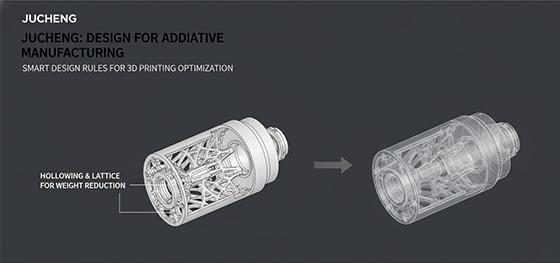
A successful 3D print begins on the drawing board. Designing for this technology requires a different way of thinking. This is called Design for Additive Manufacturing, or DfAM. A good 3D printing design is a smart design.
The question of how to design 3d print models for success comes down to a few key principles. First, think about Wall Thickness. Try to keep it as consistent as possible to manage thermal stress. For hollowing out parts to save weight and cost, this is a great strategy. But remember to add Escape Holes. These small holes allow uncured resin or unsintered powder to be removed from the internal cavities. Without them, the part will be a solid, heavy, and expensive brick.
Another key is understanding Support Generation. Most processes need supports for overhanging features. A smart designer will orient their part on the build plate to minimize these. The "45-degree rule" is a good starting point. Most printers can build overhangs up to 45 degrees without any supports. By keeping your design within these limits, you can reduce material waste and post-processing time.
A Realistic Look at Tolerances

Engineers need to know about precision. A common question we get is, "how much tolerance for 3d printing is typical?" It is important to distinguish between hobbyist and industrial machines. Professional 3D printing tolerances are in a different league.
Generally, for industrial polymer processes, a good starting point is around +/- 0.1mm to 0.2mm for the first inch, with a small additional tolerance for each subsequent inch. This level of accuracy is suitable for the vast majority of prototyping and even some end-use applications.
So, what is a good tolerance for 3d printing? A "good" tolerance is one that is fit for purpose. For a high-resolution process like SLA, achieving +/- 0.1mm on small features is considered excellent. For a thermal process like MJF or DMLS, the tolerances might be slightly wider due to the heat involved, but the results are highly repeatable. A professional partner like JUCHENG will always provide a clear statement of our standard tolerances for each process.
Finishing the Job: Post-Processing

A 3D print is rarely "finished" right off the machine. It needs professional 3D printing post processing to become a true product. This involves a range of skilled techniques.
The first step is always cleaning and Support Removal. For resin parts, this means washing in an alcohol solution and then curing in a high-intensity UV Curing Oven. For powder parts, it means carefully removing the part from the powder bed and cleaning it with compressed air or a bead blaster.
Then comes the surface finishing. Sanding with progressively finer sandpaper grids is a common method to achieve a smooth surface. For Nylon parts made with SLS or MJF, a process called Vapor Smoothing can be used. It uses a chemical vapor to slightly melt the outer surface of the part, resulting in a sealed, smooth, almost injection-molded quality finish. Finally, many parts are sent for Painting or Dyeing to achieve the perfect cosmetic look. Safety precautions are critical here, from using PPE for resin handling to proper dust control for powders.
Choosing Your Tool: Additive vs. Subtractive

A key strategic decision is choosing between a cnc machine vs 3d printer. They are two fundamentally different philosophies.
CNC machining is "subtractive." It is like a sculptor. It starts with a solid block of material and carves away everything that is not your part. 3D printing is "additive." It is like a potter. It builds your part from the ground up, layer by layer.
The cost difference is a major factor. For low volumes (1-10 parts) or parts with extreme geometric complexity, 3D printing is often cheaper because there are no setup costs. For medium volumes (50+ parts) of a relatively simple design, CNC is often more cost-effective because its speed per part is much faster. A true manufacturing partner offers both, so they can give you unbiased advice on the smartest choice.
Breaking Down the Final Cost
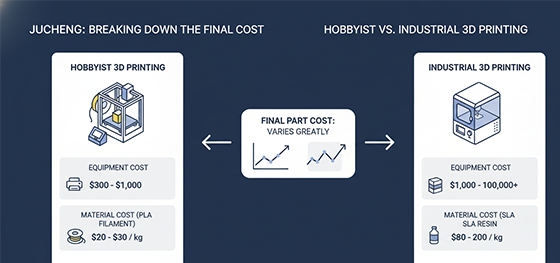
The final 3D printing cost is a blend of several factors. A frequent question is, "how much does a 3d printer plastic cost?" The answer reveals the gap between hobby and industry.
A 1kg spool of basic hobbyist PLA filament might cost $20. A 1kg bottle of high-performance, certified industrial resin for an SLA machine can cost $200. A kilogram of certified titanium powder for DMLS can cost many hundreds more.
But material is only one part of the equation. The biggest cost driver is almost always machine time. This is determined by the total volume of your part and, most importantly, its height in the build orientation. A taller part means more layers, which means more time. Finally, the amount of skilled labor required for post-processing will also impact the final cost.
Seeing it in Action: Industry Applications
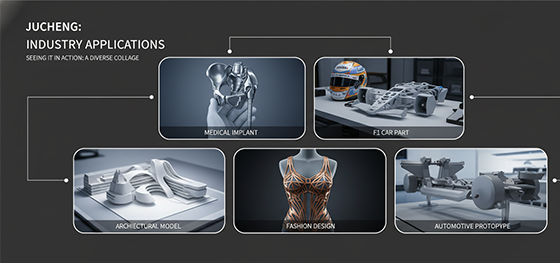
The true power of this technology is revealed in its real-world 3D printing industry applications.
The Medical field uses DMLS to print patient-specific titanium implants. The Aerospace industry uses industrial FDM with Ultem to print strong, lightweight, and flame-retardant interior components. The Automotive industry uses SLS and MJF to create durable, functional prototypes and assembly jigs. Architects use large-format SLA to build magnificent, highly detailed scale models. And the Fashion industry is using SLS and MJF to create complex, customized wearable items with lattice structures that are impossible to make any other way. The possibilities are truly endless.

