


Delivering a luxury metallic aesthetic demands aggressive mechanical friction. Hardware founders often assume liquid metal ejects from the mold looking exactly like a shiny smartphone chassis. Raw injected parts actually feature dull, slightly textured outer skins covered in tiny flow marks and parting lines. Executing professional aluminum die casting polishing physically erases these ugly manufacturing scars, transforming basic structural brackets into premium consumer hardware. Selecting an inexperienced vendor to perform this heavy abrasion guarantees a skyrocketing scrap rate on your assembly line.

Sanding raw metal requires extreme factory caution. Grinding too deeply into the outer layer instantly exposes hidden internal gas bubbles, turning a viable part into worthless scrap. Evaluating your baseline die casting surface finish determines exactly how much material operators can safely remove without breaching the dense outer shell.
Operating our massive Shenzhen precision hub, JUCHENG balances aggressive material removal against strict dimensional tolerances. Let's dissect the brutal physical challenges of buffing porous alloys, review the step-by-step mechanical progression, and discover why perfect surface prep guarantees indestructible paint adhesion.
content:
The Porosity Trap: Why Do Polished Parts Break?
Step-by-Step Execution: Sanding to Mirror Shine
Prepping for Paint: Creating the Ultimate Canvas
JUCHENG Hub: Shenzhen's Automated Robotic Polishers
FAQ: Honest Answers About Dimensional Changes and Rust
The Porosity Trap: Why Do Polished Parts Break?

Grinding machines easily destroy expensive hardware if operated blindly. Unlike solid forged billets, injected metals contain microscopic air pockets trapped just beneath the hard outer skin during the high-speed cooling phase.
Chewing through that protective millimeter of dense metal exposes a horrifying sponge-like matrix. Once a polishing wheel hits this porous layer, achieving a high-gloss reflection becomes mathematically impossible because the chemical waxes simply pack into the open holes.
Foundry engineers must dial in the hydraulic injection pressure perfectly to ensure the outer skin remains incredibly thick. This allows finishing technicians to buff away superficial flow marks safely without ever rupturing the dangerous internal gas voids.
Step-by-Step Execution: Sanding to Mirror Shine

Eradicating sharp parting lines marks the beginning of the mechanical journey. Technicians deploy coarse abrasive sanding belts to aggressively flatten the stepped edges left behind by the separating steel mold halves.
Buffing immediately follows this heavy material removal phase. Utilizing softer cotton wheels loaded with specific chemical cutting compounds gently smooths out the deep directional scratches left by the initial abrasive belts.
Achieving a true mirror reflection requires the final color-buffing stage. High-speed soft wheels paired with ultra-fine rouge compounds physically burnish the metallic surface, creating a brilliant, flawless aesthetic suitable for luxury electronics.
Prepping for Paint: Creating the Ultimate Canvas

Liquid coatings absolutely refuse to bond with jagged, oxidized manufacturing burrs. Creating a beautifully smooth foundation ensures your final topcoat adheres flawlessly to the underlying metallic structure without bubbling or flaking off.
Understanding exactly how to paint die cast parts relies entirely on this aggressive pre-treatment phase. Rough surfaces cause expensive automotive paints to pool unevenly, creating ugly ripples that ruin the perceived value of your commercial product.
Applying robust aluminum die casting powder coating also demands exceptional baseline smoothness. Erasing tiny surface craters prevents the baked polymer layer from forming massive outgassing blisters during the intense oven curing cycle.
JUCHENG Hub: Shenzhen's Automated Robotic Polishers
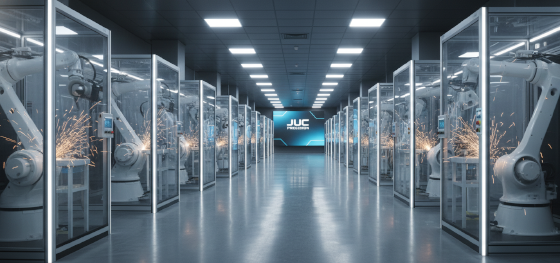
Relying purely on manual human labor to buff thousands of complex enclosures guarantees inconsistent aesthetic results. Fatigue causes hand-polishers to apply uneven pressure, slowly altering the dimensional tolerances of critical mounting bosses across a long shift.
Deploying advanced 5-axis robotic buffing cells eliminates this human error entirely. Our automated robotic arms apply the exact same friction and pressure to every single unit, delivering flawless, repeatable high-gloss finishes across massive production runs.
Stop paying for ruined batches of porous metal. Send your cosmetic hardware CAD files to our engineering team today for a rigorous manufacturing audit. We provide unyielding baseline castings and deliver stunning, mirror-polished components ready for global retail.
FAQ: Honest Answers About Dimensional Changes and Rust

Does heavy buffing change the physical dimensions of the hardware?
Yes, aggressive abrasive friction removes a measurable layer of material. We actively compensate for this fractional reduction during the initial tool design phase to ensure final assembly tolerances remain perfect.
Can you polish every single internal corner of a complex heatsink?
No. Spinning buffing wheels physically cannot reach deep inside narrow cooling fins or tight internal pockets. We utilize alternative mass-finishing techniques like tumbling for highly complex internal geometries.
Why do some polished parts lose their shine after a few weeks?
Raw, untreated alloys naturally oxidize when exposed to atmospheric moisture. Applying a clear protective lacquer or a transparent anodizing layer immediately after buffing seals the mirror finish permanently.
Will aggressive sanding erase deep flow marks completely?
Shallow flow marks vanish effortlessly. However, extremely deep cold shuts or severe metal folding defects cannot be sanded away safely without destroying the part's structural integrity.

