


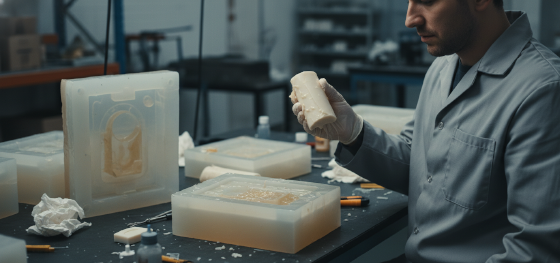
Manufacturing integrity evaporates during the final seconds of a failed demolding operation. Engineers often wait four hours for a silicone block to cure, only to split the mold and discover a catastrophic air pocket on a critical mounting boss or a layer of unreacted "goo" where the surface should be pristine. These Common Silicone Mold Defects represent more than just lost material; they signify a breakdown in physical and chemical process control. Many low-cost prototype shops treat these failures as unavoidable "bad luck," but Jucheng Precision views every defect as a traceable violation of manufacturing physics. Achieving a perfect silicone mold for casting requires a surgical management of vacuum pressures, mixing ratios, and material compatibility. This troubleshooting guide dissects the four most lethal defects in the casting room, providing the technical forensic data needed to identify why a tool failed and how to ensure your next batch reaches the market without a single surface blemish.
Atmospheric Voids: The Physics of Entrapped Air
Chemical Warfare: Solving Catalyst Cure Inhibition
Mechanical Drift: Eradicating Parting Line Mismatch
Structural Tearing: Managing Geometric Stress Risers
JUCHENG Protocol: Standardized Process Control
Atmospheric Voids: The Physics of Entrapped Air
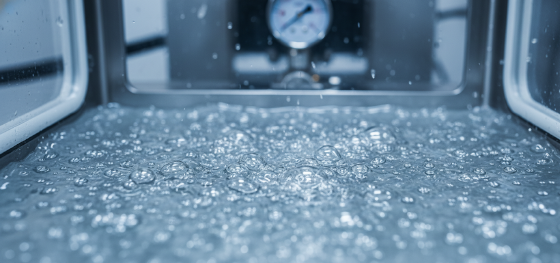
Air is the primary antagonist in Common Silicone Mold Defects. When a technician mixes two-part RTV silicone, they inadvertently whip millions of microscopic nitrogen and oxygen bubbles into the viscous liquid. If this mixture is poured directly over a master pattern, surface tension causes these bubbles to cling to sharp corners and recessed textures. These trapped voids become permanent "pimples" or pits on the final cast part. Preventing this requires reaching a "Deep Vacuum" of at least 29 inches of Mercury (Hg). At this pressure, the bubbles expand to thirty times their original volume, rising to the surface in a violent "boil" before the mixture collapses into a dense, air-free state. Amateur setups often fail because their vacuum pumps lack the CFM (Cubic Feet per Minute) to reach this critical threshold before the silicone begins to cross-link. Jucheng Precision eliminates this risk by using multi-stage industrial vacuum chambers and a "long pour" technique, where the degassed silicone is poured in a hair-thin stream from a height of one meter, allowing any residual micro-bubbles to stretch and burst before touching the master.
Chemical Warfare: Solving Catalyst Cure Inhibition
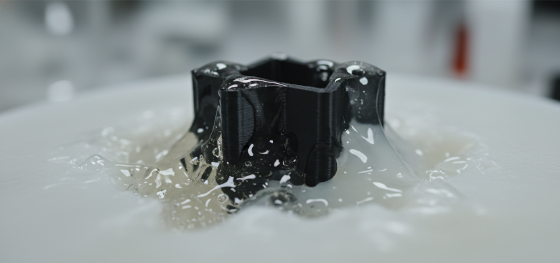
Catalyst poisoning is perhaps the most frustrating among Common Silicone Mold Defects because the mold appears perfect until you touch it. You split the cured silicone block only to find a layer of sticky, uncured liquid exactly where the silicone touched the master pattern. This is "Cure Inhibition." It occurs primarily with platinum-cure (addition-cure) silicones when they encounter "inhibitors" such as sulfur, tin, or certain nitrogen-based chemicals found in specific 3D printing resins (like SLA or DLP materials). These chemicals effectively "blind" the platinum catalyst, preventing the polymer chains from locking. The resulting mold is ruined, and the master pattern is often contaminated. We solve this through rigorous "Material Interrogation." Before pouring, Jucheng Precision technicians apply a specialized barrier coating to all printed master patterns. We also perform a "Small-Patch Test" on unknown materials to ensure the silicone cures flawlessly against the substrate. By isolating the chemistry, we guarantee that the exothermic reaction proceeds to 100% completion, delivering a rock-solid mold every time.
Mechanical Drift: Eradicating Parting Line Mismatch
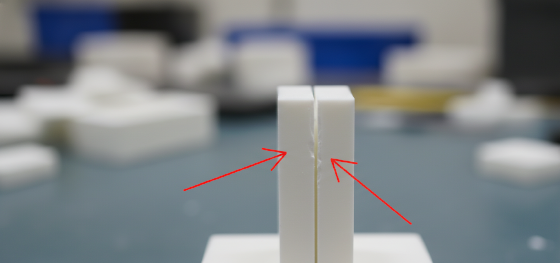
Precision disappears when the two halves of a mold fail to align. This defect, known as "Parting Line Mismatch," manifests as a noticeable "step" or offset at the seam of the final part. It is a mechanical failure caused by the shifting of the silicone halves under the hydrostatic pressure of the liquid resin. If the "Registration Keys"—the conical indentations that lock the halves together—are too shallow or too few, the mold will slide during the vacuum cycle. This is particularly prevalent in large-format Common Silicone Mold Defects where the sheer weight of the resin exerts massive lateral force. Jucheng Precision prevents mechanical drift by engineering "High-Engagement Keys" into the first pour. We use deep, interlocking geometric features that prevent even a micron of lateral movement. We also utilize rigid outer "Mother Molds" (jackets) made of fiberglass or acrylic for large parts, ensuring the soft silicone remains perfectly constrained under pressure. This ensures that the parting line remains a microscopic seam rather than a structural deformity.
Structural Tearing: Managing Geometric Stress Risers
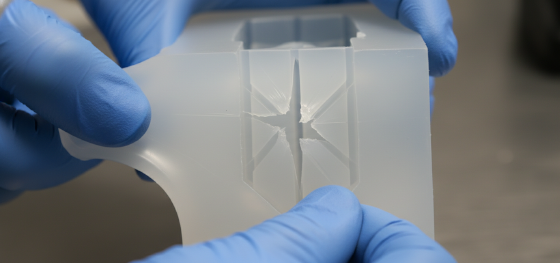
Mechanical fatigue kills a mold before its time. While silicone is flexible, it has a finite "Tear Strength" limit. Defects often appear as jagged tears at the base of deep internal ribs or sharp mounting bosses. These tears occur during the "De-molding" phase, when the technician pries the rigid polyurethane part out of the flexible tool. If the part geometry features zero draft angles or sharp 90-degree internal corners, the friction and stress become localized, eventually "biting" a piece of silicone out of the mold. Every subsequent part will then exhibit a corresponding "blob" of excess plastic where the mold wall is missing. We preemptively solve this through elite "Mold Surgery." Our technicians use scalpels to create "stress-relief cuts" in non-critical areas, allowing the mold to expand more freely during extraction. We also insist on a minimum 0.5-degree draft angle for deep features during our complimentary DFM review. By reducing the physical friction, we extend the life of the tool and prevent the premature tearing that plagues amateur casting operations.
JUCHENG Protocol: Standardized Process Control
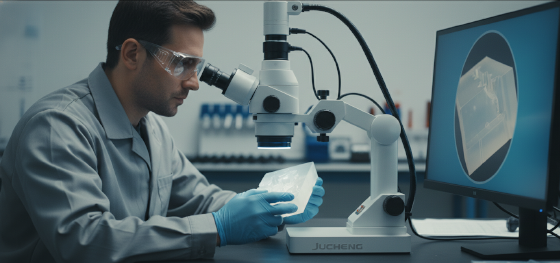
Quality is a byproduct of relentless standardization. At Jucheng Precision, we recognize that Common Silicone Mold Defects are entirely preventable through rigorous SOPs (Standard Operating Procedures). We utilize digital mixing stations to ensure exact 1:1 or 10:1 ratios, preventing the "soft cure" issues caused by manual guesswork. Our quality control lab inspects every mold cavity using high-magnification digital microscopes before the first resin pour. If we detect a single micro-bubble or a trace of parting line drift, the mold is scrapped immediately. We don't "fix" molds with epoxy or tape; we manufacture perfection from the first pour. This commitment to process sovereignty is why JUCHENG remains the preferred partner for medical manifold developers and automotive interior designers who require 100% fidelity. Stop gambling with your prototype budget. Leverage our decade of process mastery to ensure your hardware arrives on time, on spec, and without a single defect.

