


Let's clear up one of the biggest misconceptions in prototyping. The term "silicone vacuum casting" does not mean you are making a part out of silicone.
This is a shock to many designers. They search for this term because they want a soft, rubbery, silicone-like prototype. But the name of the process is misleading. It describes the tool, not the final product.
Understanding the true roles of the different materials in this process is the key to unlocking its power. This guide will act as your detective, revealing the true identity of each player in this fascinating manufacturing story.
content:
A Common, Confusing Term
Unmasking the Roles: Silicone is the 'Mother'
Polyurethane is the 'Child'
So, Can You Get a 'Silicone-Like' Part?
Choosing a Partner Who Clarifies, Not Confuses
A Common, Confusing Term

The term "silicone vacuum casting" is confusing because it contains two different materials. An engineer needing a soft, rubbery prototype sees the word "silicone" and assumes that is the final material.
This is a logical assumption. But it is incorrect. In this process, silicone plays a critical, but temporary, role. It is the creator, not the creation.
To truly understand the process, we need to assign the correct roles to the two main players: Silicone and Polyurethane.
Unmasking the Roles: Silicone is the 'Mother'
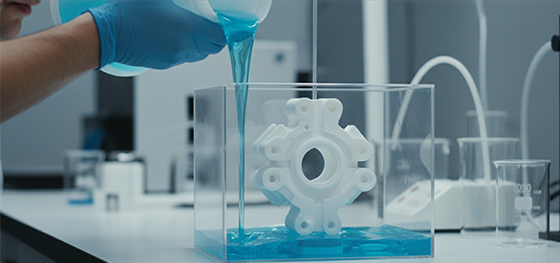
In the silicone vacuum casting process, the silicone's role is to be the mold. Think of it as the "mother" mold.
The process starts with a perfect master pattern of your part. We then pour liquid RTV (Room-Temperature-Vulcanizing) silicone rubber around this pattern. The silicone cures into a solid, flexible block.
We then cut this block open and remove the master pattern. What remains is a beautiful, highly detailed, and flexible silicone mold. Its internal cavity is a perfect negative of your part.
Silicone is chosen for this role because it is amazing at capturing fine details. It is also flexible, which makes it easy to remove the final, cured part, even if it has some undercuts. And it is durable enough to make about 15-25 copies.
Polyurethane is the 'Child'
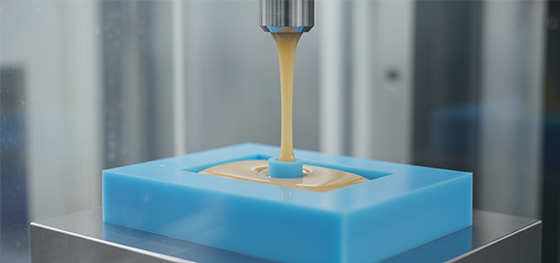
If the silicone mold is the "mother," then the final part is the "child." And that child is made of polyurethane.
Once the silicone mold is ready, we mix a two-part liquid polyurethane resin. This is the actual material that will become your part. This is the most important category of vacuum casting materials.
We pour this liquid resin into the silicone mold inside a vacuum chamber. The vacuum removes all air bubbles, ensuring a perfect, solid part. The resin then cures inside the mold, taking on its exact shape and texture.
So, the final part that you hold in your hand is a polyurethane casting that was born from a silicone mold.
So, Can You Get a 'Silicone-Like' Part?

This brings us to the most important question. If the final part is made of polyurethane, how can you get the soft, rubbery, silicone-like prototype you wanted?
The answer lies in the incredible versatility of polyurethane resins. These resins are not one single material. They are a huge family. A library of materials.
There are special formulations of polyurethane that are designed to perfectly mimic the properties of silicone rubber. These are called elastomeric polyurethanes.
We can choose a formulation with a very low Shore A hardness, for example, 20A or 30A. The resulting part will be extremely soft, flexible, and stretchy. It will feel almost exactly like a soft silicone part. We can even make them in a translucent finish to complete the illusion.
Choosing a Partner Who Clarifies, Not Confuses
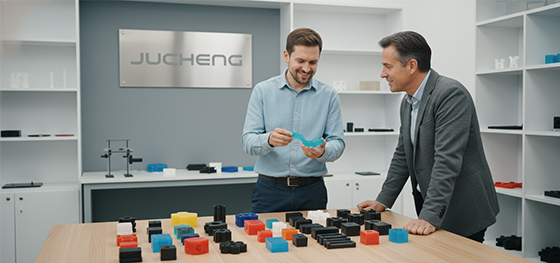
The term silicone vacuum casting is confusing. A good manufacturing partner will not just take your order. They will clarify the process for you.
When a customer comes to us and asks for this, our first question is always: "Are you looking for a part made of silicone, or a part that feels like silicone?"
This is the start of a conversation. It is a consultation. We can then explain the process and introduce them to the amazing library of elastomeric polyurethanes we offer. We can provide samples with different hardness levels.
This is the value of an expert partner. We do not just process your order. We help you navigate the complex world of materials and processes. We make sure you get the part that has the exact properties and feel that your project needs to succeed.

