


Pouring liquid alloy into hardened steel triggers brutal thermodynamic reactions. Hardware engineers frequently design perfectly dimensioned 3D models, completely forgetting that boiling metal shrinks violently as it freezes. Failing to mathematically calculate the required die casting shrinkage allowance guarantees your final physical parts will eject significantly smaller than your blueprint. Discovering this microscopic dimensional drift during final assembly instantly bankrupts your production budget.

Mismatched screw holes and ruined sealing grooves directly result from ignored thermal physics. Toolmakers must intentionally carve the mold cavity slightly larger to compensate for this natural contraction. Referencing a comprehensive die casting design guide forces your procurement team to acknowledge these specific metallurgical behaviors before signing expensive tooling contracts.
Locking down your commercial hardware requires absolute mathematical precision. Let's explore exactly why liquid metals contract, how different alloys behave inside the press, and why aggressive flow simulations rescue your assembly tolerances.
content:
Thermal Physics: Why Does Metal Contract?
Material Variables: Benchmarking Contraction Rates
Tooling Compensation: Oversizing the Cavity
Internal Tearing: Defeating Shrinkage Porosity
JC Rapid Hub: Flawless Geometric Execution
FAQ: Honest Answers About Cooling and Tolerances
Thermal Physics: Why Does Metal Contract?
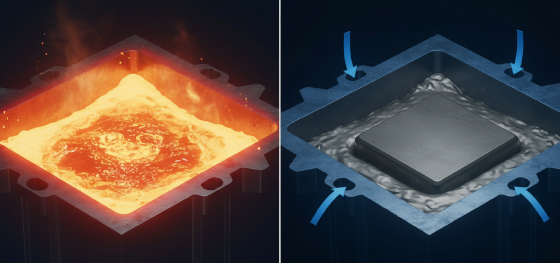
What physical mechanism forces solidifying parts to lose overall volume?
Dropping extreme heat out of molten alloy forces the molecular lattice to pack itself incredibly tight, rapidly pulling the exterior walls inward and physically reducing the overall geometric footprint within seconds.
Ignoring this violent contraction destroys tight assembly clearances. Engineers trying to mount delicate circuit boards inside uncompensated housings will find the mounting pillars misaligned, rendering the entire batch completely useless.
Fighting thermodynamic laws remains mathematically impossible. Factories must simply anticipate the geometric reduction and adjust their CNC milling pathways accordingly when manufacturing the heavy H13 tool steel molds.
Material Variables: Benchmarking Contraction Rates
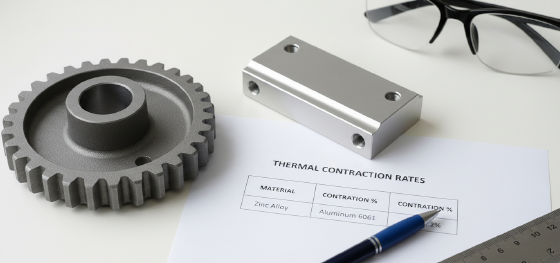
Do all commercial metals shrink at the exact same physical speed?
No; swapping raw metal ingots drastically alters the final geometric footprint because highly fluid zinc cools remarkably calmly while aerospace aluminum reacts significantly more aggressively to temperature drops.
Designing structural automotive brackets with aluminum requires toolmakers to apply much wider compensatory margins. They must actively offset the severe thermal shrinking to prevent the final product from rejecting necessary mating components.
Balancing these natural material variations dictates your final compliance limits. Adhering to official nadca die casting tolerances provides engineers with established mathematical formulas to predict exactly how much each specific alloy will warp.
Tooling Compensation: Oversizing the Cavity

How do factories guarantee the final cooled product matches your blueprint?
Carving the perfect mold requires cutting the steel cavity deliberately larger than the CAD file, applying a precise die casting shrinkage allowance calculated specifically for your chosen alloy.
Complex geometries do not cool uniformly across the entire chassis. Massive, thick structural hubs hold onto heat significantly longer than paper-thin cooling fins, meaning the contraction happens at wildly different speeds across the exact same part.
Fixing a tool cut too small requires entirely replacing the massive steel block. Adding material back onto a machined cavity remains physically impossible, making upfront mathematical compensation the most critical phase of hardware manufacturing.
Internal Tearing: Defeating Shrinkage Porosity
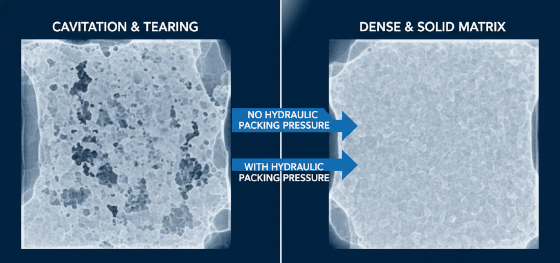
What happens to the liquid core while the exterior metal skin freezes?
Volumetric reduction causes the still-liquid internal core to shrink independently, desperately pulling material away from the center and creating microscopic sponge-like voids known as porosity.
This specific defect completely destroys the load-bearing integrity of heavy-duty hardware. Subjecting these compromised parts to severe highway vibration or harsh drop tests guarantees the metal will snap exactly where the internal voids formed.
Feeding fresh liquid metal continuously into the cooling cavity prevents this internal tearing. Precision factories utilize massive hydraulic pressure to pack extra material into the mold, physically crushing those voids before the part solidifies completely.
JC Rapid Hub: Flawless Geometric Execution

Why does bypassing DFM audits invite catastrophic assembly delays?
Outsourcing your tooling strategy to inexperienced brokers guarantees they will blindly cut your exact CAD dimensions into the steel, entirely ignoring the necessary thermodynamic compensation required for success.
Operating our massive precision manufacturing hub gives JC Rapid total control over these mathematical variables. Our senior tooling engineers aggressively audit your blueprints, apply the correct compensatory values, and deliver flawless hardware.
Stop bleeding capital on ruined injection molds and mismatched components. Send your intricate assemblies to our technical team today for a rigorous DFM analysis to secure perfect, zero-gap commercial production runs.
FAQ: Honest Answers About Cooling and Tolerances
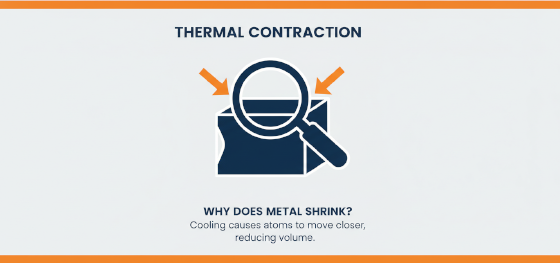
Can operators change the chilling water temperature to stop the part from contracting?
Thermal contraction remains a fundamental law of physics. Adjusting the chilling fluid speed only alters the cycle time and surface finish; it cannot stop the alloy from returning to its natural solid volume.
Do secondary CNC milling operations compensate for poorly calculated molds?
Subtractive milling easily shaves away excess metal if the mold was cut too large. However, if the part shrinks too much, CNC machines cannot magically add missing metal back onto the chassis.
Why do internal bores and holes require different contraction mathematics than exterior walls?
Shrinking metal tightens aggressively around internal steel core pins. This inward crushing force requires entirely different draft angles and compensatory math than exterior walls pulling away from the cavity.
Does applying thick powder coating resolve minor dimensional shrinkage errors?
Heavy polymers add superficial thickness but physically cannot correct severe misalignment between critical mounting standoffs or electronic sensor mounts.

