


Forcing molten metal to freeze within fractions of a millimeter requires aggressive, expensive factory intervention. Hardware designers frequently ruin their commercial budgets by blindly applying extreme subtractive cutting limits to raw injection blueprints. Evaluating die casting vs machining tolerances forces procurement teams to confront the brutal physical reality of thermodynamic drift. Boiling alloys shrink unpredictably as they chill inside heavy steel tools, making absolute geometric perfection mathematically impossible without secondary mechanical help. Understanding a comprehensive die casting design guide prevents you from over-engineering simple structural walls that nobody will ever see.
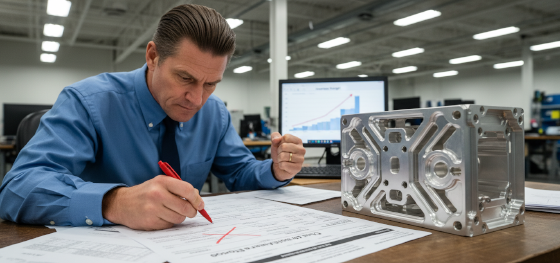
Procurement teams usually suffer heart attacks when reviewing tooling quotes loaded with microscopic geometric demands. Foundries must drastically slow down their hydraulic injection speeds and replace expensive tool steel much faster to hit those extreme limits. Slashing your final piece price requires deploying a ruthless hybrid manufacturing strategy.
Mastering this dimensional overlap separates successful product launches from bankrupt hardware startups. Let's dissect exactly why raw metal twists, calculate the staggering financial penalty of unnecessary precision, and learn how targeting your cutting pathways rescues your profit margins.
content:
Fundamental Accuracy: Injection Versus Subtractive
Cost Multipliers: Paying for Unnecessary Precision
The Hybrid Approach: Combining Both Worlds
Technical Data: Benchmarking the Exact Limits
Turnkey Hub: Seamless Subtractive Integration
FAQ: Honest Answers About Measurement and Shrinkage
Fundamental Accuracy: Injection Versus Subtractive

Why do raw injected metals fail to hit microscopic assembly targets?
Liquid alloys shrink violently during the cooling phase, dragging the physical geometry slightly off-center, whereas solid metallic billets remain completely thermodynamically stable during cold physical cutting operations.
Spinning CNC drill bits operate under completely different physics. High-speed cutters shave precise layers off a frozen, unyielding block of aerospace aluminum. This cold environment completely eliminates thermal expansion variables, allowing the machine to guarantee microscopic zero-gap perfection.
Pouring liquid alloys introduces intense manufacturing chaos. Even the most advanced factories cannot perfectly predict the exact microscopic warping behavior of every single component geometry. Recognizing this fundamental material difference remains critical for establishing realistic quality control baselines.
Cost Multipliers: Paying for Unnecessary Precision
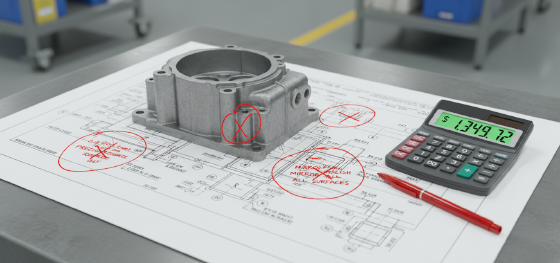
How does over-tolerancing a blueprint destroy commercial budgets?
Demanding aerospace exactness on a cosmetic cover forces the foundry to CNC mill every single exterior face, instantly tripling your labor costs for absolutely zero functional advantage.
Smart hardware founders isolate their extreme tolerance needs immediately. If your structural chassis mounts inside a dark server cabinet, the exterior walls simply need to exist. Demanding perfectly flat, milled sides for an invisible surface burns immense amounts of factory spindle time.
Protecting your bottom line requires auditing the entire CAD file aggressively. Every single strict measurement callout adds minutes to the manufacturing cycle. Stripping away impossible demands ensures your product remains highly competitive against cheaper global alternatives.
The Hybrid Approach: Combining Both Worlds
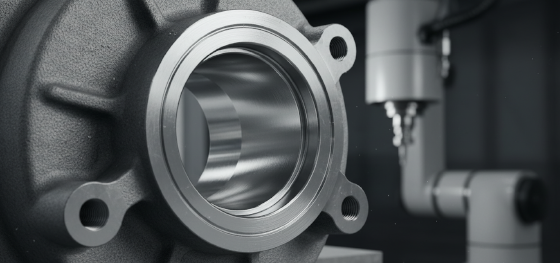
When should engineers blend raw metallurgy with secondary milling?
Mating delicate sensors requires absolute zero-gap fitment; engineers pour the complex overall shape cheaply, then utilize 5-axis mills strictly on the critical sealing faces to guarantee watertight performance.
Adding a precise die casting machining allowance to your digital blueprint locks in this hybrid strategy perfectly. You intentionally design specific mounting pillars slightly thicker than necessary, providing the spinning cutter with just enough sacrificial metal to shave flawlessly flat.
This strategic combination unleashes ultimate manufacturing scalability. You secure the lightning-fast production speeds of high-tonnage hydraulic presses while confidently hitting the microscopic assembly requirements normally reserved for incredibly expensive, fully milled aerospace billets.
Technical Data: Benchmarking the Exact Limits
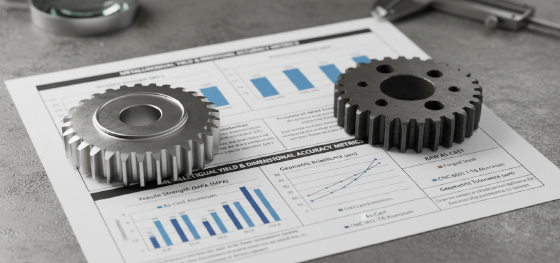
Reviewing the die casting vs machining tolerances matrix provides a clear financial roadmap. The data below outlines exactly when your engineering team must abandon raw injection and deploy subtractive intervention.
| Dimensional Requirement | Raw Cast Performance | Secondary Milling Required? |
|---|---|---|
| General Wall Thickness | Excellent (Highly predictable) | No (Keep as-cast) |
| O-Ring Sealing Grooves | Poor (Leaves wavy textures) | Absolutely Mandatory |
| Internal Screw Threads | Terrible (Shrinkage ruins pitch) | Yes (Drill and tap post-cast) |
| Bearing Journals | Poor (Lacks perfect concentricity) | Absolutely Mandatory |
Cross-referencing your blueprint against this matrix immediately highlights financial waste. Stop demanding bearing-journal exactness on standard exterior protective walls. Funneling your budget exclusively toward the features that actually dictate mechanical survival saves immense capital.
Turnkey Hub: Seamless Subtractive Integration
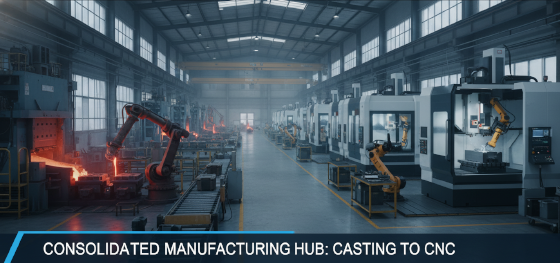
Why must hardware teams consolidate molding and milling vendors?
Shipping raw parts to external machine shops destroys accountability; if the cutter breaches a hidden gas void, the secondary shop will instantly blame the foundry, leaving you absorbing the massive scrap costs.
Operating our massive precision manufacturing hub completely obliterates this toxic logistical friction. JC Rapid executes the raw injection, utilizes advanced X-ray scans to verify internal density, and loads the hardware directly into our own 5-axis cutting centers.
Stop risking your flagship assemblies on disjointed supply chains. Send your complex CAD models to our engineering department today for a ruthless DFM audit. We pinpoint the exact geometric limits, dial in the required sacrificial layers, and deliver flawlessly mated components.
FAQ: Honest Answers About Measurement and Shrinkage
Can switching from aluminum to zinc alloys improve raw casting accuracy?
Yes, drastically. Zinc possesses incredibly fluid dynamics and melts at much lower temperatures, meaning it shrinks far less aggressively, allowing engineers to hit microscopic targets without secondary cutting.
Do moving hydraulic sliders introduce extra geometric deviations?
Moving steel blocks inherently possess tiny mechanical clearances to allow smooth sliding. These microscopic gaps introduce slight geometric shifts that solid, non-moving mold halves simply never experience.
Will aggressive vibratory tumbling alter the final machined measurements?
Heavy ceramic media physically removes microscopic layers of material from the exterior skin. Engineers must calculate this fractional material reduction before finalizing any highly sensitive mounting blueprints.
Why do cross-parting line dimensions require wider acceptable variations?
The extreme hydraulic injection pressure physically forces the two massive steel mold halves apart by a fraction of a millimeter, slightly thickening any feature that crosses that specific separation boundary.

