


Stop thinking about material removal and start thinking about atomic fusion. In the relentless landscape of the 3D printing process, there is a technological peak that transforms fine metallic dust into flight-ready hardware. This is dmls 3d printing, or Direct Metal Laser Sintering. It is not an extension of plastic printing; it is a high-stakes metallurgical battle conducted within an inert gas chamber. While FDM and SLA handle prototypes, DMLS builds the structural "spine" of modern satellites and the life-saving implants found in spinal surgery. It is a process where a high-power fiber laser welds millions of microscopic particles of titanium, aluminum, or cobalt-chrome into a monolithic block that is as dense—and often stronger—than a traditional casting.
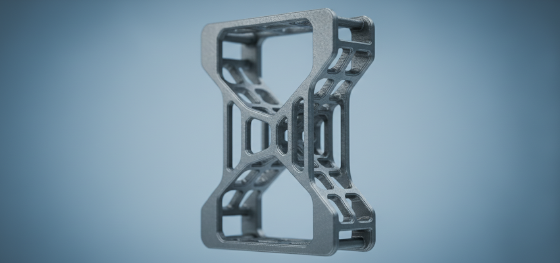
At JUCHENG, we recognize that metal additive manufacturing is a liability-heavy discipline. You cannot simply "print" a high-pressure valve and expect it to survive without managing the invisible demons of residual stress and microscopic porosity. We have engineered a hybrid facility that marries the geometric freedom of DMLS with the micron-level certainty of 5-axis CNC machining. This synergy is the only way to achieve true "net-shape" components that meet the rigorous ISO 13485 and aerospace standards. This guide moves past the basic tutorials to explore the thermodynamics of the melt pool, the structural logic of lattice engineering, and why JUCHENG’s integrated approach to post-processing is the final step in ensuring your metal designs survive the brutal realities of the field.
Manufacturing in metal requires a deep respect for the heat-affected zone. Success is found in the management of the thermal gradient. Let us break down the mechanical pillars of laser powder bed fusion and see how they lock the integrity of your most sensitive designs into physical reality.
Atomic Fusion: Mechanics of the Molten Pool
Lattice Engineering: Strength Without the Weight Mass
Thermal Hostility: Managing Residual Stress and Distortion
Post-Printing Metamorphosis: CNC and Heat Treatment
Medical Integrity: ISO 13485 and Biocompatible Printing
JUCHENG’s Hybrid Standard: Additive Meets 5-Axis
Atomic Fusion: Mechanics of the Molten Pool
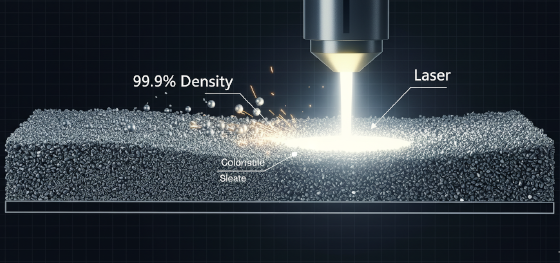
The primary differentiator of dmls 3d printing is the absolute power of the energy source. We utilize fiber lasers focused down to a spot size as small as 70 microns—thinner than a human hair. Inside the build chamber, an inert atmosphere of Argon or Nitrogen is strictly maintained to prevent oxygen from contaminating the high-purity metal powders. As the laser scans each layer, it creates a localized molten pool. This is not a simple melting event; it is a violent hydrodynamic cycle driven by surface tension gradients, known as the Marangoni Effect. The metal is heated and cooled in microseconds, leading to a refined, microcrystalline grain structure that often outperforms traditional forged or cast metals in terms of yield strength.
Precision is achieved through the management of the "Overlapping Weld." Every pass of the laser must partially re-melt the previous layer and the neighboring scan lines to ensure a homogeneous solid. If the energy density is too low, you get "Lack of Fusion" porosity; if it is too high, the metal "boils," creating gas bubbles that act as fracture points. At JUCHENG, we don't just "push go" on the printer. Our engineers calibrate the "V-H-P" (Velocity, Hatch-spacing, Power) parameters for every specific alloy batch. This ensures that a part made from Titanium Grade 5 is 99.9% dense, possessing the fatigue resistance needed for a jet engine bracket. We treat the laser as a microscopic welder, building the molecular integrity of your design from the ground up, layer by grueling layer.
Lattice Engineering: Strength Without the Weight Mass
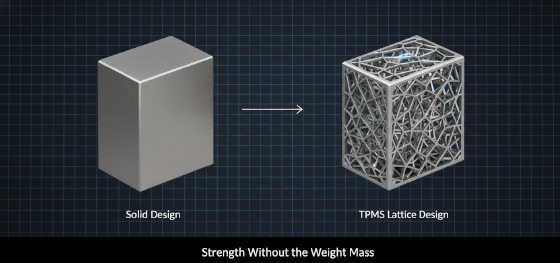
Why specify DMLS over traditional CNC machining? The answer is often "Topology Optimization." Traditional machining is limited by tool access; you cannot hollow out the inside of a solid block to make it lighter without weakening it. DMLS 3d printing removes this constraint. It allows us to build "Lattice Structures"—intricate, skeletal networks of beams that provide maximum rigidity with minimum mass. This is a game-changer for the aerospace and racing sectors, where a 40% reduction in weight translates directly to thousands of dollars in fuel savings or seconds off a lap time.
These lattices are not just for weight reduction; they are for heat management. We often design parts with internal "conformal cooling" channels—fluid paths that twist and turn through the part to pull heat away from critical zones. This is physically impossible to create via drilling or milling. At JUCHENG, we help our clients navigate this design freedom. We provide DFM advice on "Support-Free" angles, ensuring that these complex lattices don't collapse during the print cycle. By engineering the internal voids of your metal parts, we help you build components that are mathematically optimized for their specific load environment, proving that mass is no longer a requirement for strength.
Thermal Hostility: Managing Residual Stress and Distortion
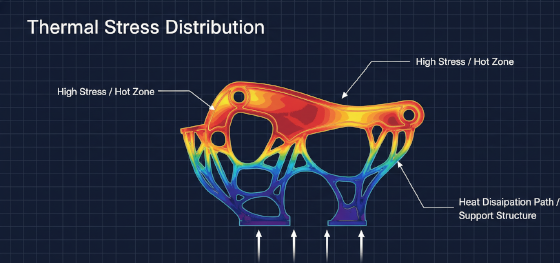
Metal printing is an inherently hostile thermal event. As the laser melts the top layer, the layers below are already cooling. This creates a massive temperature gradient that introduces "Residual Stress." If you try to print a large, flat metal plate without a proper strategy, the part will physically tear itself off the build plate or warp into a bow-shape. This "Thermal Hostility" is the primary reason for failure in inexperienced shops. Managing these forces is what separates industrial production from prototyping.
JUCHENG utilizes a three-tier defense against stress. First, we design "Sacrificial Support Structures." These are not just for propping up overhangs; they are thermal heat sinks that pull energy away from the part and anchor it to the build plate. Second, we utilize "Heated Build Plates" and controlled inert gas flow to keep the temperature of the entire build volume as uniform as possible. Third, and most importantly, we implement mandatory stress-relief cycles. Before the part is ever removed from the build plate, it is placed in a vacuum furnace to "bake" the internal stresses away. This relaxes the metal grains and ensures that when the part is finally cut off, its dimensions stay "true." By respecting the laws of thermal expansion, we deliver metal 3D prints that are dimensionally stable and ready for the extreme cyclic loads of a launch pad or a high-speed assembly line.
Post-Printing Metamorphosis: CNC and Heat Treatment
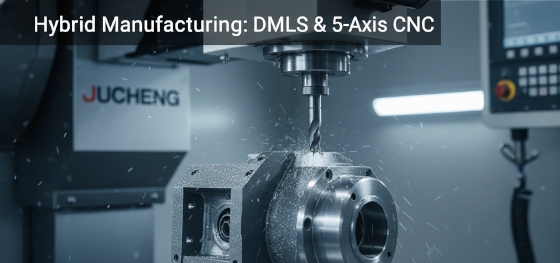
A raw DMLS part is a "near-net-shape" component. It has a rough surface—similar to a fine-grit casting—and its tolerances are typically +/- 0.1mm. For many industrial applications, this is not precise enough. This is where JUCHENG’s "Post-Printing Metamorphosis" occurs. We don't view 3D printing as the final step; we view it as the "casting phase" of a larger 3D printing process. We utilize our in-house 5-axis CNC centers to machine critical mating surfaces, threaded holes, and bearing bores into the printed metal part.
This "Hybrid" approach combines the best of both worlds: the geometric complexity of additive and the micron-level precision of subtractive. We utilize specialized Wire EDM to cut the parts cleanly from the build plate, followed by vibratory finishing to smooth the aesthetic surfaces. For parts requiring maximum hardness, we perform HIP (Hot Isostatic Pressing). By subjecting the part to extreme heat and pressure simultaneously, we "heal" any microscopic porosity, ensuring the part reaches 100% theoretical density. This level of post-process technical rigor is mandatory for parts that live in high-vibration engine bays or sub-sea valve blocks. We don't just ship you a print; we ship you a finished, verified, and high-performance metal component.
Medical Integrity: ISO 13485 and Biocompatible Printing
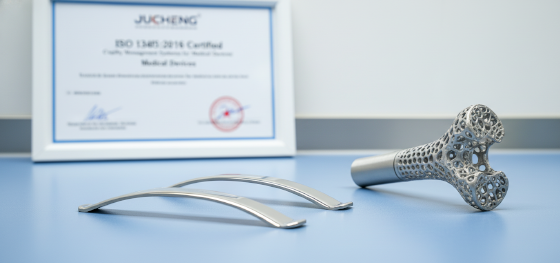
The medical industry is the largest adopter of dmls 3d printing for a single reason: patient-specific geometry. We produce orthopedic implants—spinal cages, cranial plates, and hip joints—that are customized to the patient's CT scan. But in medical manufacturing, "biocompatibility" is a mandatory legal requirement. JUCHENG operates an ISO 13485:2016 certified facility, ensuring that every titanium print is handled with surgical cleanliness. We utilize Grade 23 (ELI) Titanium, a high-purity alloy designed specifically for human implants.
Our medical protocol includes "Osseointegration Surface Engineering." We use the DMLS process to create a controlled "porous" texture on the surface of the implant. This mimics the structure of natural bone, allowing the body to grow *into* the metal part for a permanent mechanical bond. We manage the entire verification chain, from powder batch tracking to final sterilization-ready cleaning. When you partner with JUCHENG for medical metal printing, you aren't just buying a part; you are buying a validated process that ensures patient safety and regulatory compliance. We bridge the gap between digital anatomy and physical healing, providing surgeons with the tools they need to rebuild human lives.
JUCHENG’s Hybrid Standard: Additive Meets 5-Axis
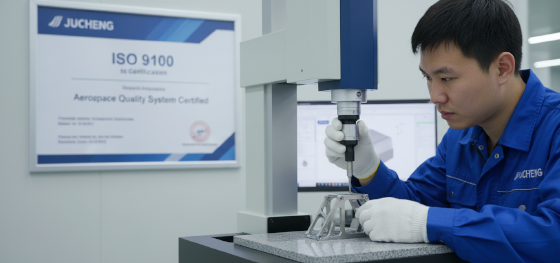
Choosing a partner for metal 3D printing is a decision of technical trust. If your supplier only owns a printer, they are only half a solution. Jucheng Precision offers a unified ecosystem where the printer and the mill exist in perfect technical harmony. We understand that a DMLS part is a metallurgical event that requires post-process stabilization and precision refinement. Our fleet of over 150 CNC machines, including 25 high-precision 5-axis centers, ensures that your complex metal prints are finished to the tightest tolerances in the industry.
We treat your metal parts with the same technical reverence whether they are being sintered from dust or milled from a solid billet. We provide full material traceability, CMM inspection reports, and DFM reviews that look for every opportunity to reduce weight and increase strength. Don't let the limitations of traditional manufacturing stifle your innovation. Experience the raw power and the extreme precision that JUCHENG’s hybrid DMLS protocols can clarify and elevate for your next mission-critical project. Contact our engineering team today for a technical review and see how we can turn your most difficult metal designs into physical reality.

