


Scaling a design from a handheld device to a meter-long industrial component is a violent assault on traditional manufacturing physics. For hardware innovators in 2026, the question of how to manufacture large plastic parts is often met with exorbitant tooling quotes and logistical nightmares. Standard 3D printing fails to provide the isotropic strength needed for structural frames, while high-pressure injection molding requires a six-figure capital investment that kills niche programs before they launch. Jucheng Precision operates as a high-fidelity manufacturing sanctuary, providing the technical depth to bridge the gap between "experimental scaling" and "market-ready sovereignty." Within the broader framework of Large plastic parts manufacturing, we identify the specific thermodynamic and economic thresholds that dictate whether your oversized enclosure should be formed, foamed, or cast. We don't just "make things bigger"; we engineer a strategic pathway to ensures your largest designs survive the laboratory and dominate the boardroom.

Establishing a resilient launch for oversized hardware demands the rejection of single-process dogmas. Amateurs often default to thermoforming for large shells, only to realize too late that the process cannot accommodate the internal mounting bosses and structural ribs their electronics require. Jucheng Precision eliminates this "Capability Gap" by positioning Reaction Injection Molding (RIM) as the primary hero for complex, large-format components. By utilizing low-pressure liquid chemistry and cost-effective aluminum molds, we deliver parts up to two meters in length with injection-molded precision but for 80% less in upfront CapEx. This guide deconstructs the four primary pillars of large-scale fabrication, providing the data needed to secure your project’s ROI.
What are the primary methods for manufacturing large plastic parts?
How does RIM solve the large injection molding cost gap?
Why do structural foam and vacuum forming fail complex large designs?
How does JUCHENG optimize large plastic fabrication in 2026?
Frequently Asked Questions: Manufacturing Large Parts
What are the primary methods for manufacturing large plastic parts?

Selecting the correct fabrication route depends on the "Complexity-to-Volume" ratio of your design. When engineers ask how to manufacture large plastic parts, they typically evaluate four industrial technologies: Thermoforming, Structural Foam Molding, Injection Molding, and Reaction Injection Molding (RIM). Thermoforming is excellent for thin-walled, simple shells like cargo boxes, but it cannot produce internal features. Structural Foam provides high rigidity but leaves unsightly "swirl marks" on the surface. Injection molding offers perfect quality but is financially toxic for low volumes due to $100,000+ mold costs. Jucheng Precision identifies RIM as the "Golden Mean"—the only process capable of producing complex 3D internal features (bosses, ribs) and Class-A cosmetic surfaces for batches under 2,000 units. To assist in your routing decision, we provide the following technical matrix:
| Feature | Thermoforming | Injection Molding | JUCHENG RIM |
|---|---|---|---|
| Wall Thickness | Uniform only | Highly uniform | Variable (Zero Sink) |
| Internal Ribs | None | Limited | Complex / Deep |
| Tooling CapEx | Low ($) | Extreme ($$$$) | Moderate ($$) |
How does RIM solve the large injection molding cost gap?
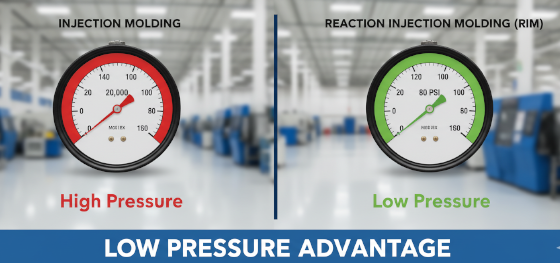
Low-pressure fluid dynamics represents the "unfair advantage" of the RIM process. Standard injection molding requires 20,000 psi of pressure to ram molten plastic through a cavity, necessitating massive steel mold plates and 2,000-ton presses. This brute force makes Large plastic parts manufacturing prohibitively expensive for most companies. RIM, however, utilizes a chemical reaction between two low-viscosity liquid components mixed at room temperature. This mixture enters the mold at less than 100 psi, flowing effortlessly into large cavities like water. Because the pressure is minimal, Jucheng Precision can utilize cost-effective aluminum or composite tooling. This transition in physics slashes your initial Large plastic molding cost by 60% to 80%, while delivering a part with identical mechanical strength and superior dimensional stability. We don't fight the material; we manage its reaction, ensuring your cash flow remains fluid while your part is being poured.
Why do structural foam and vacuum forming fail complex large designs?
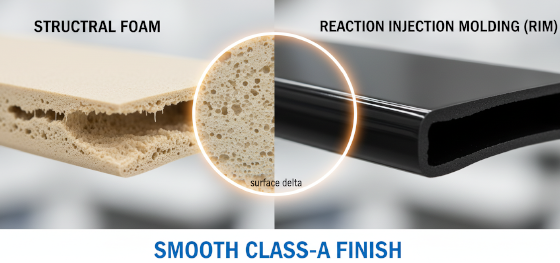
Functional density dictates the success of industrial equipment enclosures. Vacuum forming (Thermoforming) is essentially a "stretching" process; as the plastic sheet is pulled over a mold, the corners become dangerously thin, resulting in weak structural points. Furthermore, it is impossible to mold a mounting boss for a PCB or an internal bracket into a thermoformed shell. Structural foam molding solves the strength problem by injecting gas into the plastic, but it leaves an irregular "swirl" texture on the surface that requires extensive sanding and filling before painting. RIM provides the "Surgical Cure." Jucheng Precision utilizes specialized thermoset polyurethanes that produce a dense, high-gloss skin and a structural core in a single cycle. We can mold 10mm thick strengthening ribs directly behind a 3mm cosmetic wall without any sink marks—a feat that is physically impossible in standard injection molding. We turn "simple shells" into "integrated mechanical assemblies."
How does JUCHENG optimize large plastic fabrication in 2026?

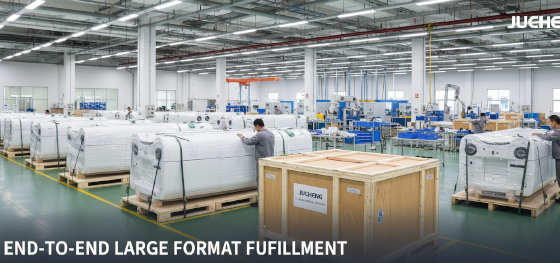
Engineering excellence at Jucheng Precision is built on the foundation of single-source accountability. We don't just recommend a process; we manage the entire "BOM integration." Our facility, housing over 150 CNC machines and specialized RIM units, is optimized for the Low volume large plastic parts sector. When you upload a CAD file to our facility, our veteran engineers perform a comprehensive "Size-to-Weight" audit. We suggest where to consolidate separate panels into a single RIM molding to reduce assembly labor and improve waterproofing. We utilize all-electric 5-axis machines to finish mold parting lines with sub-micron accuracy, ensuring your oversized parts emerge with zero flash and perfect alignment. We don't just fill molds; we deliver showroom-ready hardware that survives the rigors of hospital clinics and factory floors. Leverage our decade of large-scale mastery to validate rapidly and launch early.
Frequently Asked Questions: Manufacturing Large Parts
Question: Can RIM parts be used for Large plastic medical enclosures like CT scanners?
Answer: Absolutely. RIM is the gold standard for large medical devices. It offers the high strength-to-weight ratio needed for mobility and the ability to pass strict UL94 V-0 fire safety certifications required by clinical auditors.
Question: What is the maximum size part JUCHENG can produce?
Answer: Our Shenzhen-based hub handles parts up to 2.5 meters (approx. 8 feet) in length. We specialize in the "Oversized Bracket" and "Large Equipment Cover" categories where standard injection molding machines reach their mechanical limits.
Question: Does RIM support Painting and finishing large plastic parts?
Answer: Yes. Polyurethane RIM parts have excellent surface energy, making them far superior for paint adhesion than Polypropylene or Polyethylene. We offer in-house automotive-grade painting and silk-screening for a retail finish.
Manufacturing sovereignty on a large scale requires an agnostic partner who values your ROI over their machine uptime. Jucheng Precision eliminates the friction of vendor-hopping by offering integrated CNC and RIM under one ISO 9001 certified roof. Stop being ransomed by high-volume tool shops that ignore your niche project. Not sure if your wall thickness is uniform or your chosen method is optimal? Upload your 3D CAD file to JUCHENG today for a Free DFM Review. Our experts will identify the most profitable How to manufacture large plastic parts roadmap for your brand, ensuring your transition to production is seamless, beautiful, and profitable.

