


Engineering limits fracture the moment a project scales beyond the boundaries of standard equipment. In the hyper-competitive landscape of 2026, many hardware innovators encounter a manufacturing "dead zone" when transitioning from digital CAD to oversized physical hardware. A meter-long medical MRI shroud or a heavy-duty industrial robot base cannot be treated like a smartphone case. The physics of volumetric shrinkage, the financial weight of multi-ton steel molds, and the logistical stress of large-format quality control create an uncompromising barrier to market entry. Navigating this complexity requires the strategic deployment of Large plastic parts manufacturing. This technology represents the structural soul of oversized hardware, delivering the rigidity and aesthetic authority required for high-stakes environments. Jucheng Precision operates as a high-fidelity manufacturing sanctuary in the Shenzhen precision manufacturing hub, providing the technical depth to bridge the gap between "experimental scaling" and "market-ready sovereignty." We don't just "make parts bigger"; we engineer a specialized ecosystem where Large-scale hardware remains capital-efficient and structurally sound.
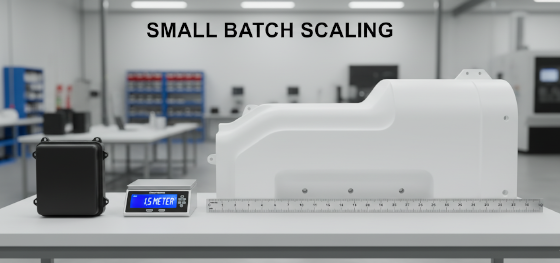
Establishing a resilient launch for oversized hardware demands the rejection of traditional injection molding dogmas. For batches of 100 to 2,000 units, the six-figure financial anchor of a massive steel tool is a strategy for bankruptcy. Jucheng Precision eliminates this "Tooling Debt" by introducing Reaction Injection Molding (RIM) as the primary engine for your large-part roadmap. By utilizing low-pressure thermodynamics and cost-effective aluminum molds, we allow you to launch meter-long enclosures with production-grade aesthetics for a fraction of the traditional CapEx. This guide deconstructs the standoff between additive, subtractive, and formative methods, revealing why the "RIM Secret" is the mandatory foundation for anyone developing Custom large plastic enclosures or Large plastic medical enclosures. We provide the manufacturing insurance needed to ensure your largest designs survive the laboratory and dominate the boardroom.
Why is scaling up plastic parts an engineering nightmare?
What are the limitations of traditional methods for oversized components?
How does Reaction Injection Molding (RIM) solve the large-part problem?
What design freedom does RIM offer for variable wall thickness?
Which materials best simulate industrial toughness in large-scale casting?
How to manage painting and finishing for meter-long plastic panels?
Which high-stakes industries rely most on large-scale polymer molding?
Frequently Asked Questions: Large Plastic Parts
Why is scaling up plastic parts an engineering nightmare?
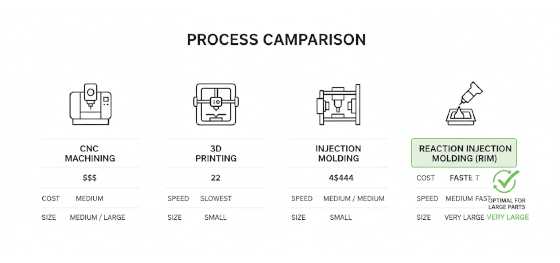
Thermodynamic volatility is the primary saboteur of oversized components. In Large plastic parts manufacturing, the sheer volume of material amplifies every subtle physical failure. First, internal residual stress acts as a ticking time bomb; as a two-meter part cools, uneven thermal gradients pull the geometry into a "potato-chip" warp that ruins assembly tolerances. Second, the "Sink Mark Crisis" escalates; thick mounting bosses required for large-scale stability pull the cosmetic surface inward, creating unsightly dimples. Third, the "Financial Ransom" of tooling is existential. A traditional steel mold for a medical cart housing can exceed $100,000, effectively killing niche programs before the first unit is sold. Jucheng Precision recognizes that managing these "Geometric Ghosts" requires more than just a big machine; it requires a surgical understanding of low-pressure fluid dynamics to neutralize stress before it settles into the polymer matrix.
What are the limitations of traditional methods for oversized components?
Process inefficiency dictates the success or failure of your scaling strategy. Most How to manufacture large plastic parts queries lead to a binary choice between "Too Expensive" and "Too Slow." To assist engineers in early-stage project routing, Jucheng Precision provides the following definitive comparison matrix for large-scale fabrication:
| Method | Tooling Cost | Design Freedom | Low Volume ROI |
|---|---|---|---|
| CNC Machining | Zero (NRE) | High | Very Poor (Slow) |
| 3D Printing | Zero | Extreme | Poor (Fragile) |
| Injection Molding | Extreme ($$$) | Moderate | None (< 10k parts) |
| JUCHENG RIM | Low ($) | Superior | Optimal (100-2k) |
Observing the data confirms that for Low volume large plastic parts, traditional high-pressure molding is a fiscal suicide. Thermoforming is an alternative, but it produces "empty shells" that lack the mounting bosses and internal ribbing required for structural robotics. JUCHENG’s Reaction Injection Molding (RIM) bridges this "Capability Gap," delivering injection-molded complexity without the injection-molded debt.
How does Reaction Injection Molding (RIM) solve the large-part problem?
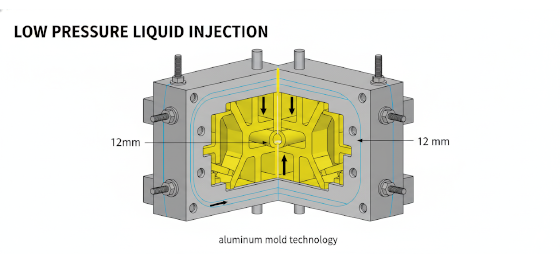
Low-pressure thermodynamics represent the core innovation of the RIM process. Unlike standard molding that rams molten pellets into a tool at 20,000 psi, RIM utilizes a chemical reaction between two low-viscosity liquid components—Polyol and Isocyanate. These liquids are mixed at high speed and poured into the cavity under extremely low pressure (often less than 100 psi). This "Gentle Fill" means the mold doesn't need to be massive blocks of hardened steel; we can utilize lightweight aluminum or epoxy tooling. Jucheng Precision leverages this physics to slash your Large plastic molding cost by up to 80%. Because the material "grows" inside the mold via an exothermic reaction rather than being forced in, the resulting part possesses virtually zero internal residual stress. This is why RIM parts stay perfectly flat and stable over meter-long spans where injection molding would warp uncontrollably.
What design freedom does RIM offer for variable wall thickness?
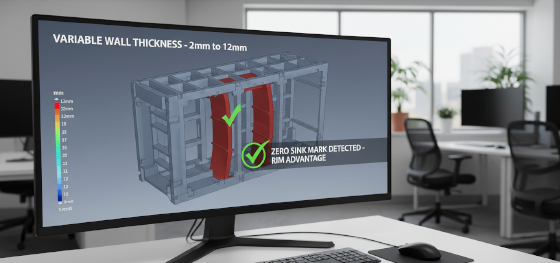
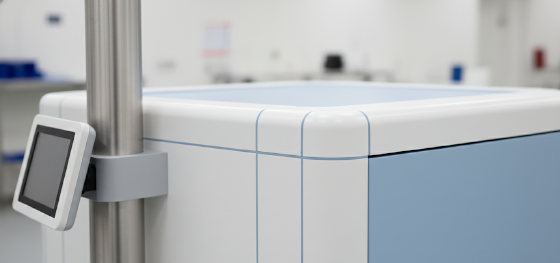
Geometric sovereignty in RIM allows for the violation of standard DFM rules. In Large plastic parts manufacturing, the "Sink Mark" is the primary architect of cosmetic rejection. Standard molding mandates that a rib cannot exceed 60% of the wall thickness. RIM ignores this constraint. Because the low-viscosity liquid fills the cavity completely before the expansion reaction takes place, you can mold a 3mm wall that transitions directly into a 20mm thick structural boss without a single dimple on the cosmetic face. This "Sink-Free Power" allows JUCHENG engineers to design massive strengthening ribs into Custom large plastic enclosures, ensuring they survive the most abusive factory environments while maintaining a "retail-ready" mirror finish. We don't just "fill a box"; we engineer structural masterpieces that ignore the limitations of prehistoric molding.
Which materials best simulate industrial toughness in large-scale casting?
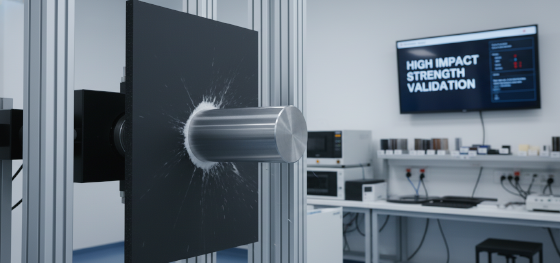
Molecular mimicry dictates the functional survival of oversized hardware. While RIM utilizes polyurethane chemistry, the final parts are engineered to simulate the mechanical spine of ABS, Polypropylene (PP), and high-impact Nylon. Jucheng Precision utilizes specialized thermoset systems that offer "Impact Sovereignty"—the ability to absorb kinetic energy without brittle fracture. This is vital for Large plastic medical enclosures where the device must withstand being bumped by heavy hospital beds or diagnostic equipment. We offer flame-retardant (UL94 V-0) and chemically resistant formulations that survive aggressive cleaning protocols. By matching the polymer’s flexural modulus to your specific mechanical load, we deliver a large-format surrogate that behaves exactly like production-grade thermoplastic, but at a fraction of the scaling cost.
How to manage painting and finishing for meter-long plastic panels?
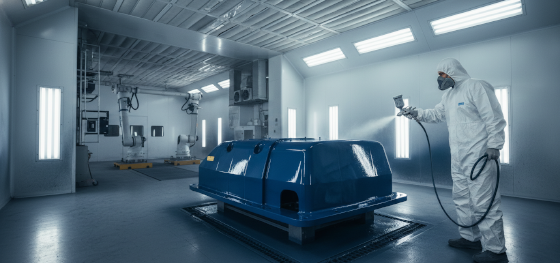
Visual authority on a large scale is won in the finishing booth. A two-meter panel acts as a giant canvas; a single dust inclusion or paint sag is magnified ten-fold. Painting and finishing large plastic parts at Jucheng Precision is a metrological exercise conducted in oversized Class 100,000 cleanrooms. Because RIM polyurethanes possess high surface energy, they provide a superior "Chemical Handshake" for primers and automotive-grade 2K paints. Our facility integrates value-added secondary operations including large-format silk-screening for corporate logos and precision laser-etching for backlit icons and serial numbers. We turn a raw industrial casting into a showroom asset, ensuring your medical carts, kiosks, and server racks arrive retail-ready and documented for brand dominance.
Which high-stakes industries benefit most from large-scale polymer molding?
Manufacturing excellence at Jucheng Precision is built on the foundation of industry-specific compliance. We recognize that Large plastic parts manufacturing for the healthcare sector (MRI, CT scanners) demands ISO 13485 traceability, while the robotics sector requires the high strength-to-weight ratios of advanced polymer skeletons. By replacing heavy sheet metal with RIM-molded enclosures, JUCHENG helps clients reduce the "Mobility Barrier" of their devices, making heavy equipment easier to transport and safer for human interaction. Our Low Volume Injection Molding and bridge tooling strategies empower innovators in the Injection molding application industries to iterate rapidly without the fiscal anchor of mass-production debt. Stop compromising your large-format designs with crude shells or expensive steel. Leverage our decade of large-scale replication mastery to validate rapidly and scale profitably.
Frequently Asked Questions: Large Plastic Parts
Question: How big can JUCHENG manufacture large plastic parts using RIM?
Answer: Our facility in the Shenzhen hub is equipped to produce parts up to 2.5 meters in length and weighing over 50kg. RIM technology is uniquely suited for these oversized dimensions due to its low-pressure nature.
Question: Is RIM tooling as durable as injection molding steel?
Answer: No, RIM tools (usually aluminum or epoxy) are designed for 100 to 5,000 cycles. This aligns perfectly with the "Low Volume" sweet spot, providing significant tooling savings for niche products.
Question: Can RIM parts pass UL94 V-0 fire testing?
Answer: Yes. Jucheng Precision utilizes specialized flame-retardant polyurethane resins that meet strict safety standards for Large plastic medical enclosures and aerospace interiors.
Question: How does the cost of RIM compare to large-scale 3D printing?
Answer: While 3D printing is cheaper for a single unit, RIM becomes the financial victor at quantities over 10 parts. RIM also offers superior isotropic strength and retail-quality surface finish that 3D printing lacks.
Manufacturing sovereignty on a large scale requires a partner that operates across the entire volume spectrum. Jucheng Precision eliminates the friction of vendor-hopping by offering integrated CNC, RIM, and high-tonnage injection molding under a single roof. We provide full material lot traceability and CMM dimensional inspection reports for every oversized batch, ensuring your hardware journey is lean, predictable, and market-ready. Contact our technical team today for a free DFM review and see how we can turn your digital intent into a structurally sovereign, large-scale reality that is documented for success.

