


Integrating robust, permanent connections into lightweight panels without introducing heat warping is a major engineering challenge. Specifying the process of riveting sheet metal parts provides your custom assemblies with a highly stable, vibration-resistant joint that completely preserves the metal's mechanical properties. This cold-joining method represents a critical milestone in custom sheet metal fabrication, allowing you to combine dissimilar alloys while maintaining a pristine, coat-ready cosmetic surface.

Suffer from thermal warping, wave-like distortion, or burned coatings caused by standard spot welding on your thin-gauge panels? Introducing high weld heat into sheets under 1.5mm causes severe volumetric shrinkage, pulling adjacent flanges out of flat. Transitioning to a mechanical, non-thermal riveting setup completely eliminates these cosmetic failures, establishing tight-tolerance joints with zero-heat stress.
Let's examine why mechanical cold-locking outperforms thermal welding on delicate enclosures, compare standard blind pop rivets against solid structural rivets, and review the DFM parameters required to execute flush countersunk riveting.
Why Use Rivets Instead of Welding?

Why is mechanical riveting preferred over spot welding on thin cosmetic enclosures?
Mechanical riveting requires zero thermal heat, completely preventing panel warping, protecting pre-anodized coatings, and allowing secure bonds between dissimilar metals.
Executing thermal welds on thin aluminum or steel panels is a major manufacturing risk. The intense heat of a weld arc melts the parent metals, causing severe thermal contraction upon cooling that leaves permanent, wavy distortions. Furthermore, welding is restricted to compatible metals, making it impossible to join copper to aluminum or steel directly.
Mechanical riveting resolves these limitations by operating entirely at room temperature. The riveting process relies on expanding a hollow rivet shank inside pre-drilled holes, clamping the sheets together under high, uniform force. This allows designers to combine a lightweight aluminum skin with a strong steel frame, optimizing overall structural strength with zero heat-induced warping.
Types of Rivets: Pop Rivets vs. Solid Rivets
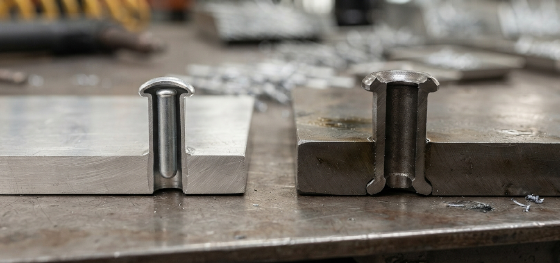
What is the structural difference between blind pop rivets and solid rivets?
Pop rivets are blind fasteners installed from a single side of the sheet, while solid rivets require access to both sides of the joint to mechanically compress and deform the entire rivet body.
When selecting fasteners, engineers must decide between pop rivets and solid rivets based on load requirements. Blind pop rivets utilize a central mandrel that is pulled by a pneumatic tool, expanding the hollow sleeve against the back sheet. This makes pop rivets incredibly fast to install on enclosed boxes where the back of the joint is completely inaccessible.
For maximum shear capacity and vibration resistance, solid rivets are preferred. Installing a solid rivet requires a pneumatic hammer on one side and a heavy bucking bar on the other. This intense squeezing force deforms the solid metal shank to fill the entire mounting hole, creating an exceptionally rigid joint highly utilized in aerospace and heavy industrial chassis.
Countersunk Rivets for Flush Cosmetic Surfaces
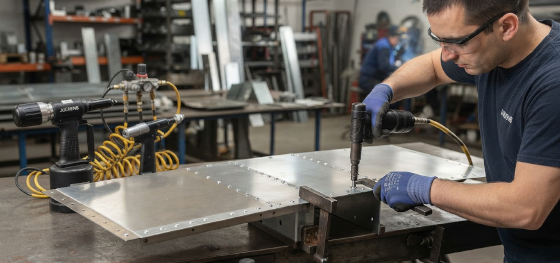
How do countersunk rivets achieve completely flush, seamless outer surfaces?
The mounting hole is pre-chamfered with a specific angle, allowing the beveled rivet head to sit perfectly flush with the outer sheet surface after mechanical compression.
For high-end appliances, medical analyzer faceplates, and luxury audio housings, visible dome-headed rivets are highly undesirable. To maintain completely smooth outer profiles, we utilize countersunk rivets. The flat pattern must be prepared with precise countersinking depths to match the rivet bevel, ensuring that the rivet head does not protrude or sit recessed.
Executing clean, flush riveting requires strict control of the sheet thickness. If the sheet is too thin (under 1.0mm), there is not enough material to support a cut chamfer. In these scenarios, we utilize a pre-dimpling process on our press brake machines, cold-forming a beveled recess into the thin sheet to accommodate the countersunk head cleanly without compromising joint strength.
Precision Mechanical Assembly at Jucheng Precision
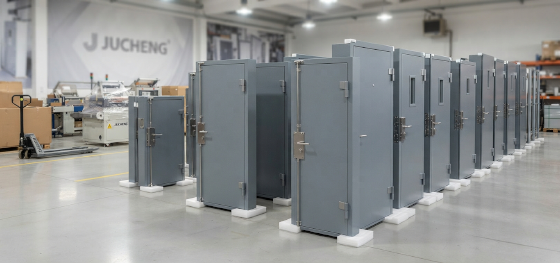
Sourcing high-integrity mechanical connections requires absolute process control on the shop floor. Jucheng Precision operates dedicated manual and pneumatic riveting workstations equipped with force-monitoring sensors, ensuring that every rivet expands uniformly without inducing local stress concentrations. By maintaining perfect alignment between the pneumatic hammers and custom bucking bars, we prevent surface scratching and deliver completely flush assemblies ready for immediate structural service.
Every custom order is managed under a unified quality system certified to ISO 9001 and AS9100 standards, ensuring that high-precision sheet metal fabrication runs meet strict medical, automotive, and aerospace regulations. We provide certified shear and tensile testing reports to verify the mechanical integrity of every batch. Supported by our flexible no MOQ policy and rapid delivery turnaround, we manage your project from initial flat pattern laser blanking to final, fully integrated packaging with zero dimensional drift.
FAQ: Critical Questions About Riveting Sheet Metal Parts

Our engineering team has compiled professional, concise solutions to the most common quality challenges faced during mechanical riveting runs:
Is a riveted joint stronger than a welded joint?
While a continuous weld provides higher absolute tensile strength, a properly engineered mechanical riveted joint provides superior resistance to structural vibration and fatigue.How do you prevent raw sheets from scratching during high-pressure riveting?
We execute riveting on custom-designed assembly fixtures, utilizing protective polyurethane liners on our bucking bars to prevent any metal-on-metal friction.Can aluminum and stainless steel parts be riveted together directly?
Yes, but to prevent galvanic corrosion, we utilize zinc-plated or nickel-plated rivets, or insert non-conductive nylon washers to physically isolate the dissimilar alloys.How does Jucheng Precision ensure that riveting sheet metal parts remains highly consistent?
We verify mounting hole concentricity using digital pin gauges before assembly, and conduct real-time coordinate measuring machine (CMM) audits to ensure perfect alignment.

