


Leaving your 3D printing budget to the default settings of a slicer software is a recipe for silent financial drainage. In the competitive arena of 3d printing cost management, a "passive" approach to CAD data results in paying for mass and machine time that contributes zero functional value to your part. Most engineers treat the 3D printer as a magic box that prints anything, but the reality is that the machine is a cold accountant measuring every cubic millimeter of material and every second of Z-axis travel. Learning how to reduce 3d printing cost is not about finding a cheaper supplier; it is about engineering the geometry to exploit the specific physics of additive manufacturing. It is a transition from visual design to fiscal engineering, where a single change in orientation or a hollowed-out core can slash your invoice by forty percent without compromising a single mechanical requirement.
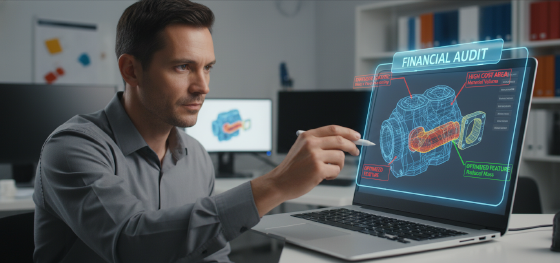
JUCHENG operates as a technical sanctuary for hardware teams who need to iterate at the speed of the market without being anchored by excessive R&D costs. We recognize that for a medical diagnostic startup or an automotive Tier-1 supplier, the "Price per Part" is the primary barrier to market validation. We have moved past the era of generic pricing to offer our clients a collaborative DFM (Design for Manufacturability) culture. Our facility's engineers don't just "hit go" on your files; we audit them for economic survival. This guide moves past the basic tips to explore the hard-physics of volumetric reduction, the logic of "Digital Foam," and why JUCHENG’s integrated approach to material selection ensures your project reaches its functional goals on a lean budget.
Profitability in the additive world is won by those who can remove the "Z-Axis Tax" and minimize the human touch in post-processing. You aren't just buying a part; you are buying the ability to fail fast and fix faster while preserving your capital. Let us break down the technical pillars of cost-reduction and see how geometric foresight can lock the integrity of your budget into physical reality.
The Hollowing Protocol: Slashing Material Volume
Z-Axis Triage: Optimizing Orientation to Kill Time
Material Pragmatism: Choosing the Right Grade
Support Minimization: Designing for Zero Scaffolding
The Batch Advantage: Leveraging Nesting and Scale
JUCHENG’s Verdict: Engineering the Price Point
The Hollowing Protocol: Slashing Material Volume
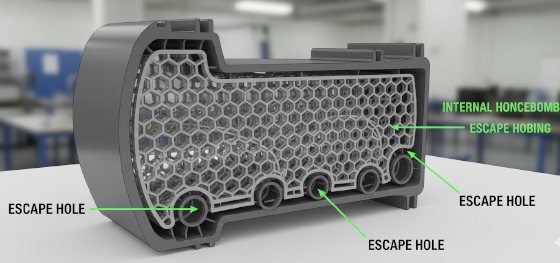
The most immediate victory in the fight for how to reduce 3d printing cost is the removal of internal mass. In the subtractive world, you pay for what you throw away; in the additive world, you pay for what remains on the build plate. If you design a part with a solid 30mm thick core, you are essentially paying for a hidden volume of expensive resin or powder that provides no structural advantage. For most industrial designs, a solid core is an engineering oversight.
Our technicians advocate for a "Shell and Infill" approach. By hollowing your model to a wall thickness of 2mm or 3mm, we can reduce the material consumption by up to 70%. However, hollowing requires the mandatory inclusion of "Escape Holes." If you are using SLA, trapped resin will create a heavy, unstable part that might eventually explode during post-curing. If you are using SLS or MJF, trapped powder remains inside the part, negating the weight and cost savings. We help you place these holes strategically—often in hidden mating surfaces—to ensure the part is clean, light, and cheap. For parts requiring rigidity, we utilize internal lattice structures (honeycomb or gyroid) that provide 90% of the strength of a solid part with only 20% of the material. This "Digital Foam" strategy is the definitive answer for large-format housings and structural prototypes that need to survive the field while protecting the project budget.
Z-Axis Triage: Optimizing Orientation to Kill Time
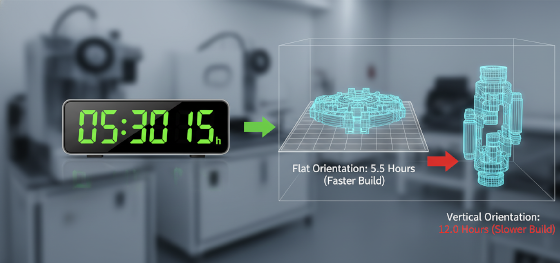
Time in 3D printing is measured vertically. Every technology, from DMLS to FDM, builds layer-by-layer. This introduces a "Vertical Tax": the taller your part is on the build plate, the more the machine must travel and the more layers it must deposit. If you orient a 150mm long shaft vertically, it will take roughly five times longer to build than if it were oriented horizontally. In the pursuit of how to reduce 3d printing cost, orientation is your most powerful temporal lever.
JUCHENG’s CAM engineers perform an "Orientation Audit" for every quote. We look for ways to minimize the Z-height without compromising the critical surface finish. We also account for the "Support Footprint." A part tilted at an angle may take longer to print but require fewer support structures, saving you money on manual labor and material waste. Conversely, laying a part flat might reduce build time but ruin a cosmetic face. We navigate this compromise with our clients, using simulation software to predict the exact minute-by-minute cost of different orientations. By flattening your designs and optimizing the packing density of the build plate, we move the 3D printing cost from the "premium" bracket into the "production" bracket. We don't just print your file; we choreograph its birth to ensure it respects the clock.
Material Pragmatism: Choosing the Right Grade
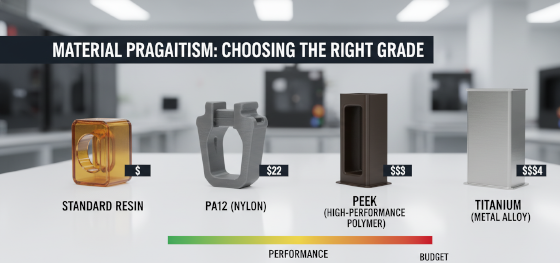
Material over-specification is a silent killer of ROI. We often see engineers specify high-performance resins like PEEK-simulants or high-temp resins for parts that will only ever sit on a conference table at room temperature. In the 3D printing materials landscape, the price jump from standard to engineering grades can be 300% or more. How to reduce 3d printing cost often begins with a honest material audit.
At JUCHENG, we offer tiered material options to fit your specific validation phase. If you are in the "Form and Fit" phase, we recommend standard SLA resins or FDM plastics to keep costs low. We reserve expensive materials like Titanium (DMLS) or Ultem (FDM) for the "Functional Test" phase where their specific mechanical superpowers are a mandatory requirement. We also suggest "Hybrid Materials"—for instance, using a glass-filled nylon (MJF) to achieve the stiffness of a metal bracket at a plastic price point. By matching the molecular cost to the mechanical mission, we ensure that your budget is spent on functional integrity, not on expensive chemical labels that offer no functional advantage for your specific use-case. Our team provides tactile samples to help you feel the difference, ensuring you make an informed decision based on physics, not just a datasheet.
Support Minimization: Designing for Zero Scaffolding
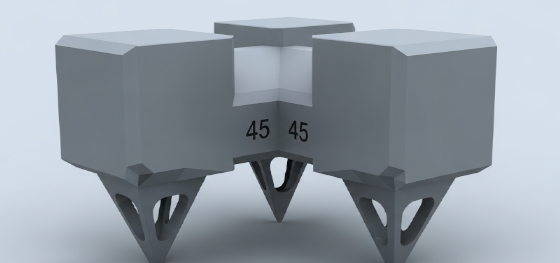
Supports are the "wasted labor" of additive manufacturing. They consume material, add time to the build, and require a human technician to manually clip and sand the surface after the print is finished. This labor-intensive post-processing is a major component of the final quote. True mastery of how to reduce 3d printing cost involves "Geometric Self-Defense"—designing your part so that it supports its own weight as it grows.
The golden rule is the "45-Degree Limit." Any feature angled at more than 45 degrees relative to the build plate will generally print without the need for scaffolding. We suggest replacing sharp 90-degree overhangs with chamfers or gussets. We also advise on the use of "Teardrop Holes"—changing the top of a circular hole into a pointed arch to make it self-supporting. These small geometric shifts are invisible to the assembly’s performance but are highly visible on your invoice. By reducing the support mass, you aren't just saving pennies on resin; you are removing the need for a skilled technician to spend thirty minutes sanding your part. At JUCHENG, we highlight these support-heavy zones during our DFM review, providing you with a roadmap to a "Zero-Finish" part that is born clean and ready for assembly.
The Batch Advantage: Leveraging Nesting and Scale

Economics in 3D printing are fundamentally driven by "Build Density." For technologies like MJF and SLS, the machine fuses an entire layer regardless of how many parts are on it. This means the per-part cost is lowest when the build chamber is packed to its maximum density. If you order a single small part, you are bearing the entire setup and heating cost of the machine. If you order fifty parts that fit into that same build volume, the cost is shared. This is the "Batch Dividend."
We help our clients consolidate their orders to exploit this efficiency. Instead of printing one part every week, we suggest batching your monthly requirement into a single build. We also utilize "3D Nesting" algorithms to stack parts vertically and horizontally, filling every cubic inch of the machine’s capacity. This approach is the primary reason JUCHENG can offer production-level pricing that competes with injection molding for quantities of 100 to 500 units. By understanding that "Scale Erases Setup Costs," you can strategically manage your procurement cycle to achieve a lower total cost of ownership. We bridge the gap between "one-off" prototyping and high-volume manufacturing, providing the technical platform needed to scale your product without the anchor of high unit prices.
JUCHENG’s Verdict: Engineering the Price Point
The final hallmark of a professional manufacturing partner is the move away from "transactional" quoting. At Jucheng Precision, we act as an extension of your engineering team. We don't just want your order; we want your project to succeed financially. This is why our how to reduce 3d printing cost protocol includes a manual DFM audit for every serious quote. We look for the "High-Cost Killers" that our automated systems might miss—the tiny radius that forces a slower print speed or the unnecessary solid mass that could be lightened.
We offer our clients the "One-Stop Advantage." Because we also possess a massive CNC department, we can often suggest a hybrid solution that is cheaper than a purely additive one. We might 3D print a complex core and machine a simple exterior housing, optimizing your budget across the entire manufacturing floor. When you partner with JUCHENG, you are accessing a decade of cost-engineering data. We provide the technical clarity needed to lower your price point while elevating your part quality. Whether you are building an innovative medical valve or a high-performance aerospace housing, our expertise ensures your vision is delivered with absolute precision and fiscal integrity. Contact Jucheng Precision today for a technical DFM review and see how our cost-reduction protocols can armor your next manufacturing breakthrough.
| Cost Driver | High-Cost Design | JUCHENG’s Reduction Strategy |
|---|---|---|
| Material Usage | Solid volumes / Thick sections | Hollowing with 2mm walls & escape holes |
| Build Duration | Vertical orientation / High Z-height | Horizontal orientation / Nesting |
| Post-Processing | 90° overhangs / Complex supports | Self-supporting angles (45° chamfers) |
| Scale Economics | Frequent single-part orders | Batch consolidation for build density |
| Precision | Over-specified high resolution | Functional resolution based on part use |

