


Budget creep is the phantom menace of additive manufacturing. An engineer might spend weeks optimizing a CAD model for peak mechanical performance, only to receive a quote that is three times higher than the initial estimate. The reason for this financial disconnect is often found in the non-linear relationship between a digital shape and the physical build cycle. In the complex landscape of 3d printing cost management, the price of a component is not a simple function of its weight. Instead, it is a weighted calculation of machine volume utilization, thermal history, and manual intervention. Understanding the Factors Affecting 3D Printing Cost is the only way to move from "paying for the machine" to "engineering the profit." If you ignore the vertical tax of the Z-axis or the abrasive reality of post-processing, you are essentially gambling with your project’s ROI.
JUCHENG operates a unified technical hub where we treat every quote as an engineering audit. We have moved past the era of generic pricing to provide our clients with a deep-dive analysis of their design’s "economic footprint." We recognize that for a Tier-1 automotive supplier or a medical startup, a ten-dollar increase in part cost can be the difference between a successful launch and a stalled project. By identifying the specific bottlenecks in your CAD data—whether it is an inefficient orientation or an over-specified resolution—we provide a roadmap to lower costs without sacrificing structural safety. This guide explores the mechanical and financial drivers that dictate the additive invoice, helping you master the variables of modern industrial production.
Profitability in 3D production is won in the first five minutes of the DFM review. A part that is optimized for the machine's build volume is a part that wins the price war. Let us break down the physical and logistical pillars of additive economics and see how technical foresight can lock the integrity of your budget into physical reality.
Part Geometry: The Bounding Box vs. Net Volume
Material Alchemy: Navigating the Price of Resins and Alloys
Technology Selection: Machine-Hour Rates and Cycle Times
Vertical Tax: The Physics of Orientation and Z-Height
Resolution Trap: Layer Height vs. Surface Fidelity
Labor Latency: The Unseen Cost of Post-Processing
Part Geometry: The Bounding Box vs. Net Volume
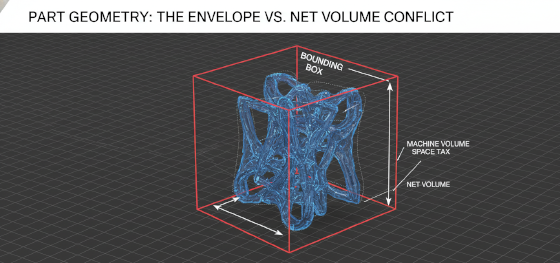
The most powerful number in a 3D printing quote is not the weight of the finished part; it is the "Bounding Box." In additive manufacturing, you are renting space inside a pressurized, temperature-controlled tank. If you design a spindly, spider-like bracket that spans 200mm in every direction, you are effectively occupying a massive volume of the machine’s capacity, even if the actual material used is minimal. This is one of the primary Factors Affecting 3D Printing Cost. A part that blocks other parts from being "nested" beside it carries a premium price because it reduces the machine's throughput.
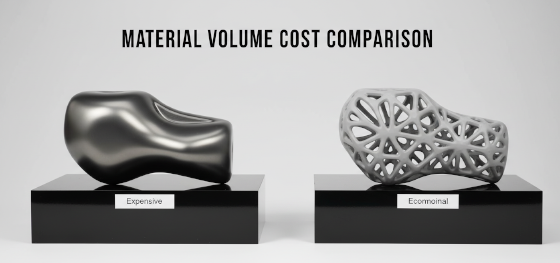
At JUCHENG, we analyze the relationship between "Net Volume" and "Envelope Volume." If a part is bulky and solid, the material cost dominates. If a part is large and airy, the "Space Tax" dominates. This is why hollowing is a mandatory technical skill. By hollowing out thick sections, you reduce material consumption directly. However, for technologies like MJF or SLS, hollowing a part without providing powder escape holes is a failure—the trapped powder will still be charged as used material. We help our clients find the geometric balance, suggesting split-part strategies or internal lattices that provide structural rigidity while shrinking the part's footprint in the build chamber. By managing the displacement of space, you can often cut your production costs by 40% without changing the part’s function.
Material Alchemy: Navigating the Price of Resins and Alloys
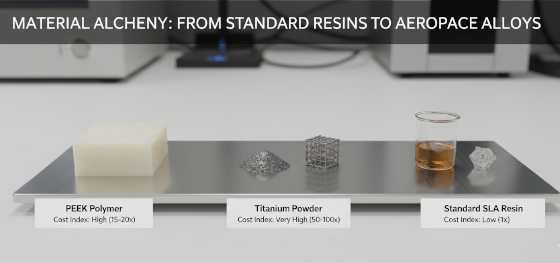
Material choice is the obvious lever in 3D printing cost management, but the price difference between "simulants" and "industrial alloys" is often astronomical. In our facility, we categorize materials into a tiered hierarchy. Standard resins for SLA (Stereolithography) are the most economical, ideal for visual prototypes. Moving into engineering-grade nylons (PA12, PA11) increases the price due to the higher energy required for sintering and the cost of the raw powder. The true leap in budget happens when moving to high-performance polymers like PEEK 3D Printing or Ultem 3D Printing. These resins can cost ten times more than standard ABS because they require high-temperature chambers and specialized extruders.
Metal powders like Titanium and Inconel represent the peak of the cost curve. Beyond the raw powder price, these materials introduce "Process Taxes"—the cost of high-purity Argon gas, the slow laser scan speeds needed for 99.9% density, and the mandatory vacuum stress-relief cycles. Jucheng Precision helps you perform a "Material Fidelity" audit. If you only need a part for a fit-check, we will steer you away from expensive titanium and toward an aluminum simulant or a glass-filled nylon. By matching the molecular cost to the mechanical mission, we ensure your budget is spent on performance, not on over-specified chemical purity that offers no functional ROI.
Technology Selection: Machine-Hour Rates and Cycle Times
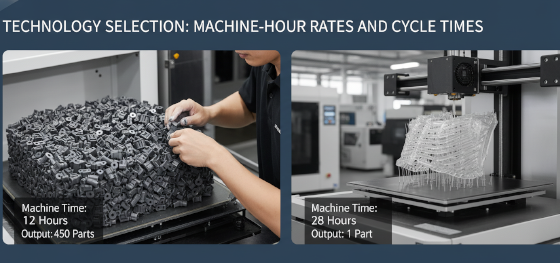
The machine itself is a financial entity with a specific "rental rate." Different technologies have different capital costs and maintenance requirements, which are passed on to the part price. SLA and FDM are generally the most affordable machine-hour options because they are relatively simple systems. Factors Affecting 3D Printing Cost include the amortized cost of the hardware; a high-end metal DMLS machine can cost ten times more than an industrial SLA center. This high "Machine Debt" means that even a small metal part carries a high base price to cover the energy and maintenance of the laser system.
The outlier here is MJF 3D Printing. Because MJF fuses an entire layer in a single pass of an infrared lamp, its throughput is massive. While the machine is expensive, its ability to print 500 parts in the same time an SLA machine prints 50 makes it the winner for low-volume production. JUCHENG manages a diversified fleet precisely to exploit these differences. We don't just "hit go" on the machine you select; we suggest the technology that delivers the fastest cycle time for your specific geometry. We treat the 3D printing process as a throughput equation, using the high speed of MJF to lower your unit price for batches, while reserving the precision of SLA for single, high-fidelity prototypes.
Vertical Tax: The Physics of Orientation and Z-Height
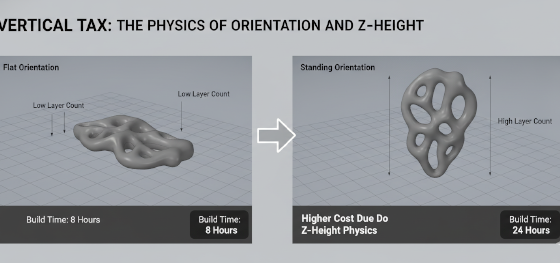
Time in the 3D world is measured in the Z-axis. Every additive technology builds layer-by-layer. Therefore, every extra layer added to a part is a tick of the production clock. This is the "Vertical Tax" of 3D printing. If you orient a part so it stands 200mm tall, it will require 4,000 layers at a 50-micron resolution. If you lay that same part flat so it is only 20mm tall, it requires only 400 layers. The machine time for the tall orientation will be roughly ten times longer, even though the material volume is identical. This is a critical factor in Factors Affecting 3D Printing Cost.
JUCHENG’s technicians are masters of "Orientation Strategy." We rotate parts on the build plate to minimize Z-height while balancing the need for surface quality. Orientation also dictates the "Support Mass." A part tilted at 45 degrees might need thousands of support pins that consume material and labor. Laying it flat might eliminate supports but ruin the surface finish of the bottom face. We navigate this compromise with our clients, helping you decide where to trade time for quality. By understanding that "Up is Expensive" and "Flat is Cheap," you can optimize your designs for the machine's natural pace, ensuring your prototypes reach the assembly line faster and with a lower price-per-unit.
Resolution Trap: Layer Height vs. Surface Fidelity
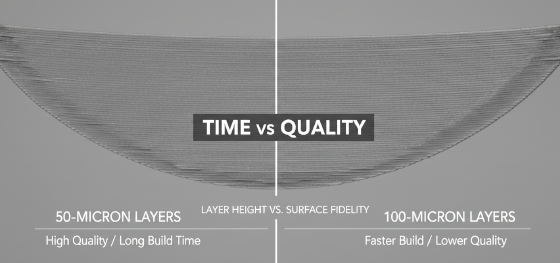
Resolution is an alluring trap for designers. Everyone wants a part with 25-micron layers because it looks like a molded component. However, resolution is a direct multiplier of cost. Cutting the layer height in half doubles the number of layers, which effectively doubles the build time and the machine-hour rate. In many industrial applications, a 100-micron layer height provides the exact same functional integrity as a 50-micron height, but at 50% of the cost. The 3D printing cost of high resolution is a premium that should only be paid when visual perfection is a functional requirement.
At Jucheng Precision, we advocate for "Functional Resolution." For internal structural brackets or assembly jigs, we suggest using coarser layers to maximize build speed and lower the invoice. We reserve our ultra-high-resolution SLA and DLP systems for cosmetic mockups and medical instruments where a smooth skin is mandatory. We also utilize "Variable Layer Heights" in some processes, using thick layers for solid cores and thin layers for complex surface curves. By refusing to over-engineer the resolution of non-critical features, we preserve your budget for the areas that truly impact the user experience. We help you find the "Goldilocks Zone"—not too rough, not unnecessarily smooth, but perfect for the part's mission.
Labor Latency: The Unseen Cost of Post-Processing
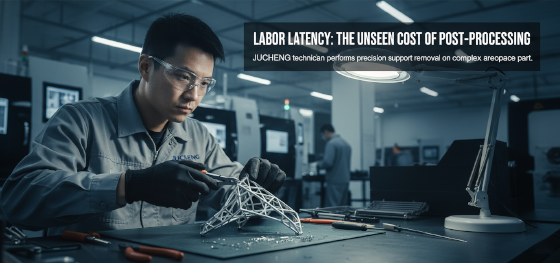
The final hallmark of a professional manufacturing partner is the transparency regarding manual labor. A 3D printer doesn't produce a finished product; it produces a "preform." Every part—especially in metal or resin—requires post-processing. This is the most variable factor among the Factors Affecting 3D Printing Cost. Removing a solid titanium support structure requires a skilled technician and often specialized Wire EDM. Sanding the layer lines off a large automotive interior panel can take four hours of manual labor.
At Jucheng Precision, we quantify this "Labor Latency." We offer tiered finishing options, from "Raw-with-Supports-Removed" to "Showroom-Ready-Paint." We understand that for an aerospace engineer, a raw, bead-blasted metal part is perfect, while a consumer brand requires Vapor Smoothing and custom color matching. By choosing the correct level of finishing during the quote phase, you can prevent the "Labor Tax" from inflating your budget. We provide the technical rigor to ensure that the time spent by our technicians is focused on the surfaces that matter to you. When you receive a component from JUCHENG, you are getting a verified engineered solution that has been audited for cost and survivability. Contact our engineering team today for a comprehensive DFM review and see how our cost-optimization protocols can clarify and armor your next manufacturing breakthrough.
| Cost Factor | Impact Level | JUCHENG’s Optimization Strategy |
|---|---|---|
| Part Volume | Critical ($$$) | Hollowing with escape holes |
| Z-Height | High ($$) | Horizontal orientation / Nesting |
| Supports | Moderate ($) | 45-degree self-supporting angles |
| Resolution | Exponential ($$$) | Adaptive layer height logic |
| Material | Variable ($ to $$$) | Simulation resin audits |

