


An engineer presses a large green button on a massive machine. A complex sequence of movements begins. A few seconds later, a perfectly formed plastic part drops into a bin. This cycle repeats, thousands of times a day.
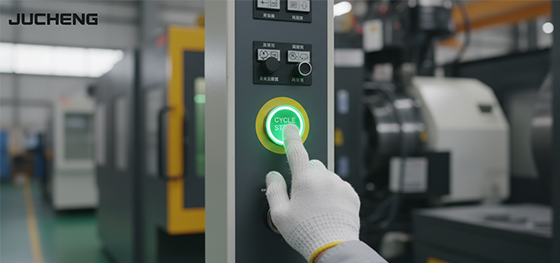
This is the Injection molding process. On the outside, it looks simple. But inside that steel mold, a powerful and precisely controlled dance of time, temperature, and pressure is taking place.
Understanding this dance is the key to understanding how high-quality plastic parts are made. This guide will take you on a journey through that cycle, one stage at a time.
Stage 1: Clamping
Stage 2: Injection
Stage 3: Cooling & Packing
Stage 4: Ejection
The Unseen Director: Scientific Molding
Stage 1: Clamping
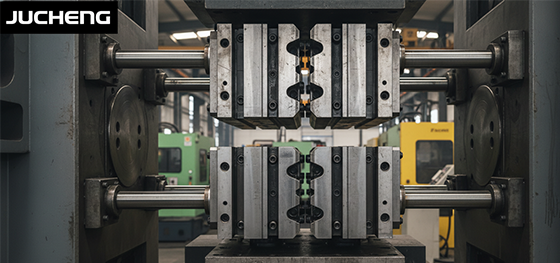
Everything begins with force. Before any plastic is injected, the two halves of the steel mold must be brought together and locked with incredible pressure. This is the clamping stage.
A powerful hydraulic or electric system pushes the mold halves together. It then applies a clamping force that can range from a few tons for a small machine to thousands of tons for a large one.
Why is so much force needed? Because the injection stage will try to force the mold apart. The clamping force must be greater than the injection force. If it is not, a defect called "flash" will occur, where plastic escapes from the parting line. A secure clamp is the foundation of a clean part.
Stage 2: Injection
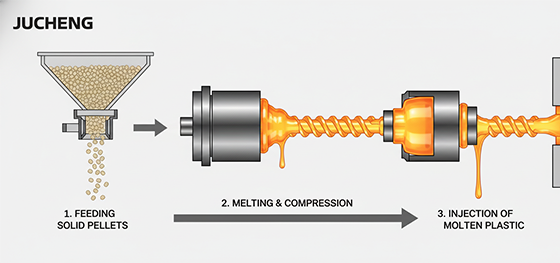
Now, the transformation from solid to liquid happens. Solid plastic pellets are fed from a hopper into the machine's barrel.
Inside the barrel is a large, rotating screw. As the screw turns, it does two things. It pushes the pellets forward. And it heats them up through friction and external heater bands. The solid pellets are melted and compressed into a homogenous molten liquid.
When enough molten plastic is ready, the screw stops rotating and acts like a plunger. It shoots forward at high speed. This injects the molten plastic under immense pressure into the empty cavity of the closed mold. The mold is filled in a matter of seconds or less.
Stage 3: Cooling & Packing
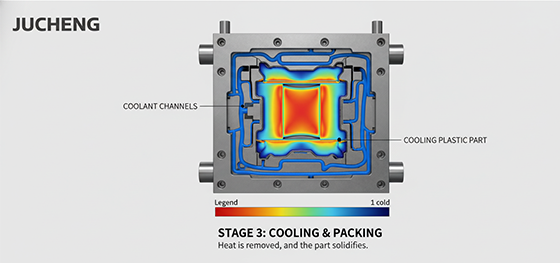
The instant the mold is full, the cooling stage begins. This is often the longest and most critical part of the entire cycle.
As the molten plastic cools, it shrinks. To compensate for this shrinkage and ensure the part is fully "packed out," the machine continues to apply pressure for a short time. This is the "packing" or "holding" phase. It is essential for creating a dimensionally accurate part and avoiding sink marks.
Then, the part is simply left to cool inside the mold. Coolant, usually water, flows through channels inside the steel mold to draw heat away from the plastic. The part must cool down enough to become solid and stable before the mold can open. The cooling time depends on the type of plastic and the thickness of the part.
Stage 4: Ejection
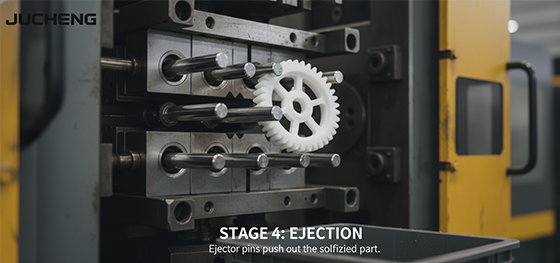
Once the part is solid, the cycle ends with a moment of birth. The clamping unit opens the mold.
A system of ejector pins, which are part of the mold, then pushes forward. These pins push the finished plastic part out of the cavity, causing it to fall into a collection bin below.
The moment the part is clear, the mold closes again, and the entire cycle starts over. This seamless repetition is what makes Injection Molding such an incredibly efficient process for mass production.
The Unseen Director: Scientific Molding
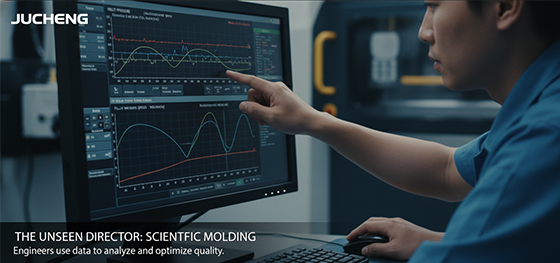
This four-stage cycle seems simple. But making it work perfectly every single time, for millions of cycles, is a science. This science is called "Scientific Molding."
It is a data-driven approach to the injection molding process. Instead of relying on an operator's guesswork, it uses sensors inside the mold to monitor pressure and temperature in real-time.
At JUCHENG, our engineers are experts in this philosophy. We do not just set the machine and hope for the best. We develop a precise and robust process window. We fine-tune the injection speed, the packing pressure, the cooling time, and dozens of other variables.
This ensures that every single part we produce is identical. It is this commitment to process control and data, not just the machines themselves, that is the true secret to high-quality injection molding.

