


Your prototype is approved. It works. It looks great. Now comes the next big question. How do you make a thousand of them? Or ten thousand? Or more?

Creating a single, perfect part is one challenge. Recreating that perfection thousands of times with incredible speed and consistency is another challenge entirely. This is the bridge you must cross from prototyping to production.
For creating high-quality plastic parts at scale, one process stands above all others. It is the gold standard of manufacturing. It is the engine of modern mass production. That process is Injection Molding.
This guide will serve as your complete introduction to this powerful technology. We will explore the process, materials, design rules, and costs. It is your roadmap to successfully navigating the path to scalable production.
Unpacking the Injection Molding Process
A World of Injection Molding Materials
Designing for Success (DFM)
Exploring Advanced Techniques
Decoding the Cost Structure
Perfecting the Final Look: Surface Finishes
Ensuring Quality, Avoiding Defects
Powering the World's Top Industries
Unpacking the Injection Molding Process
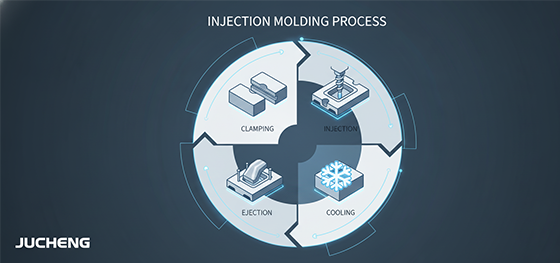
The Injection molding process is a high-speed cycle of creation. It is a highly controlled and repeatable dance of pressure, heat, and motion. Every cycle has four main stages.
It begins with Clamping. A massive press closes the two halves of a steel mold together with hundreds or thousands of tons of force. This ensures the mold stays shut against the intense pressure of the next stage.
Next is Injection. Solid plastic pellets are melted in the machine's barrel into a molten state. A powerful screw then injects this liquid plastic at very high pressure into the empty cavity of the mold. It fills every corner and detail in a fraction of a second.
Then comes Cooling. Coolant circulates through channels inside the mold, rapidly drawing heat away from the plastic. The molten plastic solidifies, taking the exact shape of the mold cavity. This is often the longest part of the cycle.
Finally, Ejection. The mold opens, and a system of ejector pins pushes the now-solid part out of the mold. The part falls into a collection bin, and the cycle immediately begins again.
A World of Injection Molding Materials
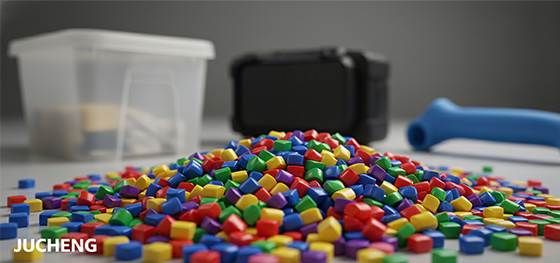
An incredible variety of thermoplastic Injection molding materials can be used. Choosing the right one is a critical design decision.
Commodity plastics are the workhorses. Materials like Polypropylene (PP) and Polyethylene (PE) are very low-cost and are used for everyday consumer goods, packaging, and toys.
Engineering plastics offer a step up in performance. ABS, Polycarbonate (PC), and Nylon (PA) provide a great balance of strength, impact resistance, and cost. They are the backbone of automotive parts, electronic enclosures, and durable goods.
High-performance plastics like PEEK and PEI (Ultem) are for the most demanding jobs. They offer extreme heat and chemical resistance for aerospace and medical applications.
Elastomers like TPE and TPU provide soft, rubber-like flexibility. They are perfect for grips, seals, and overmolded parts. At JUCHENG, we stock over 50 common resins and can help you select the perfect material.
Designing for Success (DFM)
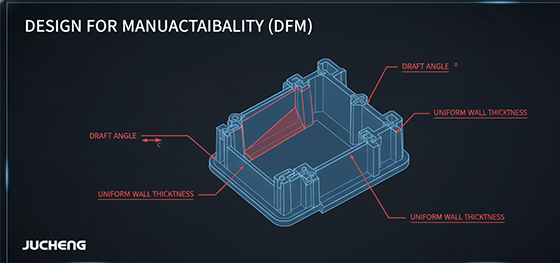
You cannot simply take a design made for 3D printing and inject it. A part must be specifically designed for the molding process. This is called Design for Manufacturability, or DFM.
Proper Injection molding design is a deep topic. But two rules are the most important. First, maintain a uniform wall thickness. Thick sections cool slower than thin sections, which can cause ugly sink marks and warping. Second, add a draft angle, or a slight taper, to all walls that are parallel to the mold opening. This helps the part release cleanly from the mold without being damaged.
Understanding DFM is critical to success. At JUCHENG, our Free DFM Review is a core part of our service. Our engineers analyze your design and provide expert feedback to prevent problems before they happen.
Exploring Advanced Techniques

Modern molding is capable of incredible complexity. The debate of overmolding vs insert molding showcases two powerful techniques.
Insert molding is the process of placing a non-plastic part, usually a metal component, into the mold before injection. The plastic then flows around the insert, permanently encapsulating it. This is the best way to create strong, reliable threads in a plastic part using a metal threaded insert.
Overmolding is a two-step process. A rigid plastic part is molded first. It is then placed into a second, larger mold. A second, softer plastic (like a TPE) is then injected over the top of the first part. This is how soft-touch grips are created on power tools and toothbrushes. Both techniques require a high level of expertise.
Decoding the Cost Structure
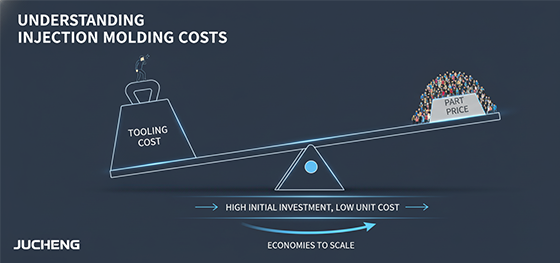
Understanding the Injection molding cost is key to planning your project. It is a story of two numbers: the mold cost and the part price.
The mold cost is a one-time, upfront investment. It is the cost to create the high-precision steel tool. This can be thousands of dollars. The price depends on the complexity of your part and the number of "cavities" (how many parts are made in one cycle).
The part price, however, is extremely low. Because the process is so fast and automated, the cost per part can be just pennies. This is a classic economy of scale. The high initial investment is spread out over thousands of parts. This is why injection molding is unbeatable for mass production. For smaller volumes, JUCHENG offers low-volume tooling options that lower your upfront investment.
Perfecting the Final Look: Surface Finishes
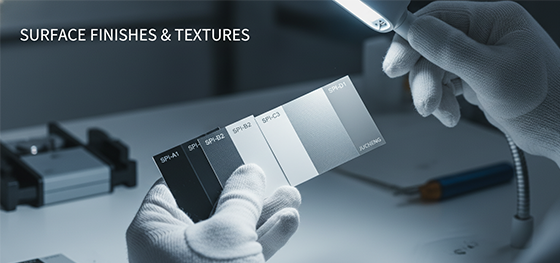
The surface of your molded part is a perfect replica of the surface inside the mold. This means we can achieve a huge variety of Injection molding surface finishes by treating the steel mold itself.
The industry uses SPI (Society of the Plastics Industry) standards to define these finishes. An SPI-A1 finish is a mirror-like, flawless polish on the mold, which creates a high-gloss part. A B-grade finish is semi-gloss. C and D grades are created by sandblasting the mold, which results in matte or textured parts.
We can also create complex patterns. VDI, or spark erosion, creates a precise, technical texture. Other custom textures, like a leather grain, can also be chemically etched into the mold. This allows you to create beautiful, finished parts directly from the machine.
Ensuring Quality, Avoiding Defects

A fast process is useless without quality. A professional manufacturer has a robust system to prevent Injection molding defects.
Many common defects, like sink marks and warping, are caused by poor part design. This is why our DFM review is so critical. We help you fix these problems on the screen, not in the steel.
Other defects, like flash or short shots, are related to the process itself. Our experienced engineers use advanced tools like Moldflow simulation to predict how the plastic will flow. This allows them to design the mold perfectly. During production, we use a data-driven "scientific molding" approach. We monitor pressure, temperature, and time to ensure every single part is identical. Finally, our QA department uses CMMs and other tools to verify that the final parts meet every one of your specifications.
Powering the World's Top Industries

The Injection molding application industries are virtually endless. If a product is made of plastic and produced in high volume, it was likely injection molded.
In the Automotive industry, we produce parts that must meet the strict IATF 16949 quality standard. In the Medical field, we operate under ISO 13485 to create device components from biocompatible materials. For Consumer Electronics, we excel at producing the thin-walled, beautiful enclosures that define modern products.
Holding these key certifications is not just a formality. It is proof that we have the processes, traceability, and quality mindset to serve the world's most demanding industries. It is your assurance that we are a partner you can trust.
Choosing to invest in injection molding is a major step. It is the step that takes your product from a prototype to a real, scalable product. At JUCHENG, we specialize in helping companies make this transition, especially for low-volume production. We are your expert partner on the journey to market success.

