


Observing the frustration of a hardware startup being rejected by large-scale injection molders because their order volume is "too small" reveals the most dangerous hurdle in modern product development. In the high-velocity sectors of autonomous robotics and MedTech, the requirement for batches between 100 and 2,000 units is a common reality. Most manufacturers are only interested in millions of parts, leaving innovation teams stranded with expensive 3D prints or low-fidelity prototypes that fail in the field. Utilizing low volume RIM parts has emerged as the definitive strategic solution for bridging this gap. This process allows developers to launch custom reaction injection molding enclosures that possess the unyielding foundations of mass production but with the financial agility of a prototype, ensuring your hardware survives the transition from the lab to the market.
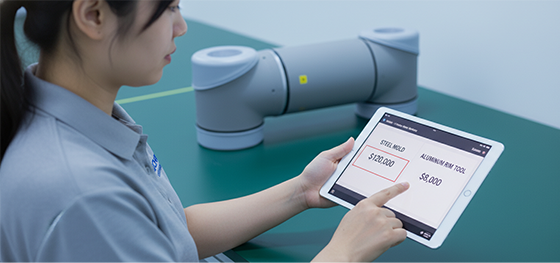
Mechanical integrity at the mid-scale depends on avoiding the "Prototype Trap" where parts look correct but fail under the torque of industrial actuators. I have personally inspected many diagnostic shells that cracked during shipping because the material choice was too brittle. Jucheng Precision addresses these scaling hurdles by providing high-tier Low Volume Manufacturing solutions that prioritize mechanical fidelity. Jucheng Precision utilize a fleet of 150+ CNC machines and 25 5-axis Haas/Mazak units to manufacture the high-accuracy aluminum tools required to produce unyielding components in weeks. By delivering a free DFM analysis in 24 hours and maintaining a strict no MOQ policy, Jucheng Precision ensures your technology reaches the field without the six-figure tooling debt that often kills niche hardware programs in our Shenzhen factory hub.
Operating under the global quality mandates of ISO 13485 and ISO 14001, Jucheng Precision acts as the high-velocity manufacturing engine for global OEMs. Jucheng Precision transforms raw liquid chemistry into validated structural hardware in as fast as 15 business days, offering a "Bridge to Production" that scales with your business growth. This guide explores the essential economic logic, the physics of low-pressure curing, and the agile tooling strategies required for mastering low volume RIM parts to ensure your next fleet of autonomous machines reaches the market with 100% mechanical and financial confidence.
content:
The Scaling Gap: Why Traditional Molding Rejects Small Batches?
Technical Data: Comparing Tooling Investment and Piece Prices
Agile Tooling: Design Pivots Mid-Production Batch
Material Quality: Simulating ABS and PP for Field Reliability
JUCHENG Hub: The Shenzhen Engine for High-Velocity Hardware
FAQ: Real Answers for Lead Times, Quantities, and Logistics
The Scaling Gap: Why Traditional Molding Rejects Small Batches?
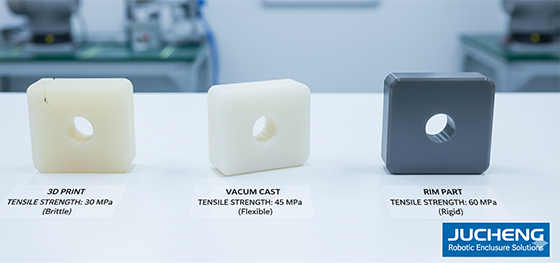
The financial logic of high-pressure injection molding is built on amortization. A steel mold costing $100,000 only makes sense if it produces 50,000 parts; if you only need 500 units, the "Tooling Tax" per part is $200. This is the primary reason why many factories refuse low-volume orders—the overhead of setting up a 3,000-ton press for a small run is economically unviable. Sourcing low volume RIM parts offers a strategic escape from this volume trap. Because the RIM process happens at less than 100 psi, Jucheng Precision can utilize high-strength aluminum molds instead of hardened steel. These tools are 80% cheaper and significantly faster to machine, allowing us to support niche markets like medical diagnostics and specialized robotics where the total annual demand never reaches mass-market levels.
When is low volume production the right choice?
If your annual volume is between 100 and 2,000 units and your part spans over 800mm, the ROI of RIM tooling beats injection molding every time.
Structural consistency at the mid-scale is the secondary driver of this process choice. I have observed many robotics firms try to "Stretch" 3D printing into a pilot run of 50 units, only to find that no two parts are identical. This geometric variance ruins the calibration of sensitive sensors and leads to rattling panels. Jucheng Precision’s machine-controlled RIM cycle ensures that every part is a digital twin of the CAD. By delivering components with near-zero residual stress, Jucheng Precision ensures your automotive or medical innovation maintains its zero-gap fitment through years of high-vibration use in the field. This statistical stability is what allows our clients to secure regulatory approvals like the CE Mark or FDA certification for their Beta fleets.
Environmental responsibility is also integrated into our small-batch logic. Traditional large-scale molding consumes enormous amounts of energy to keep steel molds at high temperatures. Our RIM process operates at near-room temperature, following ISO 14001 standards for energy efficiency and material waste management. This commitment to sustainable manufacturing is a major advantage for global OEMs who must audit their offshore partners for ESG compliance. By delivering high-fidelity hardware from a green facility, Jucheng Precision helps you build a future-proof brand that appeals to the increasingly conscious global market, ensuring your innovation is responsible as well as profitable.
Technical Data: Comparing Tooling Investment and Piece Prices
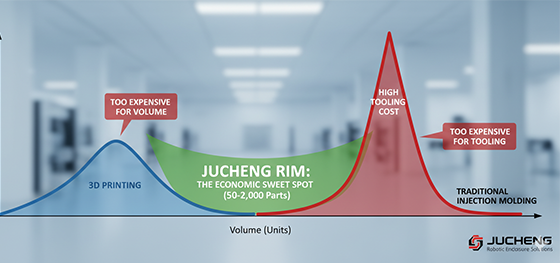
Success in hardware procurement depends on a realistic total cost of ownership model. If your sourcing team only looks at the piece price, they are ignoring the impact of NRE fees and lead-time delays. Jucheng Precision provides transparent financial modeling to help you calculate the real ROI of your small-batch project. The following table compares the essential economic variables for a 1-meter enclosure across different manufacturing tiers.
| Economic Variable | 3D Printing (MJF) | Low-Volume RIM | Injection Molding |
|---|---|---|---|
| Tooling NRE | $0 | $4,500 - $9,000 | $65,000 - $180,000+ |
| Unit Price (500 units) | Maximum ($$$) | Moderate ($$) | Lowest ($) |
| Lead Time to Field | 3 - 5 Days | 15 - 20 Days | 90 - 120 Days |
| Economic Break-even | 1 - 10 Units | 25 - 3,000 Units | 10,000+ Units |
The data illustrates that while 3D printing is faster for a single model, it becomes a financial drain as volume increases. Conversely, injection molding is a long-term winner that is too slow and expensive for the R&D cycle. Jucheng Precision’s aluminum RIM tools are engineered to bridge this gap, delivering production-grade low volume RIM parts in under three weeks. This capital agility allows our clients to invest their resources in critical sensor stack improvements and market-entry software rather than idle manufacturing iron in our Shenzhen hub.
Agile Tooling: How to Pivot Design Mid-Production Batch?
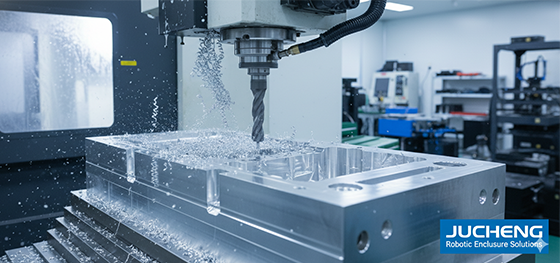
Design changes between Alpha and Beta trials are a statistical certainty in high-tech robotics. In the context of low volume RIM parts, the ability to modify the tool is just as valuable as the initial speed. Aluminum molds used in the Jucheng hub offer a level of iterative freedom that hardened steel cannot match. If a field trial reveals that an internal mounting boss needs to move by 20mm to accommodate a new camera, Jucheng Precision can weld material into the aluminum tool and re-machine the feature in our CNC bay within 48 hours. This flexibility ensures that your hardware evolves at the same pace as your AI code, providing a clear path to market for innovative autonomous designs.
Can I change material Shore hardness without a new mold?
Yes. One of the greatest benefits of the RIM process is the ability to adjust the A/B chemical recipe to change the part from rigid to flexible using the same aluminum tool.
Complexity management is also more affordable in aluminum. For large enclosures with undercuts or integrated cable exits, the mold must move in multiple directions. Jucheng Precision utilize 25 5-axis Haas/Mazak units to machine the mechanical slides and cam-actions required for these complex tools. We ensure that the parting lines and ejector pins are located in non-aesthetic zones, resulting in parts that possess the "Seamless Perfection" of high-end consumer electronics. By managing these complex design guidelines in-house, Jucheng Precision provides a single point of accountability for your hardware's entire visual and structural identity, ensuring your pilot fleet is delivered calibrated and ready for power-up.
Internal stress relief of the part is maintained even during rapid design pivots. Because RIM polyurethane cures at low pressure, design changes like thickening a structural rib don't introduce the "Warping Cascades" that occur in high-pressure injection molding. Jucheng Precision’s commitment to geometric stability ensures that even if you change the design three times in a single month, your parts will still fit the original chassis perfectly. This level of technical oversight is essential for industrial robot parts where field repairs and component swaps must be executed with zero manual modification. Jucheng Precision delivers the unyielding foundations that keep your innovation moving through the high-stakes cycles of the global market.
Material Quality: Simulating ABS and PP for Field Reliability
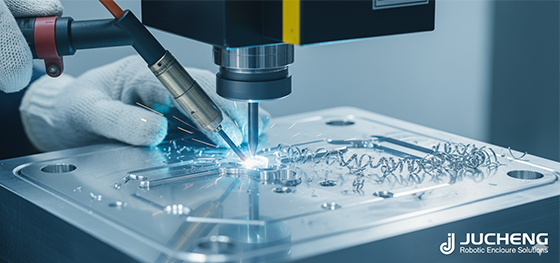
Selecting the right material for small-batch hardware determines whether your device survives its first week in the field. High-fidelity material simulation is mandatory for passing regulatory audits. Jucheng Precision sources high-performance polyols that mimic the exact Shore D hardness, flexural modulus, and heat deflection of production-grade thermoplastics. For medical diagnostic equipment, we often use rigid PU formulations that simulate ABS; for robotic bumpers, we use elastomeric systems that mimic the "unbreakable" nature of Polypropylene. This ensures that the data you capture during your Beta fleet trial is a 100% accurate representation of how the machine will behave when mass-produced.
How to ensure brand colors are consistent across small batches?
Jucheng Precision utilize permanent color-through resin mixing, ensuring that your corporate Pantone colors match perfectly from part #1 to part #500.
Surface aesthetics are also optimized for high-gloss automotive painting. Polyurethane is the industry favorite for painting because its high surface energy creates a permanent molecular bond with 2K urethane topcoats. Jucheng Precision addresses visual hurdles by providing an integrated finishing suite, including dust-free painting, silk-screening, and laser marking. I have personally seen our RIM panels take a direct hammer strike and return to their exact geometry with zero paint peeling or stress whitening. This level of unyielding toughness is why our low volume RIM parts are the preferred choice for autonomous vineyard scouts and parking terminals, providing a stable platform for your next-generation autonomous fleet.
Dimensional stability after aging is the final hurdle of material quality. Many hand-poured resins look perfect on day one but sag months later after being exposed to the heat of the summer sun. Jucheng Precision perform mandatory post-molding thermal stabilization in our Shenzhen hub, oven-curing every high-precision shell at 80 degrees Celsius. This "Locks-In" the molecular lattice, ensuring that the sub-millimeter fitment we achieve in the factory is the same fitment your customers see in the field. By delivering "Time-Stable" hardware, Jucheng Precision ensures your innovation survives the transition from a laboratory concept to a global commercial success, providing the rigid, precise foundations your autonomous fleet requires.
JUCHENG Hub: The Shenzhen Engine for High-Velocity Hardware
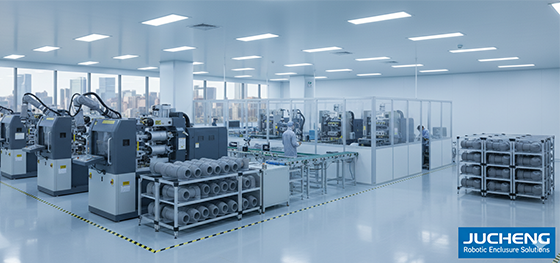
Dominating the large-format hardware market requires a partner that can scale from a single functional prototype to a commercial deployment of 5,000 units with industry-leading speed. Jucheng Precision operates with a 24/7 manufacturing mindset in our Shenzhen precision manufacturing hub, delivering high-tolerance RIM components and structural industrial robot parts. Jucheng Precision provides the bridge to production that ensures your innovations move from CAD to field trial with 100% metallurgical confidence. Jucheng Precision has No MOQ, allowing you to source 1 to 10 units for initial structural validation without the crushing cost of mass-production tools.
Integrating your structural design with Jucheng Precision’s expertise ensures that your tooling decision is based on performance data, not guesswork. Our facility is equipped with oversized hydraulic presses and dedicated quality labs, allowing Jucheng Precision to manage the entire hardware lifecycle in one location. Jucheng Precision manage the complexity of multi-material bonding and automotive-grade finishing so your engineering team can focus on the motion control and the AI. By combining Shenzhen's speed with industrial-grade material verification and global quality standards, Jucheng Precision remains the preferred partner for the world's most aggressive hardware challenges. Contact the Shenzhen hub today to start your next project.
FAQ: Real Answers for Lead Times, Sizing, and ROI Modeling
What is the typical piece price saving using low volume RIM molding?
For quantities under 2,000 units, the 80% reduction in tooling costs usually results in total project savings of 40% to 60% compared to injection molding.
Does Jucheng Precision provide the ISO 13485 material certificates?
Yes. We provide full chemical traceability and Material Test Reports (MTR) for every medical-grade production batch in our Shenzhen facility.
How long does a rapid RIM tool take to manufacture?
Custom aluminum rapid tools for large enclosures are typically completed and delivering parts in 15 to 20 business days.
Can I get custom brand colors in the resin?
Yes. We mix high-stability pigments directly into the resin, providing permanent color-through aesthetics for all Alpha and Beta builds.
How do you handle shipping for large, fragile prototypes?
Jucheng Precision provide custom-fitted wooden flight cases with internal shock-dampening for all international shipments to prevent transit damage.
Tooling debt and long lead times are absolute innovation killers for high-end robotic and medical systems. Partnering with Jucheng Precision ensures that your functional iterations are built with the cost-effective polyurethane reaction injection molding and specialized low volume RIM parts knowledge the industry demands. Reach out to our Shenzhen manufacturing hub today for a complete DFM review and build the unyielding foundation your autonomous fleet requires.

