


Designing a beautiful, million-dollar medical scanner means absolutely nothing if the control panel labels wear off after three months in the field. Hospital workers and factory operators scrub equipment with aggressive bleach and alcohol wipes every single day. If your operating instructions or brand logos smear and fade, your product instantly looks cheap and becomes dangerously difficult to use. Hardware startups frequently ignore this final visual step, treating graphics as a last-minute afterthought. Upgrading to high-fidelity silk screened RIM parts ensures your user interface stays razor-sharp and chemically immune for the entire lifespan of the machine.
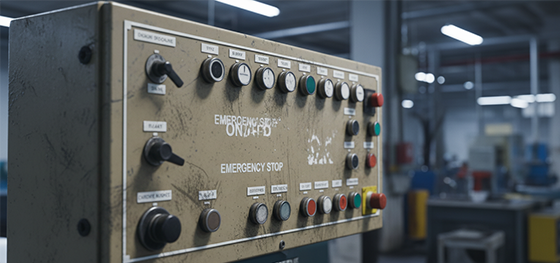
Getting ink to actually stick to raw plastic is notoriously difficult. Many procurement teams have lived through the nightmare of receiving a massive batch of custom enclosures, only to find they can easily scratch the company logo off with a fingernail. This happens when your molder and your paint shop are totally disconnected. Operating within our Shenzhen precision manufacturing hub, Jucheng Precision completely eliminates this risk by managing the base paint chemistry and the final ink application under one single roof.
Printing a single black logo on a tiny flat box is easy. Printing a four-color safety warning across a sweeping, two-meter curved tractor hood requires serious engineering discipline. Let's dig into why [2026] hardware buyers demand permanent graphics, and how our specialized reaction injection molding parts provide the perfect foundation for indestructible multi-color branding.
content:
The Adhesion Problem: Why Do Logos Rub Off?
Curved Surfaces: The Nightmare of Multi-Color Alignment
Technical Data: Comparing UI Printing Methods
JUCHENG Hub: Shenzhen's Turnkey Branding Solution
FAQ: Honest Answers About Inks, Colors, and Curing
The Adhesion Problem: Why Do Logos Rub Off?
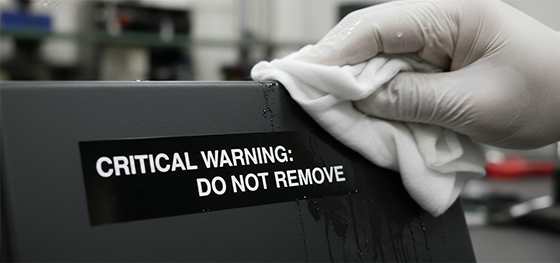
What causes expensive printed graphics to flake off a plastic shell?
Chemical incompatibility between the enclosure's base clear-coat and the printing ink prevents molecular cross-linking, meaning the logo is just sitting loosely on top of the surface rather than biting into it.
Buying raw plastic covers from one factory and shipping them to a local screen printer usually ends in disaster. The printer has no idea what chemical mold-release agents or primers were used during the casting phase. They apply standard ink, bake it, and it looks fine until a nurse wipes it down with Cavicide, instantly smearing the text.
We formulate our urethane base paints and our heavy-duty epoxy inks to chemically react with each other. When we bake your panels in our thermal ovens, the graphic literally fuses into the topcoat of the polyurethane. You get a vibrant, raised texture that acts like heavy-duty armor against harsh industrial cleaning solvents.
Curved Surfaces: The Nightmare of Multi-Color Alignment
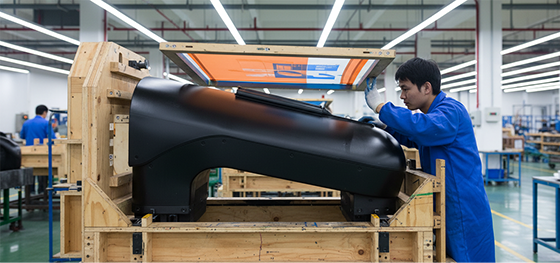
How do you print a perfect three-color logo on a heavily curved surface?
By machining custom-fit nesting jigs using our 5-axis CNC units to hold the massive curved panel perfectly still, allowing the squeegee to maintain exact tension across the uneven geometry.
Flat panels are incredibly easy to print. But modern industrial design is full of sleek, aerodynamic curves. If your screen printing mesh doesn't perfectly conform to the arc of your 1.5-meter medical housing, the ink will bleed, and the letters will look fuzzy and distorted.
Adding multiple colors makes this ten times harder. If the red warning triangle doesn't perfectly align with the black text underneath, the UI looks like a cheap knockoff. Because we handle both the molding and the printing, we build dedicated rigid fixtures that lock your specific panel in place. This guarantees flawless color registration, even on the weirdest organic shapes.
Technical Data: Comparing UI Printing Methods

Deciding how to brand your hardware heavily impacts both your unit cost and your field reliability. Hardware engineers should review the data below to understand why heavy ink deposits simply outlast cheaper alternatives on the factory floor.
| Printing Method | JUCHENG Silk Screen (Epoxy Ink) | Pad Printing | Adhesive Decals |
|---|---|---|---|
| Ink Thickness / Opacity | Very High (Bold, raised feel) | Low (Can look washed out) | N/A |
| Chemical Immunity | Excellent (Baked-in cure) | Moderate | Poor (Edges dissolve) |
| Large Format Capability | Yes (Up to 2 meters) | No (Limited to small icons) | Yes |
| Pantone Accuracy | Exact Match | Good | Varies by printer |
Pad printing is great for putting a tiny logo on a golf ball, but it lays down far too little ink for a massive industrial cover. When you need bold, high-contrast user interface buttons that operators can read clearly in a dimly lit warehouse, heavy-mesh silk screening is the only professional choice.
JUCHENG Hub: Shenzhen's Turnkey Branding Solution

Why should you stop outsourcing your hardware graphics to third-party shops?
Splitting your manufacturing across multiple vendors guarantees shipping damage, finger-pointing when adhesion fails, and massive delays in your product launch.
Sending fragile, newly painted chassis parts across town in a truck just to get a graphic printed on them is a terrible logistical strategy. Every time you move the part, you risk scratching the pristine finish. We keep your high-value components locked safely inside our Shenzhen precision manufacturing hub from start to finish.
Stop settling for blurry graphics that make your expensive technology look like a cheap toy. Send your UI artwork and CAD models to our engineering team today. We will formulate the exact chemical ink profiles needed to ensure your branding survives the absolute worst conditions your customers can throw at it.
FAQ: Honest Answers About Inks, Colors, and Curing

Can you perfectly match my company's specific Pantone brand color?
Yes. We mix our epoxy and urethane inks in-house using advanced spectrophotometers to guarantee an exact, repeatable Pantone match across all production batches.
Will the printed graphics scratch off if hit with a metal tool?
Standard wear and tear will not remove the logo. Because we thermally bake the ink into the basecoat, it possesses extreme abrasion resistance, far exceeding standard consumer paints.
What is the maximum amount of colors you can print on one panel?
We routinely execute highly complex four-color and five-color registrations on large panels, using precise CNC-milled jigs to keep every layer perfectly aligned.
Does the panel surface need to be perfectly flat for silk screening?
No. While extreme 90-degree corners are impossible, our flexible mesh screens can easily conform to large, sweeping curves and aerodynamic hardware designs.

