


Kinetic reliability dictates the survival of autonomous hardware in human-centric environments. When a design team transitions a hotel concierge bot or a last-mile delivery rover from a digital twin to the physical world, the "Collision Zone" is the most scrutinized mechanical interface. In the high-velocity environment of 2026, robots no longer operate in isolated cages; they navigate crowded airports, hospital hallways, and retail aisles. If the contact point is a rigid, unforgiving piece of sheet metal or hard plastic, the resulting impact force is transferred directly into the robot’s internal LiDAR sensors and AI logic boards, leading to catastrophic system drift. Navigating this requirement for active kinetic defense requires the strategic deployment of Overmolded robot bumpers. Jucheng Precision operates as a high-fidelity multi-material sanctuary in the Shenzhen precision manufacturing hub, providing the thermodynamic control needed to fuse disparate material durometers into a single, monolithic safety asset. Within the broader framework of service robots, we bridge the gap between "brittle enclosures" and "impact-ready sovereignty," ensuring your mobile fleet maintains its mechanical and aesthetic certainty through thousands of public interactions.
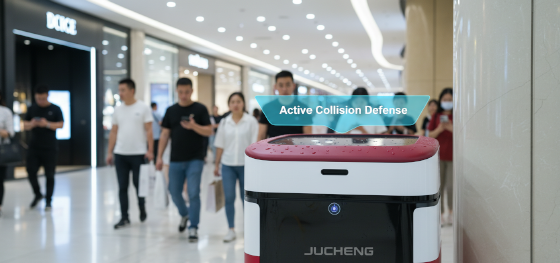
Establishing a failure-proof interaction roadmap demands the absolute rejection of "post-process" gluing. Amateurs often attempt to stick foam strips or rubber pads onto their robot's chassis using industrial adhesives, unaware that the volatile environment of high-traffic zones—including UV exposure and chemical cleaners—will cause these bonds to peel and roll within weeks. Jucheng Precision eliminates these "Maintenance Nightmares" by utilizing advanced molecular bonding protocols. We don't just "cover" your robot; we engineer a permanent tactile interface that possesses the mechanical soul of an integrated factory-line product. Whether you are developing a 200-unit pilot run for a restaurant sorter or a high-capacity autonomous forklift, our facility provides the material science and finishing rigor required for 2026 market entry. This guide deconstructs the necessity of soft-touch compliance, the physics of TPE-to-PC/ABS bonding, and why JUCHENG’s "Interlock Protocol" is the mandatory foundation for anyone developing Overmolded robot bumpers for global deployment.
Why is public safety compliance mandatory for mobile robots?
How does overmolding achieve molecular fusion between materials?
Why do glued foam strips fail compared to overmolded seals?
How to design mechanical interlocks for 100,000-impact durability?
How does JUCHENG integrate safety directly into the chassis?
FAQ
Why is public safety compliance mandatory for mobile robots?
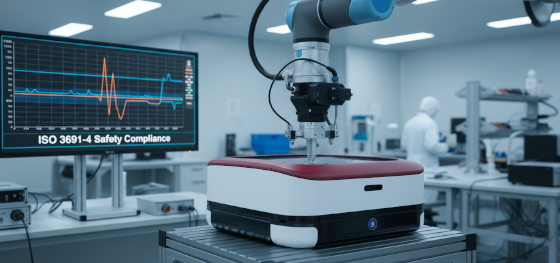
Human interaction dictates the legal barrier to autonomous market entry. In 2026, regulatory standards like ISO 3691-4 and OSHA mandates require mobile robots to minimize the force of any potential contact with bystanders. A rigid metal chassis acts as a kinetic hammer; a soft, compliant bumper acts as a mechanical shock absorber. Overmolded robot bumpers increase the "Impact Duration" during a collision, effectively lowering the peak force exerted on the user or the surrounding infrastructure. Jucheng Precision engineers utilize specialized energy-absorbing polyurethanes and elastomers to create "Damped Interfaces." This capability is vital for Large AMR enclosure manufacturing, where the momentum of a 500kg payload must be safely managed. We turn "accidental strikes" into "non-events," ensuring your fleet remains compliant with safety codes while protecting the expensive internal electronics from harmonic shockwaves.
How does overmolding achieve molecular fusion between materials?
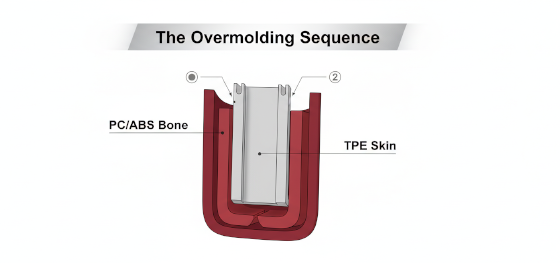
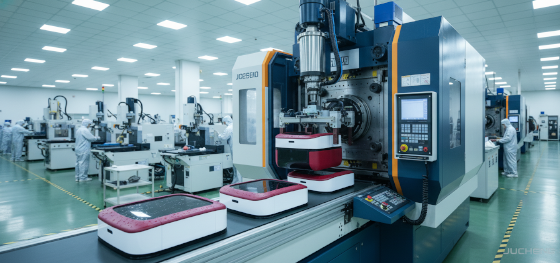
Interfacial sovereignty is a byproduct of thermodynamic synchronization. Overmolding is an advanced injection molding process where a soft elastomer is injected directly over a pre-molded rigid core. For Overmolded robot bumpers, Jucheng Precision utilizes two primary pathways: Two-Shot (2K) molding for high-volume fleets and "Pick-and-Place" overmolding for agile pilot runs. By carefully managing the melt temperature of the second resin (often TPU or TPE), we induce a covalent bond at the interface. The molten elastomer microscopically "welds" to the rigid PC/ABS or Nylon skeleton, creating a monolithic part that refuses to delaminate. This process ensures the bumper is not just a "cover" but a structural participant in the robot's frame, maintaining its position through millions of vibration cycles and hundreds of low-velocity impacts.
Why do glued foam strips fail compared to overmolded seals?
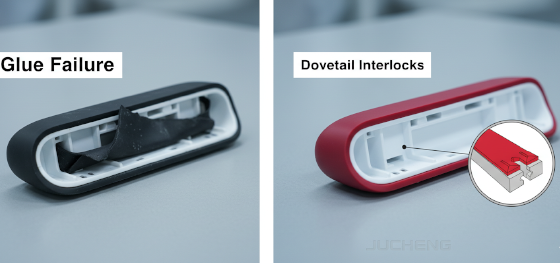
Adhesive logic is the primary architect of field service failure. Traditional "stick-on" bumpers rely on pressure-sensitive adhesives (PSAs) that are chemically vulnerable to the very environments robots inhabit. Exposure to industrial oils, floor-cleaning chemicals, and temperature fluctuations in non-climate-controlled warehouses causes glues to crystallize and lose their grip. Overmolded robot bumpers eliminate this risk by replacing the "glue" with "chemistry." At Jucheng Precision, we perform cross-hatch adhesion tests in our QC lab to ensure the polymer fusion meets ASTM standards. We turn "maintenance-heavy" foam strips into "maintenance-free" industrial armor. By integrating the bumper into the molding cycle, you also eliminate the secondary assembly labor of peeling and sticking hundreds of pads, directly improving your manufacturing ROI and ensuring a professional, retail-ready appearance that doesn't look like a homemade prototype.
How to design mechanical interlocks for 100,000-impact durability?
Geometric insurance provides the final defense against extreme shear stress. While chemical bonding is the goal of Overmolded robot bumpers, Jucheng Precision advocates for the "Belt and Suspenders" approach. During our mandatory DFM review, we instruct designers to integrate "Through-Holes," "Dovetail Grooves," and "Undercut Channels" into the rigid robot skeleton. During the secondary injection phase, the liquid elastomer flows *through* these holes and locks into the grooves, creating a physical "Polymer Rivet." This ensures that even if the robot is subjected to extreme abrasive lateral forces (like scraping against a metal rack), the bumper skin remains physically shackled to the chassis. We turn "aesthetic skins" into "certified safety armor," documented for survival in the most abusive industrial environments where standard 3D prints or glued assemblies would catastrophically fail.
How does JUCHENG integrate safety directly into the chassis?
Manufacturing excellence at Jucheng Precision is built on the foundation of single-source accountability. We don't just "mold parts"; we curate the haptic interface of your brand. Our facility houses over 150 CNC machines, elite 2K injection bays, and specialized RIM cleanrooms under one roof. This allows us to manage the entire lifecycle of your Overmolded robot bumpers—from the precision CNC machining of the mold tool to the final automotive-grade Painting and finishing robot covers. We provide the material lot traceability and metrological reports required for Tier-1 robotics supply chains, ensuring your hardware is as lean as it is durable. Stop gambling your robot's safety on uncertified shops. Leverage our decade of high-performance replication mastery to validate rapidly and scale profitably. Contact our technical team today for a free DFM review and see how we can turn your digital safety intent into a structurally sovereign physical reality.
FAQ
Q: Which material is best for high-impact robot bumpers?
A: For maximum energy absorption and tear resistance, we recommend TPU (Thermoplastic Polyurethane) with a Shore A hardness of 50A to 70A, which offers the best balance of compliance and industrial durability.
Q: Can JUCHENG overmold bumpers directly onto a metal (Aluminum) frame?
A: Yes. We utilize specialized heat-activated chemical primers and aggressive mechanical interlock designs to permanently anchor soft elastomers directly onto CNC-machined aluminum or steel linkages.
Q: How do you prevent "Bleed" where the soft and hard materials meet?
A: We design a "Step-Joint" shut-off in the mold steel, which pinches the rigid part with extreme precision, creating a hermetic seal that prevents the liquid overmold resin from leaking.
Q: What is the lead time for a prototype set of overmolded bumpers?
A: Utilizing our rapid aluminum tooling strategy, Jucheng Precision can deliver your first set of 20 high-fidelity overmolded bumpers in as fast as 12 to 15 business days.

